Can We Move THE SUN?
TL;DR
Exploring the possibility of moving our solar system through space.
Transcript
Interstellar travel is horrible-what with the cramped quarters of your spaceship and only the thin hull separating you from deathly cold and deadly cosmic rays. Much safer to stay on here Earth with our gloriously habitable biosphere, protective magnetic field, and endless energy from the Sun. But what if we could have the best of all worlds? N... Read More
Key Insights
- The concept of a stellar engine involves using the Sun's energy to propel the entire solar system through space, a feat that requires advanced technology.
- Fritz Zwicky first proposed the idea of moving the Sun using a particle accelerator in 1961, laying the groundwork for future concepts.
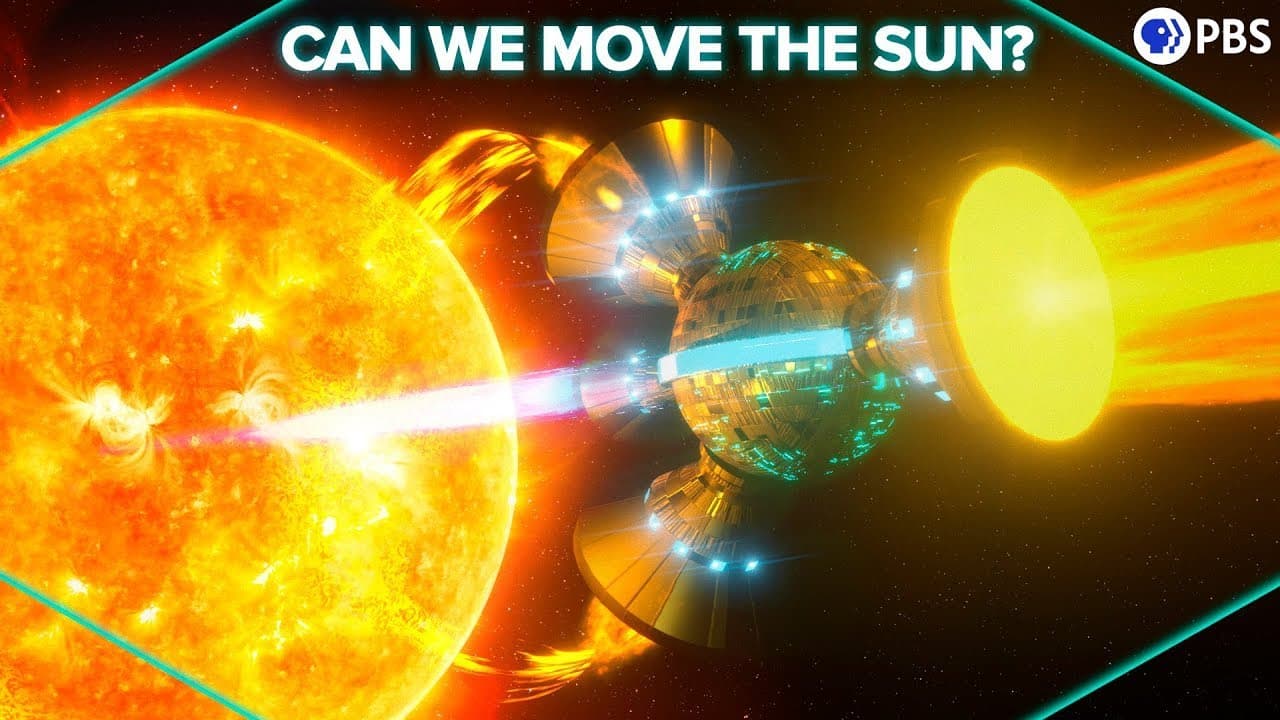
- Leonid Shkadov's thruster design uses a giant parabolic mirror to reflect photons and create momentum, allowing the Sun to move slowly through space.
- The Caplan thruster design, inspired by the Kurzgesagt channel, offers a thousand times more acceleration than the Shkadov thruster by using solar wind and fusion reactions.
- Stellar engines could potentially allow civilizations to avoid cosmic threats or facilitate interstellar migration by altering the Sun's orbit.
- Building a stellar engine requires mastering massive-scale astro-engineering, including constructing self-replicating robots to mine planetary bodies.
- Despite the challenges, studying stellar engines could help detect advanced civilizations and inspire future technological advances.
- The idea of moving the Sun remains speculative, with current focus on planetary preservation, but it opens possibilities for future exploration.
Install to Summarize YouTube Videos and Get Transcripts
Explore YouTube Video Summarizer or Get YouTube Transcript Extractor
Questions & Answers
Q: What is a stellar engine and how does it work?
A stellar engine is a hypothetical megastructure that uses the energy of a star, like the Sun, to propel the entire solar system through space. It works by creating momentum through various methods, such as reflecting photons with a giant mirror or using solar wind and fusion reactions. These engines leverage Newton's laws of motion, particularly the conservation of momentum, to gradually alter the Sun's orbit.
Q: Who first proposed the idea of moving the Sun and what was their design?
The idea of moving the Sun was first proposed by Fritz Zwicky in 1961. His design involved using a giant particle accelerator to shoot pellets at the Sun at high speeds, igniting fusion on impact. This would create jets of matter that push the Sun, using its own material as both propellant and energy source. While Zwicky didn't perform detailed calculations, his proposal inspired further exploration of stellar engines.
Q: How does the Shkadov thruster design move the Sun?
The Shkadov thruster design moves the Sun by using a giant parabolic mirror to reflect photons. This mirror, placed at a specific position, reflects sunlight back towards the Sun, creating an outward radiation pressure that is countered by the Sun's gravitational pull. This setup results in a tiny push in the opposite direction, gradually altering the Sun's position over time. The concept relies on the momentum carried by light to achieve movement.
Q: What advancements does the Caplan thruster offer over the Shkadov thruster?
The Caplan thruster offers significant advancements over the Shkadov thruster by providing a thousand times more acceleration. It achieves this by using a Dyson sphere or swarm to focus sunlight on the Sun's surface, increasing solar wind flow. This solar material is collected and channeled into a fusion reactor, where it is fused and ejected as propellant. This design not only moves the Sun but also extends its lifespan by reducing its mass through star-lifting.
Q: What are the potential benefits of building a stellar engine?
Building a stellar engine could provide several benefits, including the ability to avoid cosmic threats like supernovae or black holes by altering the Sun's orbit. It could also facilitate interstellar migration by allowing civilizations to pass near other stars or even escape the Milky Way. Additionally, the process of building and operating such engines could help extend the lifespan of the Sun, providing more time for a civilization to thrive.
Q: What are the challenges associated with building a stellar engine?
The challenges of building a stellar engine are immense, requiring mastery of massive-scale astro-engineering. This includes constructing self-replicating robots to mine and disassemble entire planetary bodies for materials. The engineering and technological advancements needed are likely several centuries or even millennia away. Additionally, the energy requirements and precise control necessary to build and operate such a structure pose significant hurdles.
Q: How could studying stellar engines help detect advanced civilizations?
Studying stellar engines could help detect advanced civilizations by providing clues about their technological capabilities. Observations might focus on looking for unusual infrared radiation or dimming patterns around stars, which could indicate the presence of a Dyson sphere or a Shkadov thruster. Detecting artificially accelerated stars or unusual star movements could also hint at the existence of civilizations capable of building and using stellar engines.
Q: Why is it important to consider stellar engines despite their speculative nature?
Considering stellar engines, despite their speculative nature, is important because it expands our understanding of future possibilities and technological advancements. It encourages innovative thinking and inspires research into potential applications and benefits. Additionally, understanding these concepts could help us identify signs of advanced extraterrestrial civilizations. While immediate focus should be on planetary preservation, exploring these ideas could eventually lead to groundbreaking discoveries.
Summary & Key Takeaways
-
The video explores the concept of moving the solar system using a stellar engine, a technology that harnesses the Sun's energy to propel it through space. Various designs, such as the Shkadov thruster and Caplan thruster, are discussed, highlighting their potential to alter the Sun's orbit and avoid cosmic threats.
-
The Shkadov thruster uses a parabolic mirror to reflect photons, creating momentum to move the Sun. In contrast, the Caplan thruster leverages solar wind and fusion reactions for greater acceleration. These concepts, while speculative, offer insights into potential future technologies for interstellar travel.
-
Building a stellar engine requires advanced astro-engineering, including constructing self-replicating robots to mine planetary bodies. While current efforts focus on planetary preservation, studying these concepts could help detect advanced civilizations and inspire future technological advancements.
Read in Other Languages (beta)
Share This Summary 📚
Summarize YouTube Videos and Get Video Transcripts with 1-Click
Try YouTube Summary with ChatGPT & Claude or YouTube Transcript Generator
Explore More Summaries from PBS Space Time 📚



Summarize YouTube Videos and Get Video Transcripts with 1-Click
Try YouTube Summary with ChatGPT & Claude or YouTube Transcript Generator