Colouring Numbers - Numberphile
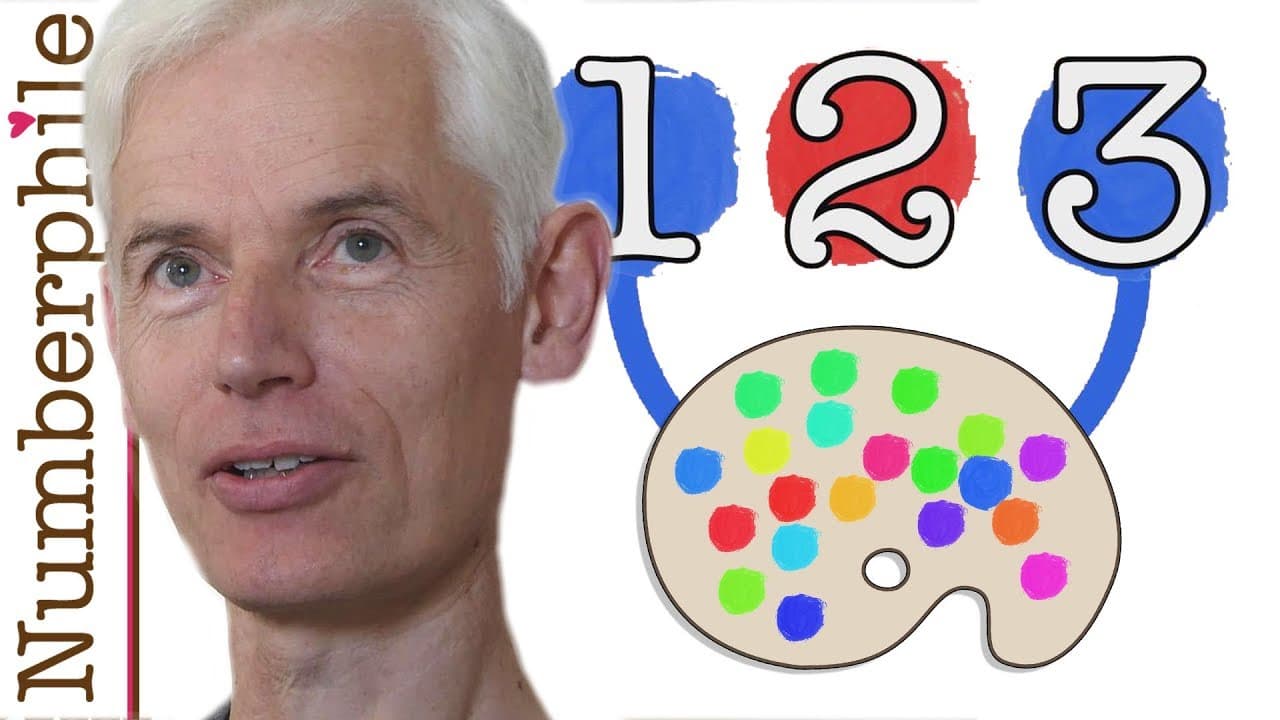
TL;DR
Van der Waerden's theorem explains the inevitability of finding colored arithmetic progressions in a finite coloring scheme.
Transcript
I was going to try and explain a bit about a result called Van der Waerden's theorem Which is one of the fundamental results of Ramsey theory, which is an area that I'm very interested in. Van der Waerden's theorem is about colouring the positive integers. So you take the numbers 1, 2, 3, 4, 5, and so on, and to each one you assign a colour. And th... Read More
Key Insights
- 👾 Van der Waerden's theorem addresses the certainty of finding arithmetic progressions in finite color schemes.
- 👾 Strategic color choices determine the outcome of the game related to the theorem.
- ❓ The proof involves the pigeonhole principle and color focusing arguments.
- ❓ Understanding the theorem involves analyzing color patterns and their relationships within arithmetic progressions.
- 👍 Proving the theorem requires intricate reasoning and strategic planning in coloring positive integers.
- 🥺 The color focusing argument illustrates how specific color configurations lead to inevitable arithmetic progressions.
- 🌥️ The theorem's applicability expands to larger progressions and coloring schemes through inductive reasoning.
Install to Summarize YouTube Videos and Get Transcripts
Explore YouTube Video Summarizer or Get YouTube Transcript Extractor
Questions & Answers
Q: What is Van der Waerden's theorem and how does it relate to coloring positive integers?
Van der Waerden's theorem deals with coloring positive integers to find arithmetic progressions, showcasing the inevitability of such patterns in finite color schemes.
Q: How does the choice of step in an arithmetic progression affect the outcome of the game explained in the video?
The choice of step in an arithmetic progression allows the player to strategize and win the game by forcing specific color patterns, as illustrated in the example of avoiding progressions of length 2.
Q: What role does the pigeonhole principle play in proving Van der Waerden's theorem?
The pigeonhole principle is crucial in proving Van der Waerden's theorem, as it ensures that within a finite coloring scheme, certain color patterns must repeat, leading to the discovery of arithmetic progressions.
Q: How does the color focusing argument contribute to understanding and proving Van der Waerden's theorem?
The color focusing argument highlights how specific color arrangements force subsequent colors in the progression, showcasing the intricate nature of the theorem's proof.
Summary & Key Takeaways
-
Van der Waerden's theorem involves coloring positive integers to find arithmetic progressions.
-
Winning the game requires choosing the step in the progression strategically.
-
The theorem's proof involves the pigeonhole principle and color focusing arguments.
Read in Other Languages (beta)
Share This Summary 📚
Summarize YouTube Videos and Get Video Transcripts with 1-Click
Try YouTube Summary with ChatGPT & Claude or YouTube Transcript Generator
Explore More Summaries from Numberphile 📚






Summarize YouTube Videos and Get Video Transcripts with 1-Click
Try YouTube Summary with ChatGPT & Claude or YouTube Transcript Generator