Worked example: Logistic model word problem | Differential equations | AP Calculus BC | Khan Academy
TL;DR
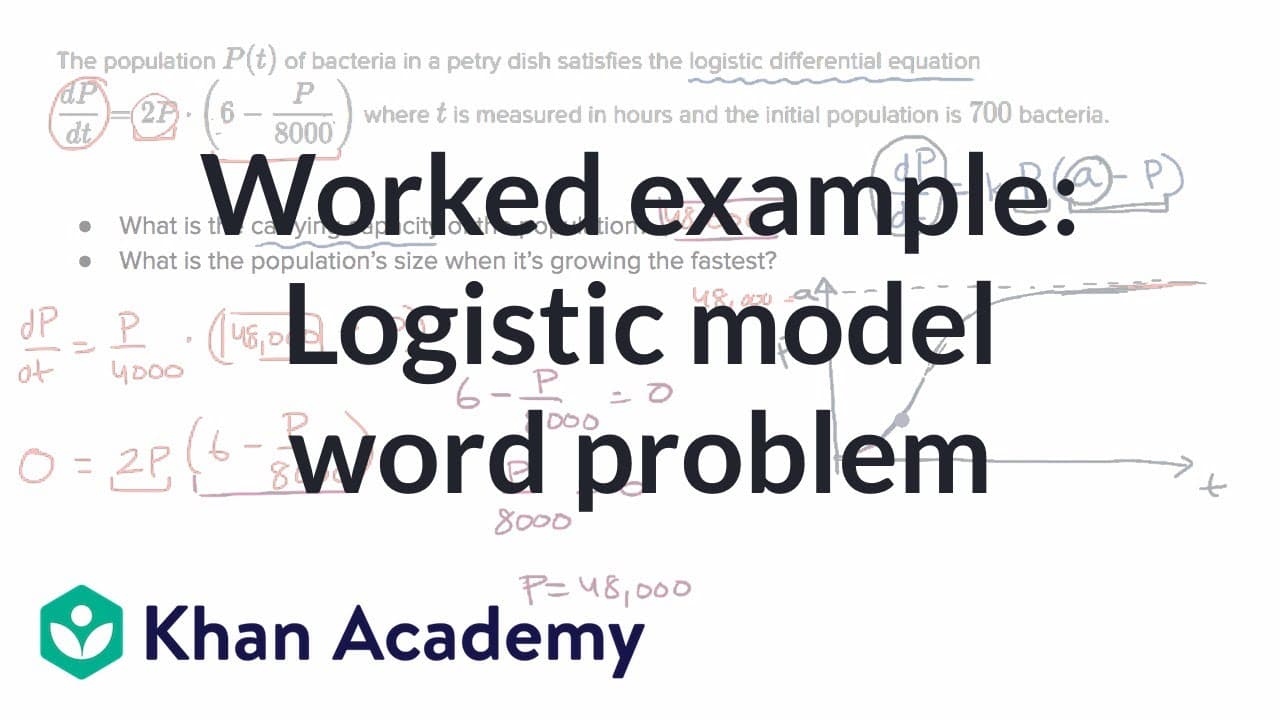
The population growth rate in a petri dish can be modeled using a logistic differential equation, which depends on the population's carrying capacity. The carrying capacity is the maximum population size the environment can sustain. The population grows the fastest when it is halfway between zero and the carrying capacity.
Transcript
- [Narrator] The population P of T of bacteria in a petry dish satisfies the logistic differential equation. The rate of change of population with respect to time is equal to two times the population times the difference between six and the population divided by 8000, where T is measured in hours and the initial population is 700 bacteria. What is ... Read More
Key Insights
- ☠️ Logistic differential equations are commonly used to model population growth rates.
- ♻️ The carrying capacity is the maximum population size that the environment can sustain.
- ❓ Logistic differential equations can be rewritten to determine the carrying capacity.
- 💗 The population grows the fastest when it is halfway between zero and the carrying capacity.
- 🆘 Understanding logistic differential equations can help predict and analyze population dynamics.
- ❓ Calculus and algebra can be utilized to solve and analyze logistic differential equations.
- ❓ The carrying capacity is an important concept in population ecology.
Install to Summarize YouTube Videos and Get Transcripts
Explore YouTube Video Summarizer or Get YouTube Transcript Extractor
Questions & Answers
Q: What is a logistic differential equation?
A logistic differential equation is a mathematical model that describes the growth rate of a population, where the rate of change of population with respect to time is proportional to the product of the population and the difference between the carrying capacity and the population.
Q: How is carrying capacity related to logistic differential equations?
The carrying capacity is the maximum population size that the environment can sustain. In logistic differential equations, the carrying capacity is the value that the population approaches as time approaches infinity and the rate of change of the population approaches zero.
Q: How is the carrying capacity of a population determined in logistic differential equations?
The carrying capacity can be determined by analyzing the logistic differential equation. By rewriting the equation in a certain form, the carrying capacity can be identified as the value that makes the rate of change expression zero.
Q: When does a population grow the fastest according to logistic differential equations?
The population grows the fastest when it is at a population size halfway between zero and the carrying capacity. This can be determined by finding the vertex of the quadratic function representing the rate of change of the population.
Summary & Key Takeaways
-
Logistic differential equations model population growth, where the rate of change of population with respect to time is proportional to the product of the population and the difference between the carrying capacity and the population.
-
The carrying capacity is the maximum population size that the environment can sustain, and it is determined by the logistic differential equation.
-
The population growth rate is highest when the population is halfway between zero and the carrying capacity.
Read in Other Languages (beta)
Share This Summary 📚
Summarize YouTube Videos and Get Video Transcripts with 1-Click
Try YouTube Summary with ChatGPT & Claude or YouTube Transcript Generator
Explore More Summaries from Khan Academy 📚



Summarize YouTube Videos and Get Video Transcripts with 1-Click
Try YouTube Summary with ChatGPT & Claude or YouTube Transcript Generator