25. Stochastic Gradient Descent
TL;DR
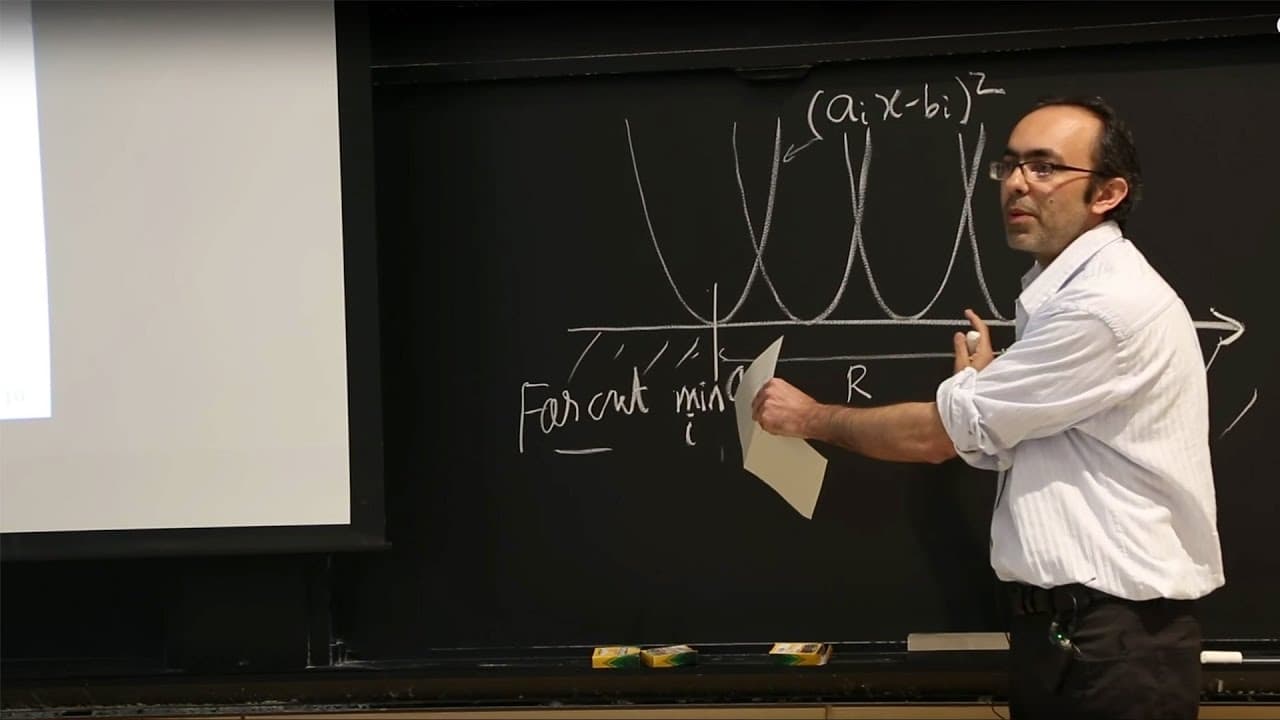
Stochastic Gradient Descent (SGD) is a popular optimization method used in machine learning and deep neural networks, offering rapid initial progress and robustness, but has challenges in step size selection, mini-batch size determination, and theoretical analysis.
Transcript
The following content is provided under a Creative Commons license. Your support will help MIT OpenCourseWare continue to offer high quality educational resources for free. To make a donation or to view additional materials from hundreds of MIT courses, visit MIT OpenCourseWare at ocw.mit.edu. PROFESSOR STRANG: [INAUDIBLE] Professor Suvrit Sra from... Read More
Key Insights
- 🌥️ Stochastic Gradient Descent (SGD) is a powerful and widely used optimization method for large-scale machine learning.
- 🤩 Unbiasedness and controlled variance are key properties that make SGD effective in approximating the true gradient of the cost function.
- 🚐 Practical challenges in using SGD include step size selection, mini-batch size determination, and the need for efficient computation of stochastic gradients.
- 👨🔬 Theoretical analysis of SGD, especially for the nonconvex case and with replacement randomness, is still an area of active research.
Install to Summarize YouTube Videos and Get Transcripts
Explore YouTube Video Summarizer or Get YouTube Transcript Extractor
Questions & Answers
Q: Why is SGD a popular optimization method in machine learning?
SGD offers rapid initial progress, robustness, and allows for parallelization, making it suitable for large-scale machine learning problems.
Q: How does the choice of step size impact SGD?
The step size determines the size of the updates made in each iteration. Proper selection of the step size is essential for ensuring efficient convergence.
Q: What is the difference between using mini-batches and a single data point in SGD?
Using mini-batches involves averaging the gradients of multiple data points, reducing variance and increasing parallelization. Using a single data point can be seen as the vanilla version of SGD.
Q: What are the practical challenges in using SGD?
Challenges include selecting appropriate step sizes, determining the optimal mini-batch size, computing stochastic gradients efficiently, and understanding the theoretical properties of SGD, particularly for neural network training.
Summary & Key Takeaways
-
Stochastic Gradient Descent (SGD) is an ancient yet effective optimization method for training large-scale machine learning systems.
-
SGD is based on the idea of using random samples of training data to estimate the gradient of the cost function, allowing for faster computation and parallelization.
-
The success of SGD relies on the unbiasedness and controlled variance of the stochastic gradients used in the updates.
Read in Other Languages (beta)
Share This Summary 📚
Summarize YouTube Videos and Get Video Transcripts with 1-Click
Try YouTube Summary with ChatGPT & Claude or YouTube Transcript Generator
Explore More Summaries from MIT OpenCourseWare 📚

Summarize YouTube Videos and Get Video Transcripts with 1-Click
Try YouTube Summary with ChatGPT & Claude or YouTube Transcript Generator