What Are State-Dependent Preferences and Biases?
TL;DR
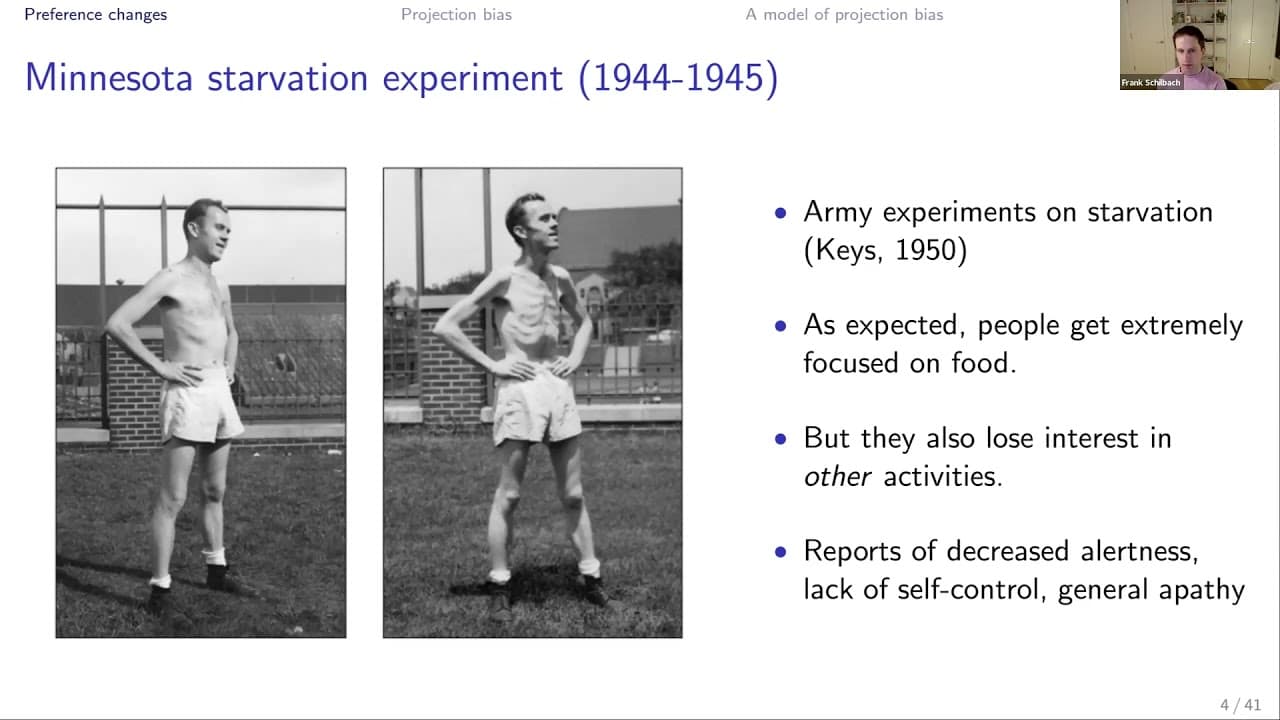
State-dependent preferences highlight how our physiological and psychological states, like hunger or mood, influence our choices. Projection bias occurs when individuals underestimate how their preferences will change in future states, such as craving more unhealthy food when hungry. This misprediction affects behaviors in addiction, decision-making, and relationships.
Transcript
[SQUEAKING] [RUSTLING] [CLICKING] FRANK SCHILBACH: Welcome to Lecture 17. This lecture talks about state-dependent preferences, projection and attribution bias. The plan for today is to talk about preference changes. So we're going to look at different circumstances in which people's preferences, predictably and sometimes unpredictably, change over... Read More
Key Insights
- 👨🎨 People's preferences are influenced by their physiological and psychological state, such as hunger, pain, or mood.
- 👯 Projection bias refers to people's underestimation of changes in their preferences in different states or circumstances.
- 🛟 Projection bias can impact addiction, relationships, and decision-making in various areas of life.
- 🥺 People may struggle to predict their own preference changes accurately, leading to cycles of quitting and restarting in addiction and difficulties in decision-making.
Install to Summarize YouTube Videos and Get Transcripts
Explore YouTube Video Summarizer or Get YouTube Transcript Extractor
Questions & Answers
Q: What is projection bias?
Projection bias refers to people's tendency to underestimate changes in their preferences in different states, such as hunger, pain, or mood. They have trouble predicting their future preferences based on their current state.
Q: How does projection bias affect addiction?
Projection bias can impact addiction by influencing people's decision-making when it comes to quitting or starting to use substances. They may underestimate the difficulties of quitting and believe they can easily stop using, leading to cycles of quitting and restarting.
Q: Are there any other areas in which projection bias can have an impact?
Yes, projection bias can affect decision-making in relationships, as people may have difficulty predicting their future feelings or preferences towards a partner. It can also influence behavior in other areas, such as purchasing decisions based on weather conditions or catalog orders.
Q: Why do people have trouble predicting their own preference changes?
It is unclear why people have difficulty predicting their own preference changes accurately. It could be a cognitive bias where individuals struggle to imagine how their preferences might change in certain states or circumstances. It may also be due to a lack of learning from past experiences.
Summary & Key Takeaways
-
State-dependent preferences: People's preferences are influenced by their physiological and psychological state, such as hunger, pain, or mood. Hunger, for example, can lead to changes in food preferences, such as buying more junk food.
-
Projection bias: People have difficulty predicting their own preference changes, especially when it comes to predicting their future preferences based on their current state. They tend to underestimate how their preferences might change when they are not in a certain state, such as hunger or addiction.
-
Implications of projection bias: Projection bias can impact behavior in addiction, as individuals may underestimate the difficulties of quitting or overestimate their ability to resist cravings. It can also affect decision-making in relationships, as people may have difficulty predicting their future feelings or preferences towards a partner.
Read in Other Languages (beta)
Share This Summary 📚
Summarize YouTube Videos and Get Video Transcripts with 1-Click
Try YouTube Summary with ChatGPT & Claude or YouTube Transcript Generator
Explore More Summaries from MIT OpenCourseWare 📚


Summarize YouTube Videos and Get Video Transcripts with 1-Click
Try YouTube Summary with ChatGPT & Claude or YouTube Transcript Generator