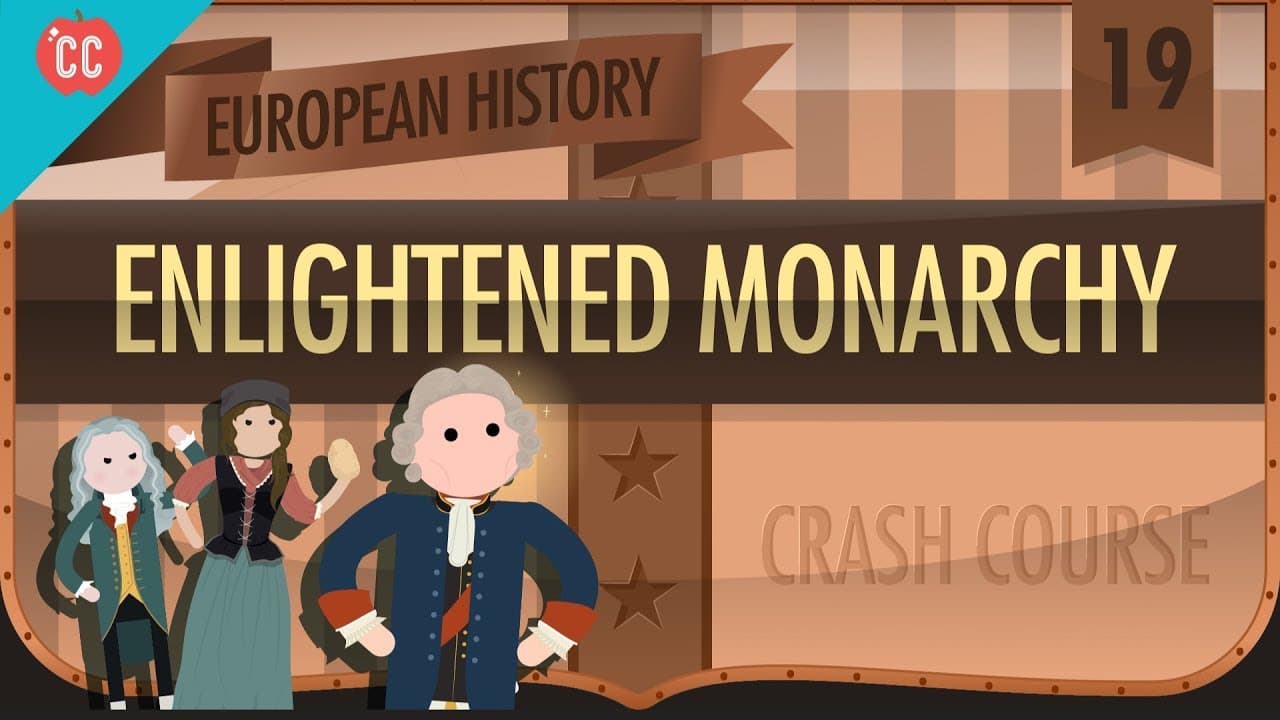
Enlightened Monarchs: Crash Course European History #19
TL;DR
Monarchs of the Enlightenment era straddled between absolutism and enlightenment ideals, adapting to philosophical changes while maintaining power.
Transcript
Hi I’m John Green and this is Crash Course European History. So last week we discussed the Enlightenment philosophers who challenged the idea that kings and nobles were qualified to be elites simply because of the families into which they were born into. But still, monarchs were also interested in Enlightenment ideals, and also understood they need... Read More
Key Insights
- ✊ Enlightenment monarchs straddled between adopting Enlightenment ideals and maintaining traditional power structures.
- 🗯️ Philosophers like Montesquieu and Voltaire advocated for rights, independent institutions, and a balance of power.
- 💍 Monarchs like Catherine II and Frederick the Great engaged with Enlightenment ideas while consolidating their authority.
- ❓ Enlightened reforms often clashed with entrenched systems of aristocracy and absolutism, highlighting a tension between ideals and practicalities.
- ✊ Enlightenment monarchs prioritized state power, education, and efficiency in administration.
- 🎓 Enlightenment ideals influenced policies such as religious tolerance, education reform, and economic development.
- 🤪 Some monarchs like Joseph II went further in implementing Enlightenment principles, emphasizing rational governance and equality.
Install to Summarize YouTube Videos and Get Transcripts
Explore YouTube Video Summarizer or Get YouTube Transcript Extractor
Questions & Answers
Q: How did monarchs like Frederick the Great and Catherine II navigate Enlightenment ideals while maintaining power?
Monarchs like Frederick the Great and Catherine II engaged with Enlightenment thinkers and implemented some reforms to strengthen state power and promote education. However, they also prioritized the aristocracy and maintained oppressive systems...
Q: What were some key differences between Enlightenment philosophes' ideals and actual monarchic practices?
Enlightenment philosophes advocated for rights, independent institutions, and checks on power, contrasting with monarchs who prioritized maintaining their authority and rewarding the aristocracy. This led to a disconnect between philosophical ideals and actual practices...
Q: How did Enlightenment thinkers influence the balance of power in European states?
Enlightenment thinkers influenced the distribution of power by advocating for rights, independent institutions, and a balance of power. Monarchs adapted to these ideas to varying degrees, leading to shifts in governance structures and policies...
Q: How did monarchs like Joseph II of Austria represent the epitome of enlightened rule?
Monarchs like Joseph II of Austria focused on reforms that benefited the state and its citizens, such as abolishing serfdom and promoting education. By prioritizing rational administration and equality, Joseph II embodied enlightened values in his rule...
Summary & Key Takeaways
-
Enlightenment monarchs like Catherine II and Frederick the Great engaged with Enlightenment ideas while consolidating their power.
-
Philosophers like Montesquieu and Voltaire critiqued despotic rule, advocating for rights and independent institutions.
-
Despite reforms, monarchs prioritized state power and aristocracy, leading to a clash between enlightenment ideals and entrenched systems.
Read in Other Languages (beta)
Share This Summary 📚
Summarize YouTube Videos and Get Video Transcripts with 1-Click
Try YouTube Summary with ChatGPT & Claude or YouTube Transcript Generator
Explore More Summaries from CrashCourse 📚




Summarize YouTube Videos and Get Video Transcripts with 1-Click
Try YouTube Summary with ChatGPT & Claude or YouTube Transcript Generator