What Are Faraday's and Lenz's Laws of Electromagnetic Induction?
TL;DR
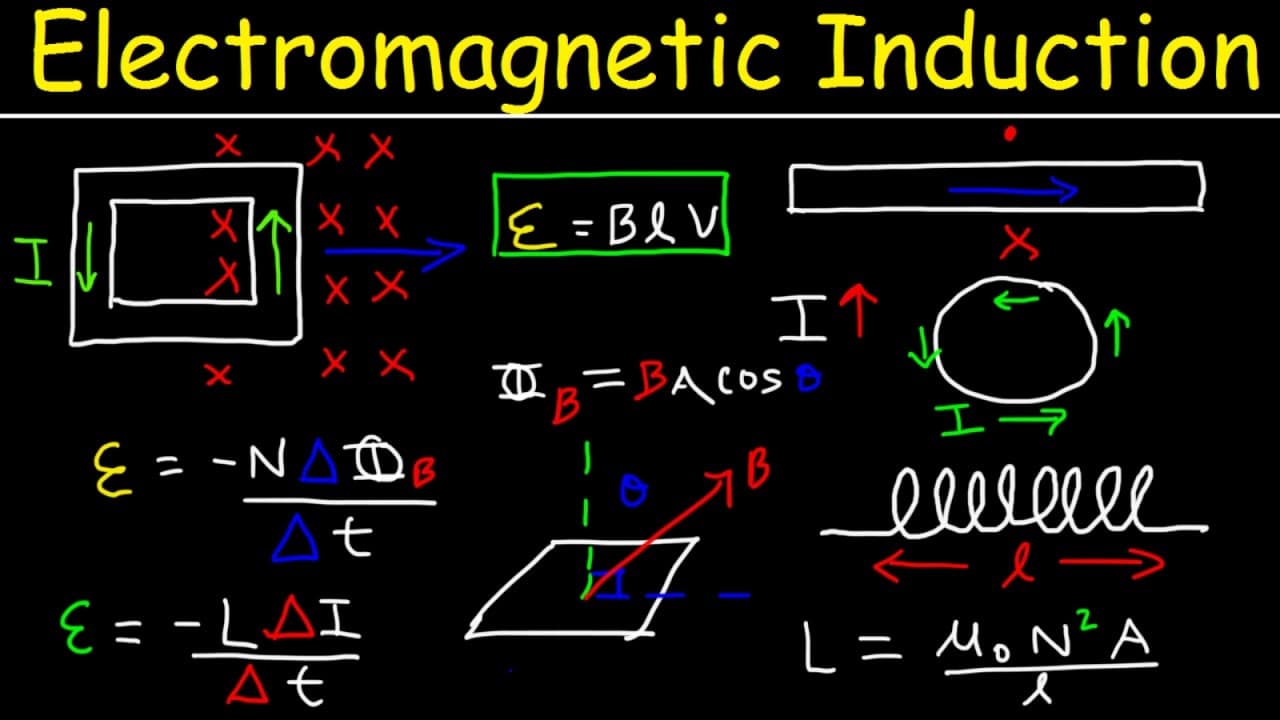
Faraday's Law states that a changing magnetic field induces an electromotive force (emf) in a coil, while Lenz's Law indicates that the induced current opposes changes in magnetic flux. Transformers utilize these principles to transfer energy between coils with differing turns, and inductance measures a coil's resistance to changing current.
Transcript
in this video we're going to talk about faraday's law of electromagnetic induction and also lens law so let's say if we have a coil of wire and if we have a magnet what's going to happen if we move the magnet into the coil if we move the magnet into the coil there's going to be a current that's generated in the coil let's say the coil is connected ... Read More
Key Insights
- 💐 Faraday's Law of Induction and Lenz's Law explain the relationship between changing magnetic fields, induced emf, and current flow.
- ⚡ Transformers are used to increase or decrease voltage in electrical systems.
- 💱 Inductance is a property of inductors that resists changes in current and is measured in henries.
- ↩️ The number of turns in a coil affects the strength of the induced emf and current.
- 💱 The direction of the induced current is determined by the change in magnetic flux and follows Lenz's Law.
- 🏑 The unit of magnetic flux is the weber, calculated by multiplying magnetic field strength, area, and the cosine of the angle between the field and the normal line.
- 💐 The potential energy stored in an inductor is proportional to the square of the current flowing through it.
Install to Summarize YouTube Videos and Get Transcripts
Explore YouTube Video Summarizer or Get YouTube Transcript Extractor
Questions & Answers
Q: What happens when a magnet is moved into a coil of wire?
Moving a magnet into a coil of wire generates an induced current that flows in the opposite direction of the magnet's movement, as described by Lenz's Law.
Q: How does the number of turns in a coil affect the induced emf?
Increasing the number of turns in a coil increases the induced emf and current, as more wire allows for a stronger magnetic field generation.
Q: How can the direction of the induced current be determined in a solenoid?
The induced current in a solenoid is determined by the direction of the change in magnetic flux. If the flux is decreasing, the induced current will be in the same direction as the original current.
Q: What is the unit of magnetic flux and how is it calculated?
The unit of magnetic flux is the weber (Wb). It is calculated by multiplying the magnetic field strength (B), the area (A), and the cosine of the angle (theta) between the magnetic field and the normal line to the surface.
Summary & Key Takeaways
-
Faraday's Law of Induction explains that a changing magnetic field induces an electromotive force (emf) in a coil of wire.
-
Lenz's Law states that the induced emf produces a current that opposes the change in magnetic flux.
-
Transformers use the principle of electromagnetic induction to transfer electrical energy between two coils with different numbers of turns.
-
Inductance is the property of a coil that resists changes in current and is measured in henries.
Read in Other Languages (beta)
Share This Summary 📚
Summarize YouTube Videos and Get Video Transcripts with 1-Click
Try YouTube Summary with ChatGPT & Claude or YouTube Transcript Generator
Explore More Summaries from The Organic Chemistry Tutor 📚



Summarize YouTube Videos and Get Video Transcripts with 1-Click
Try YouTube Summary with ChatGPT & Claude or YouTube Transcript Generator