EE102: Introduction to Signals & Systems, Lecture 22

TL;DR
Understanding the concepts of dynamic analysis and integral control in feedback systems.
Transcript
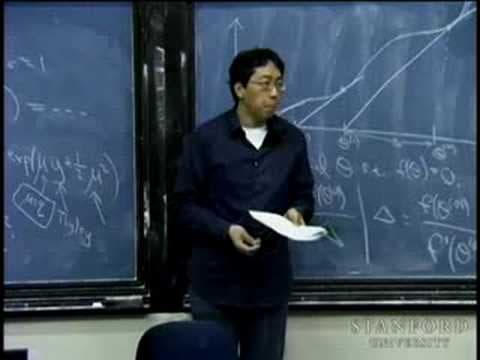
what okay hi everybody can everyone hear me today No okay I think we're trying to figure out the miking back there hmm sorry about that okay I'll be giving lecture today professor Boyd is often Paris France and he didn't make it back in time to give his class so I'll sub in for this short lecture today and we'll have a quiz at 9:40 which hopefully ... Read More
Key Insights
- 🌱 The dynamic analysis of feedback systems involves analyzing the interaction between the controller, plant, and input/output signals.
- 🖐️ The loop transfer function and sensitivity transfer function play crucial roles in the analysis of feedback systems.
- 😚 The stability of a system can be determined by checking the locations of the roots of the closed-loop transfer function and applying the Hurwitz conditions.
- 😘 Proportional integral control is widely used in practice and improves the tracking and stability of a system, particularly at low frequencies.
Install to Summarize YouTube Videos and Get Transcripts
Explore YouTube Video Summarizer or Get YouTube Transcript Extractor
Questions & Answers
Q: What is the goal of feedback control in dynamic systems?
The goal of feedback control is to ensure that the output closely follows the input, despite variations in the plant and disturbances in the system.
Q: How are closed-loop transfer functions derived?
The closed-loop transfer functions for various inputs and disturbances are derived by combining the sensitivity transfer function with the plant transfer function and the controller transfer function.
Q: What are the advantages of making the sensitivity as small as possible?
Making the sensitivity small results in better tracking of the input, reduced sensitivity to plant variations, and improved rejection of disturbances.
Q: What are the Hurwitz conditions for determining stability in polynomial equations?
The Hurwitz conditions state that for a polynomial to be stable, all of its coefficients must be positive. However, this is a necessary but not sufficient condition for stability.
Summary & Key Takeaways
-
The lecture covers the dynamic analysis of feedback systems, emphasizing the goals of making the output track the input and dealing with variations and disturbances in the plant.
-
The loop transfer function and sensitivity transfer function are defined, and the closed-loop transfer functions for various inputs and disturbances are derived.
-
The lecture then introduces the concept of stability and the Hurwitz conditions for determining stability in polynomial equations. The inequalities for polynomials up to degree 4 are provided as examples.
-
Finally, the lecture introduces proportional integral control, explaining its purpose and how it improves the tracking and stability of a system.
Read in Other Languages (beta)
Share This Summary 📚
Summarize YouTube Videos and Get Video Transcripts with 1-Click
Try YouTube Summary with ChatGPT & Claude or YouTube Transcript Generator
Explore More Summaries from Stanford 📚

Summarize YouTube Videos and Get Video Transcripts with 1-Click
Try YouTube Summary with ChatGPT & Claude or YouTube Transcript Generator