Half Wave Rectifiers
TL;DR
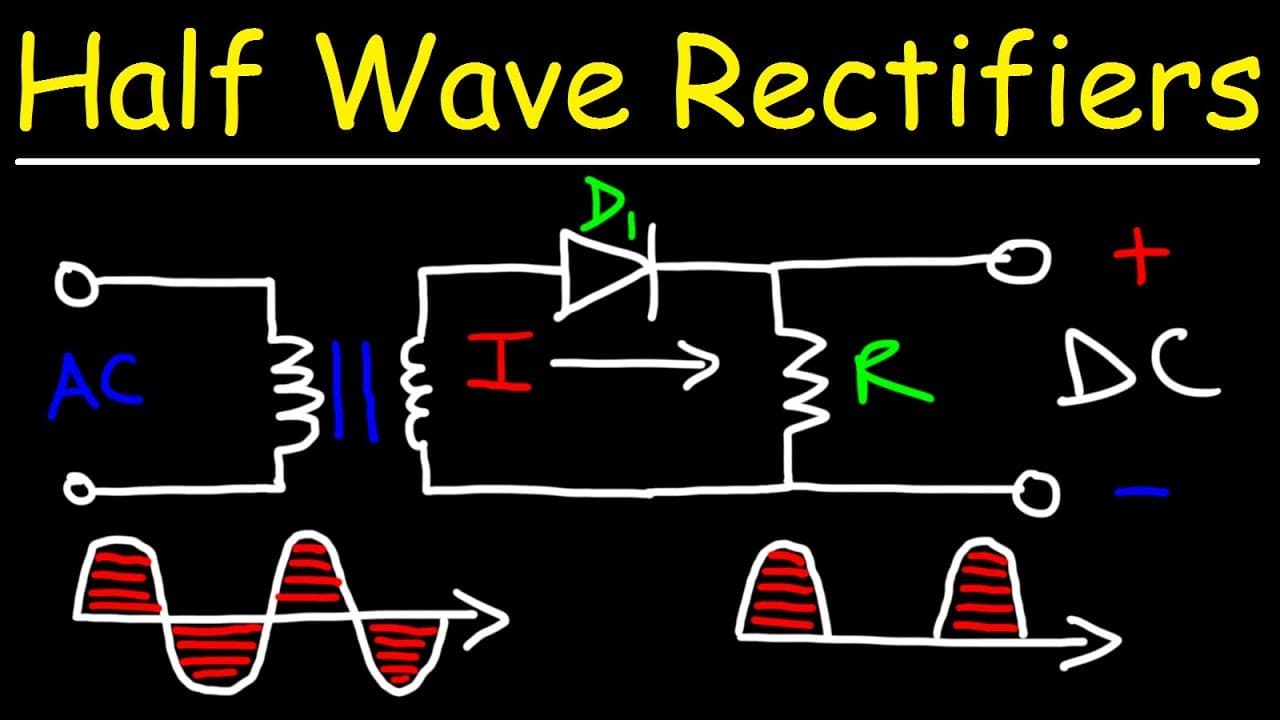
Half wave rectifiers convert AC sine waves into pulsating DC waves by allowing current to flow in one direction.
Transcript
so in this lesson we're going to talk about half wave rectifiers so let's connect the input to a transformer and then this transformer is going to be attached to a conventional diode which is attached to a resistor let's call this point a and point b and here we have diode d1 let's call this r so what's going to happen in this circuit at the input ... Read More
Key Insights
- 👋 Half wave rectifiers convert AC sine waves into pulsating DC waves by allowing current to flow in one direction.
- 👋 The output of a half wave rectifier only includes the positive or negative half of the input AC wave.
- ⚡ The average DC voltage across a resistor in a half wave rectifier can be calculated using the peak voltage and the formula peak voltage / pi.
- 👋 Half wave rectifiers are used to convert AC signals to DC in various electronic applications.
- 👋 Understanding the operation of a half wave rectifier involves analyzing the flow of current through a diode and resistor in the circuit.
- 👋 The direction of current flow in a half wave rectifier circuit depends on the orientation of the diode.
- 😒 The use of transformers in half wave rectifiers helps to step up or step down the voltage.
Install to Summarize YouTube Videos and Get Transcripts
Explore YouTube Video Summarizer or Get YouTube Transcript Extractor
Questions & Answers
Q: What is the purpose of a half wave rectifier?
The purpose of a half wave rectifier is to convert an AC sine wave into a pulsating DC wave by allowing current to flow in one direction only.
Q: How does a half wave rectifier work?
A half wave rectifier works by using a diode to block current flow in one direction, resulting in a pulsating DC output waveform that includes only the positive or negative half of the input AC wave.
Q: What factors determine the average DC voltage across a resistor in a half wave rectifier?
The average DC voltage across a resistor in a half wave rectifier is determined by the peak voltage and can be calculated using the formula peak voltage / pi.
Q: How does a half wave rectifier differ from a full wave rectifier?
In a half wave rectifier, only half of the input AC wave is converted into DC, while in a full wave rectifier, both halves of the input AC wave are converted into DC.
Summary & Key Takeaways
-
Half wave rectifiers convert AC waves into pulsating DC waves by using a diode to block current flow in one direction.
-
The output of a half wave rectifier is a pulsating DC wave that only includes the positive or negative half of the input AC wave.
-
The average DC voltage across a resistor in a half wave rectifier can be calculated using the peak voltage and the formula peak voltage / pi.
Read in Other Languages (beta)
Share This Summary 📚
Summarize YouTube Videos and Get Video Transcripts with 1-Click
Try YouTube Summary with ChatGPT & Claude or YouTube Transcript Generator
Explore More Summaries from The Organic Chemistry Tutor 📚




Summarize YouTube Videos and Get Video Transcripts with 1-Click
Try YouTube Summary with ChatGPT & Claude or YouTube Transcript Generator