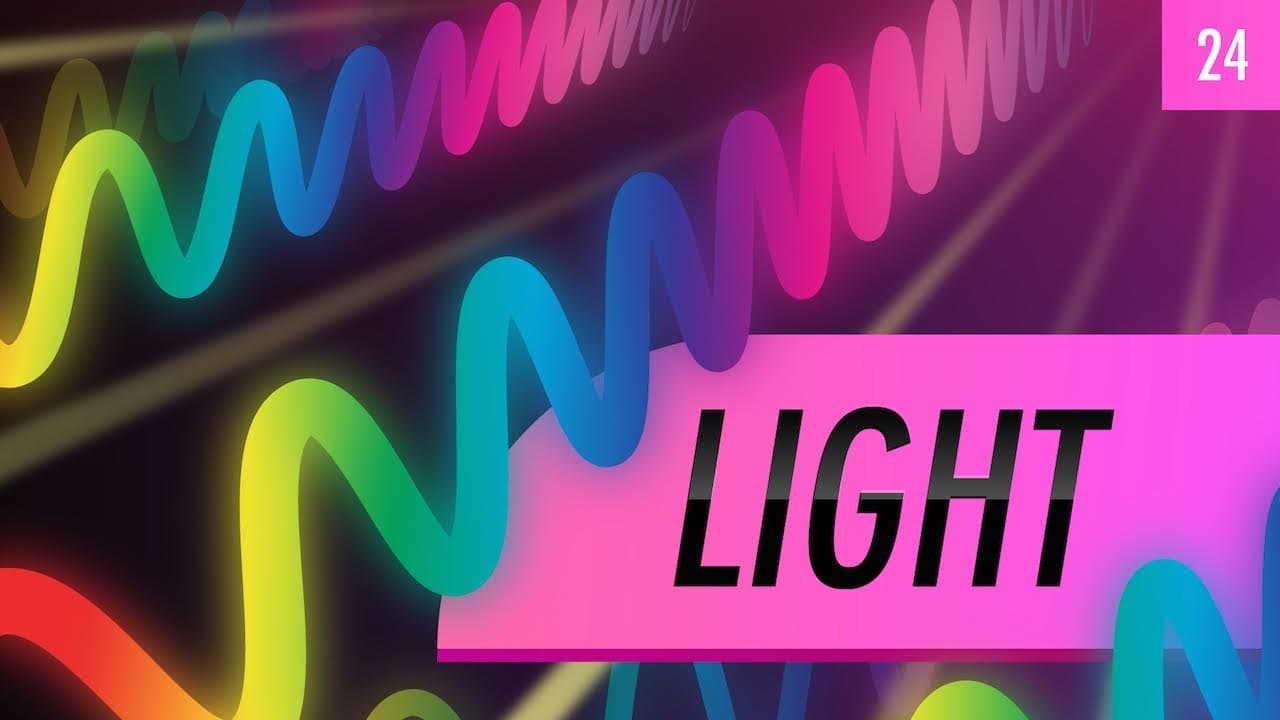
Light: Crash Course Astronomy #24
TL;DR
Light's wavelength reveals astronomical objects' properties.
Transcript
Hey, Phil Plait here and this is Crash Course Astronomy. In last week’s episode, I mentioned that nearly all the information we have about the Universe comes in the form of light. But how does that light get made? What can it tell us about these astronomical objects? And honestly, what is light? Here’s a hint. Light is a wave. It took centuries of ... Read More
Key Insights
- Light is a form of energy that travels in waves, composed of electric and magnetic fields, known as electromagnetic radiation.
- The wavelength of light determines its energy and color, with shorter wavelengths having higher energy and longer wavelengths having lower energy.
- The electromagnetic spectrum includes a range of light types, from gamma rays with the shortest wavelengths to radio waves with the longest.
- Spectroscopy allows scientists to analyze light's colors to determine an object's temperature, density, spin, motion, and chemical composition.
- The Doppler effect applies to light, with approaching objects causing blue shifts and receding objects causing red shifts in light wavelengths.
- Light is emitted when matter gains energy, often through heating, with hotter objects emitting shorter wavelength, higher energy light.
- Atomic structure plays a crucial role in light emission, with electrons absorbing or emitting light when they move between energy levels.
- Different atoms emit distinct colors of light, enabling the identification of an object's composition through precise spectroscopic measurements.
Install to Summarize YouTube Videos and Get Transcripts
Explore YouTube Video Summarizer or Get YouTube Transcript Extractor
Questions & Answers
Q: What is light and how is it structured?
Light is a form of energy that travels in waves composed of electric and magnetic fields, known as electromagnetic radiation. It has a wavelength, which is the distance between wave crests, determining its energy and color. The structure of light as an electromagnetic wave allows it to interact with matter, revealing information about the Universe.
Q: How does the electromagnetic spectrum relate to light?
The electromagnetic spectrum encompasses all types of light, arranged by wavelength. It includes gamma rays, X-rays, ultraviolet light, visible light, infrared light, microwaves, and radio waves. Each type of light has different wavelengths and energy levels, with visible light being a small fraction of the spectrum that human eyes can detect.
Q: What role does spectroscopy play in astronomy?
Spectroscopy is a technique used to analyze the colors of light emitted or absorbed by objects. By measuring the wavelengths of light, astronomers can determine an object's temperature, density, spin, motion, and chemical composition. This information is crucial for understanding the properties and behaviors of celestial bodies, even those far beyond our reach.
Q: How does the Doppler effect apply to light in astronomy?
The Doppler effect causes a shift in the wavelength of light depending on an object's motion relative to the observer. If an object is moving toward the observer, its light is blue-shifted (shorter wavelengths). If moving away, it is red-shifted (longer wavelengths). This effect is essential for measuring the velocity and direction of celestial objects, aiding in the study of the Universe's expansion.
Q: How is light emitted by matter?
Light is emitted by matter when it gains energy, often through heating. As matter heats up, it emits light with shorter wavelengths and higher energy. The color of emitted light changes with temperature, with hotter objects emitting bluer light and cooler objects emitting redder light. This principle helps astronomers determine the temperature of stars and other celestial bodies.
Q: What is the relationship between atomic structure and light emission?
Atomic structure influences light emission through electron transitions between energy levels. Electrons absorb or emit light when they move between these levels, with the energy of the light corresponding to the difference in energy levels. Different atoms have unique energy level structures, leading to the emission of specific colors of light, which can be analyzed to identify the atom's presence in astronomical objects.
Q: How can astronomers determine the composition of celestial objects?
Astronomers use spectroscopy to determine the composition of celestial objects. By analyzing the specific wavelengths of light emitted or absorbed by an object, they can identify the unique 'fingerprints' of different atoms and molecules. This allows them to ascertain the chemical makeup of stars, planets, and other celestial bodies, even those located light-years away.
Q: What insights can be gained from studying light in astronomy?
Studying light in astronomy provides insights into the fundamental properties of celestial objects. By analyzing light's wavelength, astronomers can determine an object's temperature, density, spin, motion, and chemical composition. Light's behavior under the Doppler effect also reveals information about the object's velocity and direction, contributing to our understanding of the Universe's structure and expansion.
Summary & Key Takeaways
-
Light is an electromagnetic wave, with its wavelength determining its energy and color. The electromagnetic spectrum encompasses various types of light, from gamma rays to radio waves. Spectroscopy enables the analysis of light to deduce the temperature, density, spin, motion, and composition of astronomical objects.
-
Matter emits light when heated, with the color of emitted light dependent on temperature. Atomic structure influences light emission, as electrons absorb or emit light when transitioning between energy levels. Different atoms emit unique colors, allowing scientists to determine an object's composition through spectroscopy.
-
The Doppler effect affects light, causing blue shifts for approaching objects and red shifts for receding ones. This phenomenon is vital in understanding the expansion of the Universe. Spectroscopy provides insights into various astronomical properties, revealing the fundamental characteristics of celestial objects.
Read in Other Languages (beta)
Share This Summary 📚
Summarize YouTube Videos and Get Video Transcripts with 1-Click
Try YouTube Summary with ChatGPT & Claude or YouTube Transcript Generator
Explore More Summaries from CrashCourse 📚





Summarize YouTube Videos and Get Video Transcripts with 1-Click
Try YouTube Summary with ChatGPT & Claude or YouTube Transcript Generator