How Do Low Mass Stars Evolve Over Time?
TL;DR
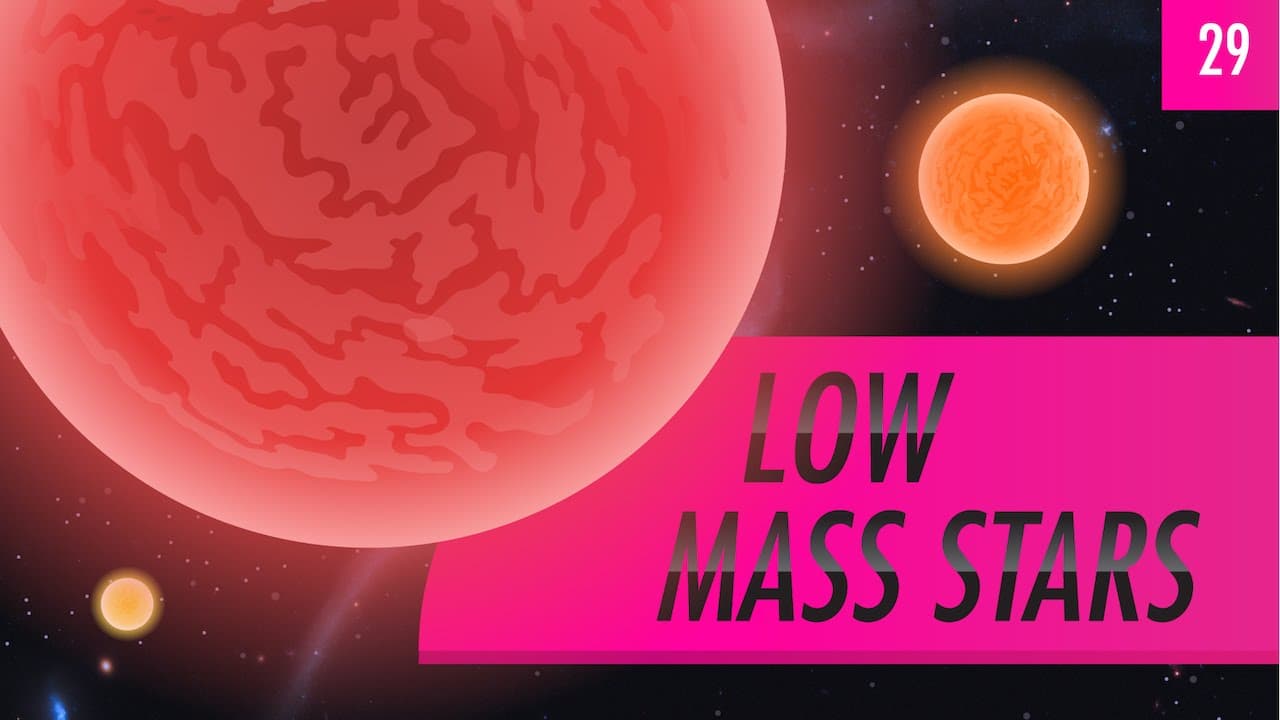
Low mass stars, like red dwarfs, have long lifespans due to their slow hydrogen fusion rates, lasting up to a trillion years. More massive stars, such as the Sun, have shorter lifespans, fusing hydrogen into helium and eventually helium into carbon, expanding into red giants before shedding mass and becoming white dwarfs.
Transcript
Stars in the sky look pretty. Flickering, intense diamonds dotting the velvety night. But make no mistake: They are churning cauldrons of violence, barely constrained thermonuclear generators, creating enough energy to vaporize the Earth a thousand times over. Their lives depend on it. Heck, our lives depend on it! But in their case, how they live,... Read More
Key Insights
- Low mass stars, such as red dwarfs, have extremely long lifespans due to their slow hydrogen fusion rates.
- Hydrogen fusion in stars involves converting hydrogen into helium, releasing energy that powers the star.
- The lifespan of a star is inversely related to its mass; more massive stars burn through their fuel faster.
- Red dwarfs can last up to a trillion years, far exceeding the current age of the Universe.
- Stars like the Sun eventually expand into red giants as they run out of hydrogen in their cores.
- During the red giant phase, stars lose significant mass through strong stellar winds.
- The Sun will eventually become a white dwarf after shedding its outer layers and exhausting its fuel.
- The fate of Earth is uncertain, but it will likely be uninhabitable long before the Sun becomes a red giant.
Install to Summarize YouTube Videos and Get Transcripts
Explore YouTube Video Summarizer or Get YouTube Transcript Extractor
Questions & Answers
Q: How long do low mass stars live?
Low mass stars, such as red dwarfs, have incredibly long lifespans due to their slow hydrogen fusion rates. They can last up to a trillion years, which is significantly longer than the current age of the Universe. This extended lifespan is due to their efficient use of hydrogen fuel throughout the entire star.
Q: What happens when a star becomes a red giant?
When a star becomes a red giant, it expands significantly as it runs out of hydrogen in its core. The outer layers swell, and the star loses a substantial amount of mass through strong stellar winds. The star's surface cools and turns red, and it becomes much brighter due to increased energy output.
Q: What is the fate of the Sun?
The Sun will eventually exhaust its hydrogen fuel and expand into a red giant, shedding its outer layers and losing a significant amount of mass. After the red giant phase, it will become a white dwarf, a hot, dense core that will slowly cool and fade over billions of years, marking the end of its life cycle.
Q: How does hydrogen fusion work in stars?
Hydrogen fusion in stars involves converting hydrogen atoms into helium in the star's core. This process releases a tremendous amount of energy, which powers the star and creates the light and heat we observe. The rate of fusion depends on the star's mass, with higher mass stars fusing hydrogen more rapidly.
Q: What will happen to Earth when the Sun becomes a red giant?
When the Sun becomes a red giant, Earth will likely become uninhabitable due to extreme heat. The Sun's expansion may cause it to engulf the planet, or Earth's orbit may shift outward due to the Sun's mass loss. Either way, the planet will be a molten, inhospitable environment long before this stage.
Q: Why do more massive stars have shorter lifespans?
More massive stars have shorter lifespans because they burn through their hydrogen fuel at a much faster rate. The increased pressure and temperature in their cores lead to a higher rate of fusion, causing them to exhaust their fuel more quickly compared to lower mass stars like red dwarfs.
Q: What is a white dwarf?
A white dwarf is the remnant core of a star that has exhausted its nuclear fuel and shed its outer layers. It is a hot, dense, and compact object that slowly cools and fades over billions of years. White dwarfs are typically about the size of Earth but have a mass similar to that of the Sun.
Q: How does a star's mass affect its evolution?
A star's mass significantly influences its evolution, lifespan, and ultimate fate. Low mass stars have longer lifespans due to slower fusion rates, while high mass stars have shorter lifespans and more explosive ends. The mass determines the star's ability to fuse heavier elements and whether it becomes a white dwarf or undergoes a supernova.
Summary & Key Takeaways
-
Low mass stars, such as red dwarfs, have long lifespans due to their slow hydrogen fusion rates. These stars can last up to a trillion years, far exceeding the current age of the Universe. Their entire mass is available for fuel, allowing them to shine for an extended period.
-
More massive stars, like the Sun, live shorter lives. They fuse hydrogen into helium and eventually helium into carbon, expanding into red giants. During this phase, they lose a significant amount of mass through strong stellar winds, eventually becoming white dwarfs.
-
The Sun will eventually exhaust its fuel and expand into a red giant, shedding its outer layers and becoming a white dwarf. This process will take billions of years, but Earth will become uninhabitable long before the Sun reaches the red giant stage.
Read in Other Languages (beta)
Share This Summary 📚
Summarize YouTube Videos and Get Video Transcripts with 1-Click
Try YouTube Summary with ChatGPT & Claude or YouTube Transcript Generator
Explore More Summaries from CrashCourse 📚




Summarize YouTube Videos and Get Video Transcripts with 1-Click
Try YouTube Summary with ChatGPT & Claude or YouTube Transcript Generator