Where Does Grounded Electricity Go and Why Is It Important?
TL;DR
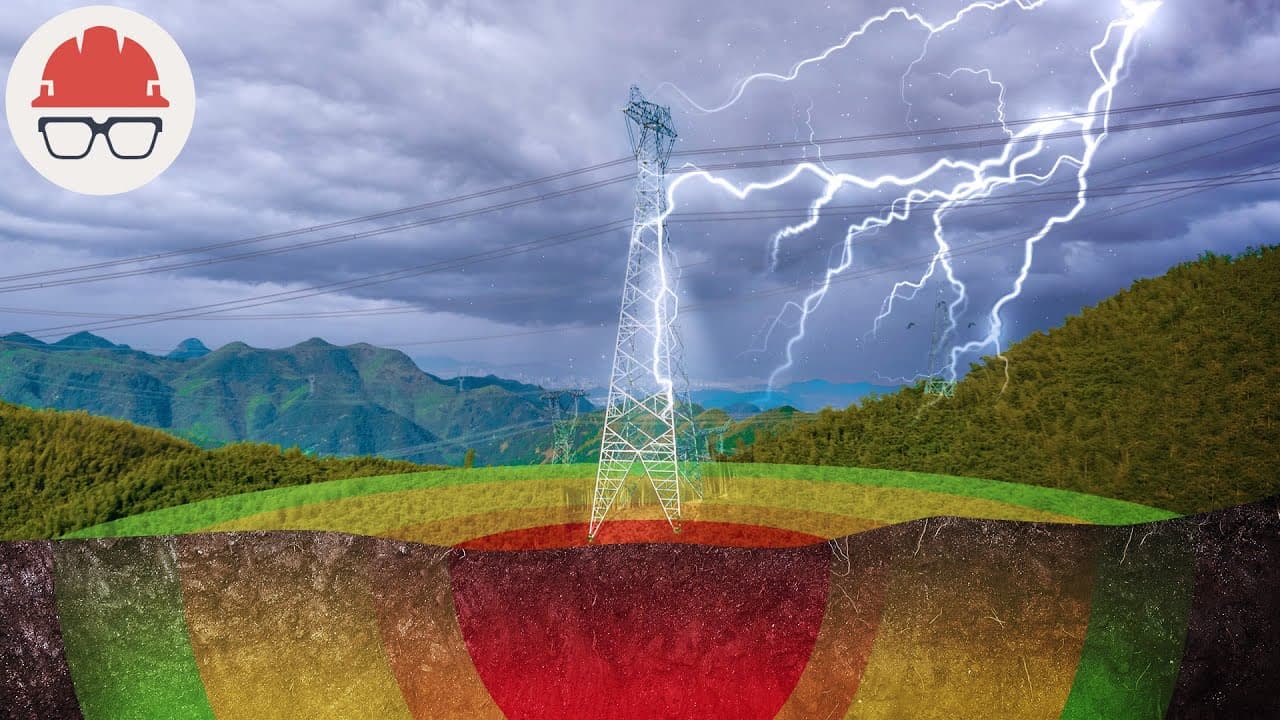
Grounded electricity usually flows through the earth rather than into it, serving as a safety mechanism to prevent electrical shocks and fires. Grounding provides a low-resistance path for fault currents, crucial for safe electrical system operation. Factors like soil resistivity, moisture, and system design significantly influence grounding effectiveness.
Transcript
Imagine this scenario: You have a diesel-powered generator on a stand that is electrically isolated from the ground. Run a wire from the energized slot of an outlet to an electrode driven into the ground. Don’t connect anything to the ground or neutral slots. Now imagine starting the generator. What happens? Does current flow from the energized ... Read More
Key Insights
- Electrical grounding is essential for safety, preventing electrical shocks and fires by providing a low-resistance path for fault currents.
- Ungrounded systems can continue operating during a ground fault but require more insulation, increasing costs.
- Ground faults cause voltage shifts in ungrounded systems, making them susceptible to increased phase-to-ground voltages.
- Grounding systems help manage step and touch potentials, which can be hazardous to humans if not properly controlled.
- Soil resistivity affects grounding effectiveness, with moisture and chemical composition playing significant roles in conductivity.
- Single Wire Earth Return systems use the earth as a return path, offering cost savings but presenting safety challenges.
- Lightning and other natural phenomena also use the ground as a conduit, highlighting the complexity of electrical currents in the earth.
- Properly designed grounding systems are critical for safe operation of power plants, substations, and transmission lines.
Install to Summarize YouTube Videos and Get Transcripts
Explore YouTube Video Summarizer or Get YouTube Transcript Extractor
Questions & Answers
Q: Why is electrical grounding important?
Electrical grounding is crucial for safety and system functionality. It provides a low-resistance path for fault currents, preventing electrical shocks and fires. Grounding helps manage voltage levels and ensures that fault currents trigger protective devices, maintaining system integrity and safety.
Q: What happens during a ground fault in an ungrounded system?
In an ungrounded system, a ground fault causes a shift in phase-to-ground voltages, although phase-to-phase voltages remain unchanged. This can lead to increased voltage levels, requiring more insulation and increasing costs. Despite these shifts, ungrounded systems can continue operating during a fault, offering some operational advantages.
Q: How does soil resistivity affect grounding?
Soil resistivity plays a significant role in grounding effectiveness. Factors like soil type, moisture, temperature, and chemical composition impact conductivity. High resistivity can impede current flow, necessitating careful design of grounding systems to ensure safety and functionality, especially in high-resistance soils.
Q: What are step and touch potentials?
Step and touch potentials refer to voltage differences that can occur during a ground fault. Step potential is the voltage difference between a person's feet, while touch potential is between a person and a conductive object. Both can be hazardous, and grounding systems must be designed to minimize these potentials to ensure safety.
Q: What is a Single Wire Earth Return system?
A Single Wire Earth Return (SWER) system uses the earth as the return path for electrical current, allowing for cost savings by reducing the number of conductors needed. While cost-effective, SWER systems present safety and technical challenges, requiring careful design to manage risks associated with using the earth as a conductor.
Q: How does lightning interact with electrical grounding?
Lightning involves static electricity, with currents flowing into or out of the ground to balance charge imbalances. Grounding systems provide a direct path for lightning currents, preventing arcing and equipment damage. Proper grounding is essential to safely dissipate lightning energy and protect electrical systems from its effects.
Q: What are telluric currents?
Telluric currents are natural electrical currents flowing through the earth, influenced by phenomena like solar wind and magnetic field changes. These currents intermingle with human-induced currents, adding complexity to how electricity flows through the ground. Understanding telluric currents is important for designing effective grounding systems.
Q: How do grounding systems manage environmental impacts?
Grounding systems must consider environmental impacts, such as corrosion of buried structures due to stray currents. Proper design mitigates these effects, ensuring that grounding systems are safe and effective. Environmental considerations include managing magnetic fields and chemical reactions caused by current flow through the ground or water.
Summary & Key Takeaways
-
Electrical grounding is a critical component of power systems, ensuring safety by providing paths for fault currents and managing voltage levels. Proper grounding prevents electrical shocks and fires by offering a low-resistance path for current flow, especially during faults.
-
Ungrounded systems can continue functioning during ground faults but require more insulation, increasing operational costs. Ground faults cause phase-to-ground voltage shifts, highlighting the importance of effective grounding systems to manage potential hazards like step and touch potentials.
-
Soil resistivity significantly impacts grounding effectiveness, with factors like moisture and chemical composition affecting conductivity. Grounding systems must be carefully designed to ensure safety in power plants and transmission lines, accounting for natural phenomena like lightning and telluric currents.
Read in Other Languages (beta)
Share This Summary 📚
Summarize YouTube Videos and Get Video Transcripts with 1-Click
Try YouTube Summary with ChatGPT & Claude or YouTube Transcript Generator
Explore More Summaries from Practical Engineering 📚




Summarize YouTube Videos and Get Video Transcripts with 1-Click
Try YouTube Summary with ChatGPT & Claude or YouTube Transcript Generator