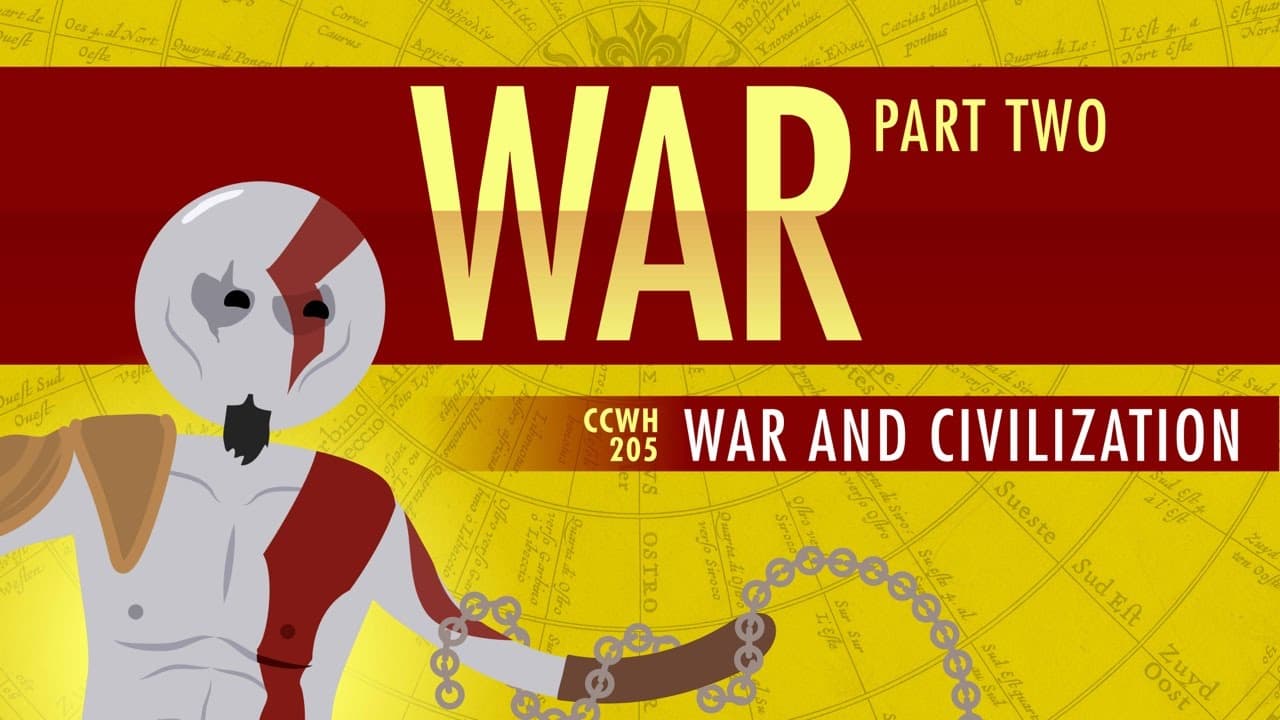
War and Civilization: Crash Course World History 205
TL;DR
War influenced human organization and development of agriculture and cities.
Transcript
Hi I'm John Green; this is Crash Course World History, and today, we're going to talk -- for the absolute last time, I promise -- about war. Well, it's not the last time we're going to talk about war because we're gonna talk about the 20th century later, pretty much defined by war, but it's the last time we're going to talk about war in an abstract... Read More
Key Insights
- War has been a driving force in human development, influencing the establishment of cities and agriculture as defensive measures.
- The need for defense against raids may have led to early human settlements and the development of agriculture as a stable resource base.
- Successful war leaders historically transitioned into political leaders, using military strength to establish and expand territories.
- City-states, like those in ancient Greece, used walls and citizen militias for defense, which altered the nature of warfare and political power.
- Empires, reliant on military power, often faced challenges such as mercenary loyalty issues and the need for constant expansion.
- The introduction of gunpowder and cannons in the early modern era transformed military strategies and increased state power through better tax systems.
- Economic factors, such as trade and wealth accumulation, have made peace more attractive than war, especially for modern liberal democracies.
- War, while historically significant in shaping civilizations, is increasingly seen as less beneficial compared to peaceful trade relations.
Install to Summarize YouTube Videos and Get Transcripts
Explore YouTube Video Summarizer or Get YouTube Transcript Extractor
Questions & Answers
Q: How did war influence the development of agriculture and cities?
War influenced the development of agriculture and cities by necessitating defensive measures against raids, leading to the establishment of settlements. These settlements, in turn, required stable food sources, promoting agriculture. The concentration of people in one place for defense also facilitated the growth of cities, which became centers of trade and political power.
Q: What role did successful war leaders play in political structures?
Successful war leaders often transitioned into political leaders by leveraging their military strength to gain control over territories. They maintained power by providing their followers with spoils of war, which necessitated continuous conflict. This process contributed to the formation of chiefdoms and eventually kingdoms, as seen in historical examples like the rise of the Zulu nation.
Q: How did city-states change the nature of warfare?
City-states changed the nature of warfare by developing defensive structures like walls and relying on citizen militias. These militias, composed of citizen-soldiers, were effective fighting forces and political catalysts, reducing the influence of warrior elites. This shift in military organization allowed city-states to defend themselves against constant threats and fostered civic pride among citizens.
Q: What challenges did empires face due to their reliance on military power?
Empires faced challenges such as the loyalty of mercenaries, who were primarily motivated by loot rather than allegiance to the state. This reliance on mercenaries necessitated constant warfare, which could stretch resources thin. Additionally, the expansion of empires often led to internal problems, such as peasant revolts, and external threats, making them vulnerable and unstable.
Q: How did the introduction of gunpowder weapons transform military strategies?
The introduction of gunpowder weapons, such as cannons, transformed military strategies by making cities more vulnerable and necessitating new fortification techniques. This military revolution increased the power of states, as they needed to modernize bureaucracies and tax systems to fund the expensive military technology. This shift contributed to the dominance of European powers after 1500.
Q: Why is peace considered more economically beneficial than war in modern times?
Peace is considered more economically beneficial than war in modern times due to the advantages of trade and wealth accumulation. Good trade relations lead to more resources and prosperity for all involved nations. The economic benefits of peace, such as access to goods, medicine, and food, outweigh the costs and destruction associated with warfare, making peaceful interactions more attractive.
Q: What role did trade play in reducing the frequency of wars between major powers?
Trade played a significant role in reducing the frequency of wars between major powers by providing a more stable and profitable means of wealth accumulation. As states became more reliant on trade, especially exploitative colonial trade, they began to shy away from expensive wars. The economic interdependence fostered by trade relations made peace more advantageous than conflict.
Q: How does John Green's perspective on war differ from traditional military history?
John Green's perspective on war differs from traditional military history by focusing on the broader implications of war on human civilization, rather than just battles and conquests. He examines the reciprocal relationship between war and the development of political and social structures, emphasizing the economic and societal factors that have influenced the frequency and nature of wars throughout history.
Summary & Key Takeaways
-
John Green explores the complex relationship between war and human civilization, questioning whether war led to the development of agriculture and cities or vice versa. He discusses how war influenced political structures and the formation of empires, highlighting historical examples like the Zulu nation.
-
War has historically driven human organization, as seen in the development of city-states with defensive walls and citizen militias. The interplay between war and political power is evident in the rise of empires, though the reliance on mercenaries often led to instability.
-
The modern era saw a shift toward trade as a more advantageous means of wealth accumulation than war, particularly for liberal democracies. This economic transformation, alongside the high costs of warfare, has contributed to a decline in large-scale wars between major powers.
Read in Other Languages (beta)
Share This Summary 📚
Summarize YouTube Videos and Get Video Transcripts with 1-Click
Try YouTube Summary with ChatGPT & Claude or YouTube Transcript Generator
Explore More Summaries from CrashCourse 📚


Summarize YouTube Videos and Get Video Transcripts with 1-Click
Try YouTube Summary with ChatGPT & Claude or YouTube Transcript Generator