Why Can't We Drink Ocean Water for Hydration?
TL;DR
Drinking seawater leads to severe dehydration because its high salt content causes water to exit your cells, worsening thirst. Instead, finding or creating freshwater is vital for survival, and methods like thermal desalination and reverse osmosis are key solutions to global water scarcity issues. In emergencies, collecting rainwater or using animal fluids are safer hydration alternatives.
Transcript
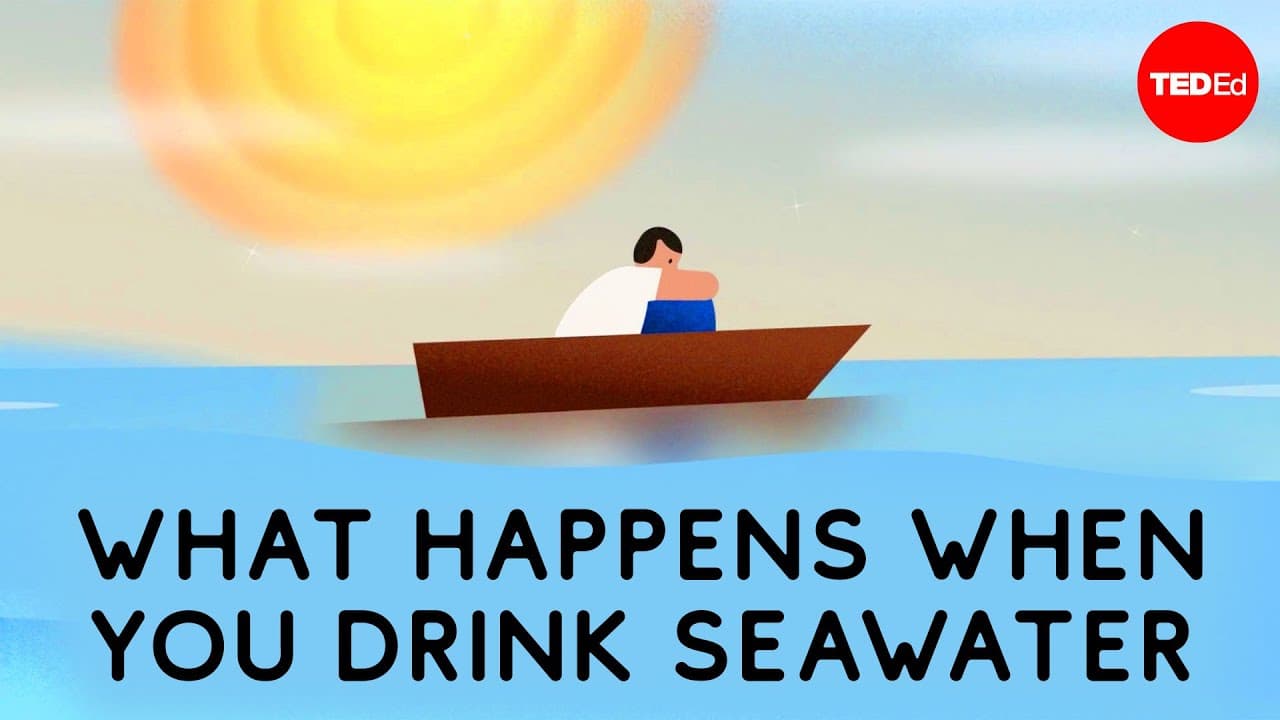
You're stranded at sea and getting thirsty. Water fills the horizon— but you know you’re not supposed to drink it. So, what would actually happen to you if you did? And how can you find a way to hydrate? The danger in drinking saltwater lies at the cellular level. To maintain their structural integrity, your body’s cells match the concentration of ... Read More
Key Insights
- 🧂 Drinking seawater exacerbates dehydration due to the body's cellular response to excess salt.
- ❓ Desalination methods have evolved over centuries, with ancient techniques still influencing modern practices today.
- 💦 Growing concerns over water scarcity make desalination methods increasingly relevant, with billions lacking access to clean water.
- 🤨 Thermal desalination, despite its historical significance, raises considerable environmental waste issues, primarily from brine.
- 🪡 Reverse osmosis represents a more efficient and ecologically friendly option for modern desalination needs.
- 🥹 Wastewater recycling holds significant potential for addressing freshwater scarcity while being less demanding energetically.
- 😋 Practical survival tips include avoiding nitrogen-rich foods and focusing on collecting available freshwater or using animal fluids.
Install to Summarize YouTube Videos and Get Transcripts
Explore YouTube Video Summarizer or Get YouTube Transcript Extractor
Questions & Answers
Q: What happens to our body when we drink seawater?
When seawater is consumed, its salt content is significantly higher than that of our blood, which causes water to leave our cells in an effort to balance salt concentrations. This dehydration restricts cellular function and can lead to critical organ failure if not addressed immediately.
Q: How did ancient Greeks approach desalination?
Ancient Greek philosopher Aristotle documented two methods of desalination that are still relevant: thermal desalination, which generates freshwater from vaporized seawater, and reverse osmosis, which uses pressure to filter out salts through a membrane, highlighting humanity’s long history of addressing water scarcity.
Q: What are the environmental concerns associated with thermal desalination?
Thermal desalination requirements are high in energy, typically sourced from fossil fuels, which raises environmental concerns. Additionally, the process produces brine waste that, if returned to the ocean, can disrupt local ecosystems by increasing salinity levels.
Q: Why is reverse osmosis becoming preferred over thermal desalination?
Reverse osmosis is increasingly favored due to its efficiency and reduced environmental impact. It requires less energy compared to thermal methods and produces less brine waste. Moreover, advancements in synthetic membranes have improved its effectiveness for contemporary desalination needs.
Q: Are there innovative solutions for water scarcity beyond desalination?
Yes, wastewater recycling has emerged as a promising alternative to desalination, as it requires less energy to filter contaminants. Utilizing reverse osmosis in wastewater treatment can produce safe drinking water, addressing both freshwater needs and reducing waste.
Q: What survival methods can you use if stranded at sea?
In case of being stranded at sea, one can collect rainwater or dew using absorbent materials. Additionally, simple thermal desalination can be achieved by letting seawater evaporate in containers and gathering condensation. Animal fluids can also provide hydrating alternatives in extreme circumstances.
Summary & Key Takeaways
-
Consuming seawater is dangerous due to the high salt content that causes fluid loss in cells, leading to severe dehydration.
-
Historical methods of desalination include thermal processes and reverse osmosis, both of which have evolved into modern techniques to combat global water scarcity.
-
In dire situations, alternatives for hydration are recommended, such as rainwater collection and utilizing available animal fluids, while avoiding harmful practices like drinking urine.
Read in Other Languages (beta)
Share This Summary 📚
Summarize YouTube Videos and Get Video Transcripts with 1-Click
Try YouTube Summary with ChatGPT & Claude or YouTube Transcript Generator
Explore More Summaries from TED-Ed 📚






Summarize YouTube Videos and Get Video Transcripts with 1-Click
Try YouTube Summary with ChatGPT & Claude or YouTube Transcript Generator