Synthetic Biology: Synthetic Biology for Industrial Biotechnology - Group 5
TL;DR
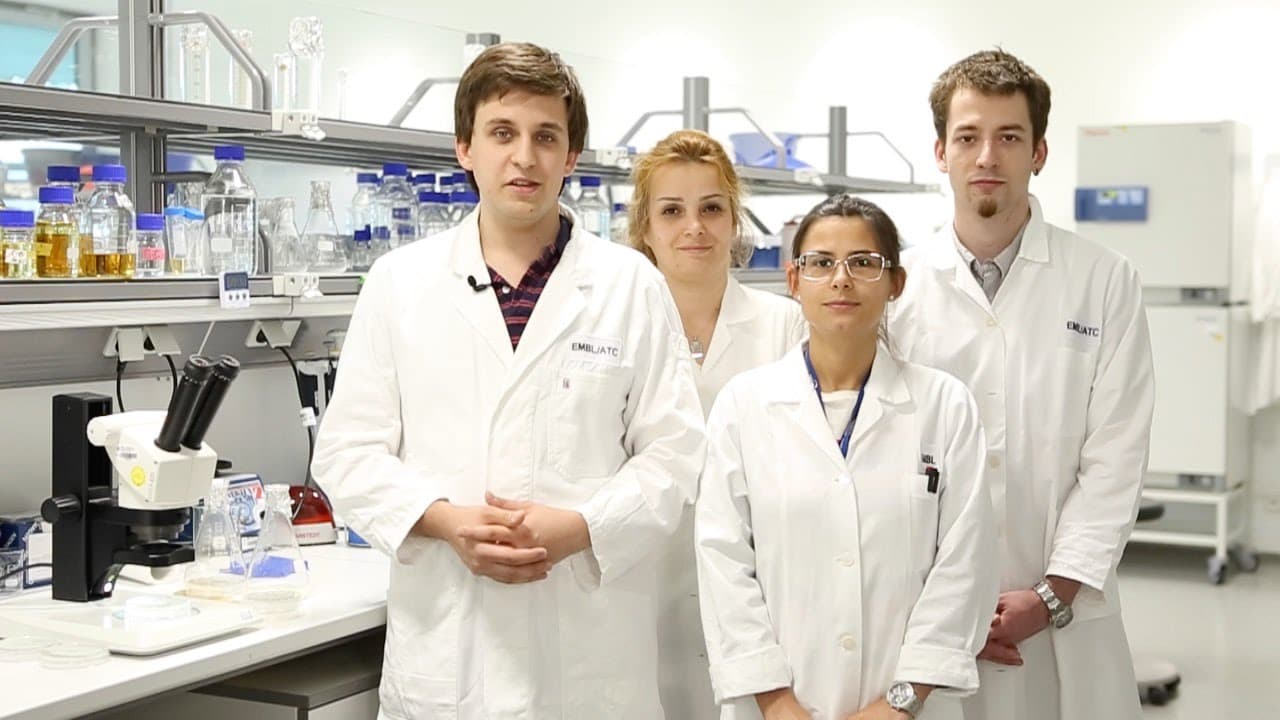
PhD students engineer yeast to produce beta-carotene using synthetic biology.
Transcript
Hello viewers, I am Nicolas, a PhD student from the Max Planck Institute in Marburg. Here, at the EMBL, me and my colleagues Gita, Joana, and Pavel, will give you an insight into synthetic biology for industrial biotechnology. We try to keep it rather practical than theoretical. Synthetic biology provides a lot of tools for metabolic engineering. T... Read More
Key Insights
- Synthetic biology provides tools for metabolic engineering, utilizing mathematical models and model organisms like S. cerevisiae to produce valuable compounds.
- The engineering cycle involves modeling, implementation, analysis, and feedback to improve compound production efficiency.
- S. cerevisiae, or baker's yeast, is a safe, fast-growing model organism used to produce beta-carotenoids, which have high-value applications.
- Modeling metabolic pathways helps balance cell fitness and compound production, using tools like flex balance analysis to optimize metabolite flow.
- DNA amplification involves obtaining genes from synthesis companies, optimizing them for protein production, and verifying sizes through gel electrophoresis.
- Transformation and DNA assembly utilize yeast's transformation-associated recombination to integrate PCR fragments into episomal plasmids.
- The final construct, with genes, promoter cassette, and terminuses, is transformed into yeast cells, leading to visible beta-carotene production.
- Visual analysis shows successful carotene production in engineered yeast, demonstrating the practical application of synthetic biology in metabolic engineering.
Install to Summarize YouTube Videos and Get Transcripts
Explore YouTube Video Summarizer or Get YouTube Transcript Extractor
Questions & Answers
Q: What is the role of mathematical models in synthetic biology?
Mathematical models in synthetic biology serve as a foundational tool for designing metabolic engineering strategies. They help predict the optimal parts and pathways to use, balancing cell fitness with compound production. By simulating metabolic networks, models guide the engineering process, allowing researchers to make informed decisions on gene modifications and pathway optimizations.
Q: Why is S. cerevisiae chosen for beta-carotene production?
S. cerevisiae, commonly known as baker's yeast, is chosen for beta-carotene production due to its safety, ease of manipulation, and fast growth. It is a well-established model organism in synthetic biology, with a wealth of genetic tools available. Its ability to be engineered for producing high-value compounds like beta-carotenoids makes it an ideal candidate for industrial biotechnology applications.
Q: How does flex balance analysis aid in metabolic engineering?
Flex balance analysis aids metabolic engineering by optimizing the flow of metabolites within a cell's network. It helps identify which genes to knock out or overexpress to enhance compound production. By analyzing the metabolic fluxes, researchers can fine-tune pathways to achieve the desired balance between cell growth and product yield, streamlining the engineering process.
Q: What is the significance of DNA amplification in this project?
DNA amplification is crucial for obtaining the necessary genetic components for engineering yeast. By amplifying genes optimized for protein production, along with plasmid backbones and promoter regions, researchers prepare the essential building blocks for DNA assembly. This step ensures that the engineered yeast can efficiently produce beta-carotene, demonstrating the importance of precise genetic preparation.
Q: How is DNA assembly achieved in yeast cells?
DNA assembly in yeast cells is achieved using transformation-associated recombination, leveraging yeast's natural ability to recombine DNA fragments. Researchers introduce PCR fragments with homologous regions into competent yeast cells, facilitating the assembly into episomal plasmids. This method allows for the integration of the desired genetic construct, enabling the production of beta-carotene in the engineered yeast.
Q: What challenges are associated with metabolic pathway engineering?
Metabolic pathway engineering faces challenges due to the interconnected nature of metabolic networks. Alterations in one pathway can impact others, requiring careful planning and modeling to achieve the desired outcomes. Balancing cell fitness with product yield is complex, necessitating tools like flex balance analysis to optimize metabolite flow and ensure efficient compound production.
Q: What visual evidence indicates successful beta-carotene production?
Successful beta-carotene production is visually indicated by the bright orange color of the engineered yeast colonies. In the experiment, a negative control showed no color change, confirming the absence of carotene production. In contrast, the engineered yeast with the heterologous pathway displayed a clear orange hue, signifying the successful synthesis of beta-carotene.
Q: What are the potential applications of beta-carotenoids produced through synthetic biology?
Beta-carotenoids produced through synthetic biology have potential applications in various industries due to their high value. They are used in food and beverage as natural colorants, in cosmetics for their antioxidant properties, and in pharmaceuticals for health benefits. The ability to produce these compounds efficiently using engineered microorganisms opens new avenues for sustainable and cost-effective production.
Summary & Key Takeaways
-
PhD students from various institutions demonstrate the use of synthetic biology to engineer yeast for beta-carotene production. They detail the process from modeling metabolic pathways to DNA amplification, assembly, and analysis, highlighting the practical applications of synthetic biology in industrial biotechnology.
-
The process begins with mathematical modeling to determine the necessary genetic modifications, followed by DNA amplification and assembly to create a construct for beta-carotene production. The engineered yeast demonstrates successful carotene production, showcasing synthetic biology's potential in producing high-value chemicals.
-
Key steps include using S. cerevisiae as a model organism, optimizing gene sequences for protein production, and employing yeast's transformation-associated recombination for DNA assembly. The project illustrates the collaborative effort of PhD students in advancing metabolic engineering through synthetic biology.
Read in Other Languages (beta)
Share This Summary 📚
Summarize YouTube Videos and Get Video Transcripts with 1-Click
Try YouTube Summary with ChatGPT & Claude or YouTube Transcript Generator
Explore More Summaries from iBiology Techniques 📚
Summarize YouTube Videos and Get Video Transcripts with 1-Click
Try YouTube Summary with ChatGPT & Claude or YouTube Transcript Generator