How To Graph Polar Equations
TL;DR
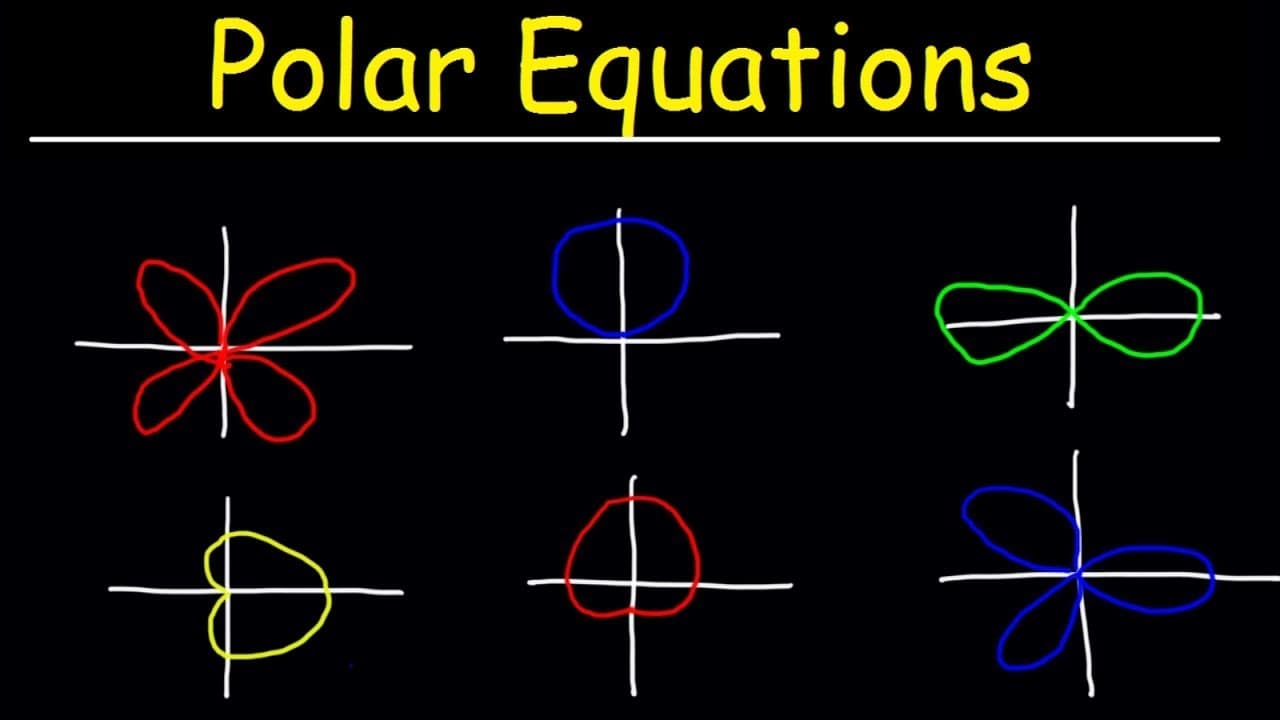
Learn how to graph polar equations, including circles, limaçons, rose curves, and lemniscates.
Transcript
in this video we're going to talk about how to graph polar equations these include circles limassons rose curves and laminas gates so let's start with a circle the first equation you may see is r is equal to a cosine theta now if a is positive this is going to be a circle directed towards the right now granted my circle is not perfect so bear with ... Read More
Key Insights
- 😮 Polar equations can represent a variety of shapes, including circles, limaçons, rose curves, and lemniscates.
- 🤘 The orientation and characteristics of a graph can be determined by the signs and values of the coefficients in the polar equation.
- 💁 Circles in polar form are centered at (a/2, 0) and have a diameter equal to a.
- 🍽️ Limaçons can have different shapes depending on the value of a/b. They can have inner loops, dimples, or resemble circles.
- 🥰 The cardioid, a special type of limaçon, has a heart-shaped graph with a dimple at the center.
- 👨💼 Lemniscates are figure-eight or infinity-shaped graphs that can be created by using equations with sine or cosine terms multiplied by a constant.
- 🐻❄️ The values of a and b in polar equations determine the size and shape of the graph.
Install to Summarize YouTube Videos and Get Transcripts
Explore YouTube Video Summarizer or Get YouTube Transcript Extractor
Questions & Answers
Q: How do you graph a circle using a polar equation?
To graph a circle, the equation is r = a * cos(theta) or r = a * sin(theta), depending on the orientation. The value of a determines the diameter, and the center is at (a/2, 0) for circles oriented towards the right.
Q: How do you graph a limaçon with an inner loop?
For a limaçon with an inner loop, the equation is r = a + b * sin(theta). If the cosine term is positive, the graph opens towards the positive y-axis. The x-intercepts can be found by evaluating a - b, and the y-intercepts are at a.
Q: How do you graph a cardioid?
The equation for a cardioid is r = a + b * cos(theta). The graph resembles a heart shape with a dimple. The x-intercepts are at a + b, and the y-intercepts are at a.
Q: How do you graph a lemniscate?
Lemniscates can be graphed using equations such as r = a * sin(2theta) or r = a * cos(2theta). The shape resembles a figure-eight or infinity symbol. The value of a determines the size of the lemniscate.
Summary & Key Takeaways
-
Polar equations can represent various shapes, such as circles, limaçons, rose curves, and lemniscates.
-
For circles, the equation is r = a * cos(theta) or r = a * sin(theta), depending on the orientation.
-
Limaçons can have inner loops and dimples, depending on the values of a and b.
-
The heart-shaped limaçon, also known as the cardioid, is a special type of limaçon.
Read in Other Languages (beta)
Share This Summary 📚
Summarize YouTube Videos and Get Video Transcripts with 1-Click
Try YouTube Summary with ChatGPT & Claude or YouTube Transcript Generator
Explore More Summaries from The Organic Chemistry Tutor 📚




Summarize YouTube Videos and Get Video Transcripts with 1-Click
Try YouTube Summary with ChatGPT & Claude or YouTube Transcript Generator