Complex roots of the characteristic equations 2 | Second order differential equations | Khan Academy
TL;DR
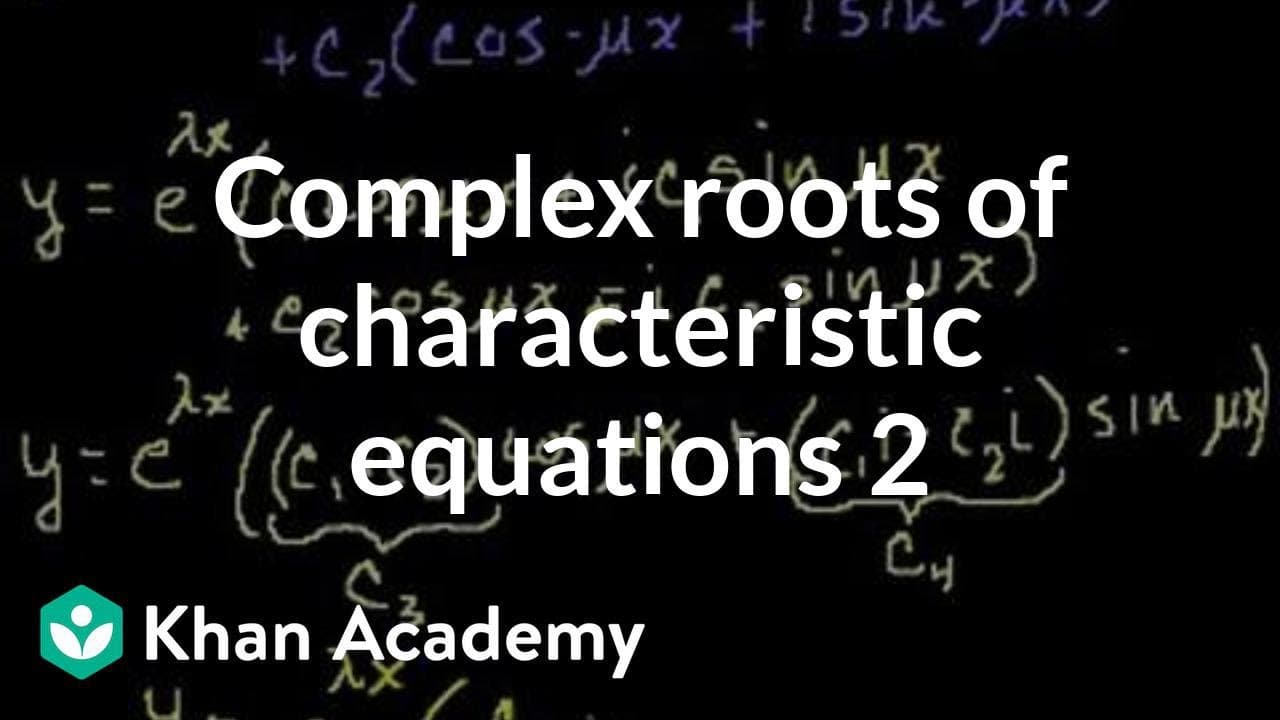
When solving equations with complex roots, the general solution involves exponential terms, cosine, and sine functions.
Transcript
So where we left off, I had given you the question-- these types of equations are fairly straightforward. When we have two real roots, then this is the general solution. And if you have your initial conditions, you can solve for c1 and c2. But the question I'm asking is, what happens when you have two complex roots? Or essentially, when you're tryi... Read More
Key Insights
- 🥺 Equations with complex roots lead to general solutions involving exponential terms and trigonometric functions.
- 🍉 The use of Euler's formula helps simplify the general solution algebraically by expressing complex exponential terms in terms of cosine and sine functions.
- 👶 The arbitrary constants in the general solution can be combined into new constants for convenience.
- 🫚 Understanding the process of simplifying the general solution is crucial for solving differential equations with complex roots.
- 🫚 The general solution for complex roots can be applied to real-world problems and systems that exhibit oscillatory behavior.
- 🫚 The characteristic equation and quadratic formula are used to find the complex roots of the equation.
- 🈸 Careful algebraic manipulation and application of trigonometric identities are required to reach the simplified general solution.
Install to Summarize YouTube Videos and Get Transcripts
Explore YouTube Video Summarizer or Get YouTube Transcript Extractor
Questions & Answers
Q: Why is it important to simplify the general solution for equations with complex roots?
Simplifying the general solution allows for a more concise and easier-to-use form for solving differential equations. It also helps in understanding the behavior of the solution over time.
Q: Can the arbitrary constants c1 and c2 be imaginary numbers?
Yes, the arbitrary constants can be any complex numbers, including imaginary numbers, as they represent the coefficients in the general solution.
Q: How can Euler's formula be used in simplifying the general solution?
Euler's formula, e^ix = cos(x) + i*sin(x), allows for the representation of complex exponential terms as combinations of cosine and sine functions. Substituting this expression into the general solution helps simplify the algebraic manipulation.
Q: Is it necessary to memorize the general solution for equations with complex roots?
While it is not necessary to memorize the general solution, it can be helpful for quick problem-solving during exams. However, it is recommended to derive the solution using the characteristic equation and substitution steps for better understanding.
Summary & Key Takeaways
-
Complex roots in a characteristic equation lead to a general solution that includes exponential terms and trigonometric functions.
-
By using Euler's formula and simplifying algebraically, the solution can be further simplified to a form with cosine and sine functions.
-
The arbitrary constants, c1 and c2, can be combined into a new constant, c3.
-
The general solution to the differential equation with complex roots is y = e^λx * c3 * cosine(μx) + c4 * sine(μx).
Read in Other Languages (beta)
Share This Summary 📚
Summarize YouTube Videos and Get Video Transcripts with 1-Click
Try YouTube Summary with ChatGPT & Claude or YouTube Transcript Generator
Explore More Summaries from Khan Academy 📚




Summarize YouTube Videos and Get Video Transcripts with 1-Click
Try YouTube Summary with ChatGPT & Claude or YouTube Transcript Generator