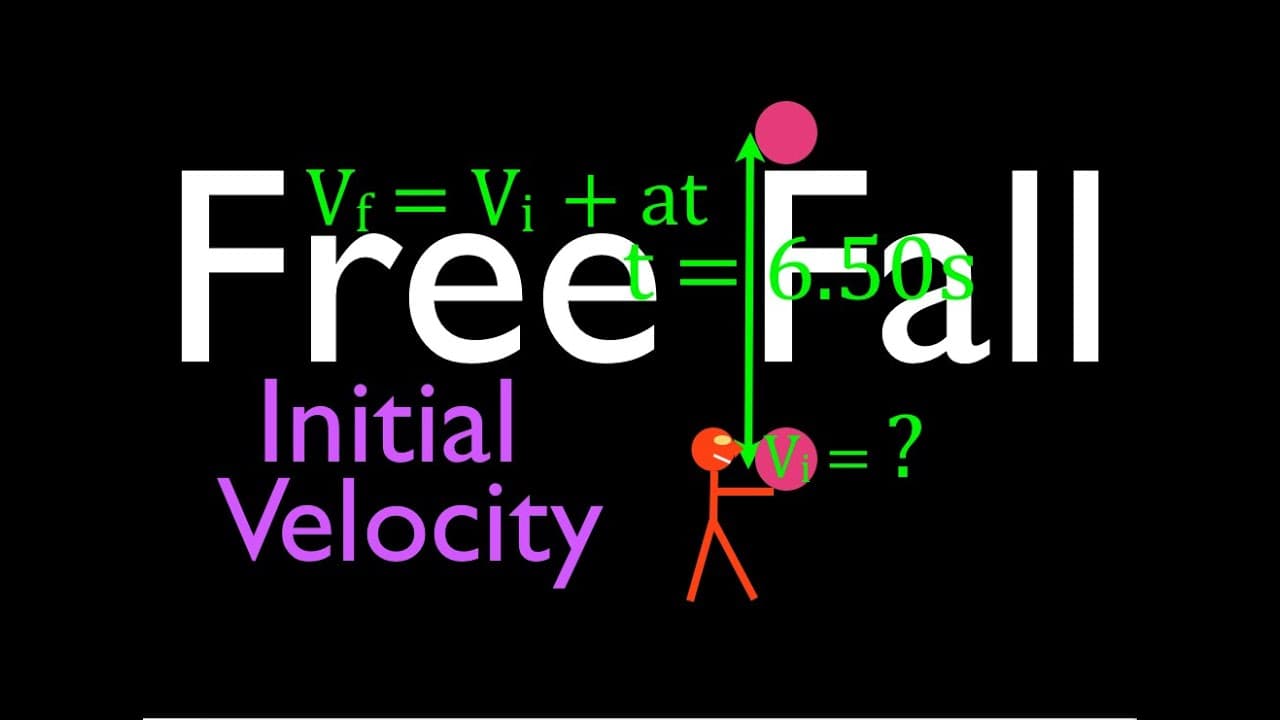
Physics, Kinematics, Free Fall (7 of 12) Initial Velocity for Known Time in the Air
TL;DR
Determine initial velocity for 6.5 seconds of total time in freefall.
Transcript
okay in this video we're going to go over another problem involving freefall kinematics and in this problem we want to know what is the initial velocity needed to achieve a certain amount of total time up and down into the air in this case 6.5 seconds and we want to know what initial glass is needed for that time of flight so our problem says an ar... Read More
Key Insights
- ❓ Kinematic equations are essential for solving problems involving freefall motion.
- 📈 Considering specific aspects of the motion, like only the upward path, can simplify calculations.
- ⌛ Understanding the relationships between variables like time, acceleration, and velocity is crucial for accurate solutions.
- ❓ The initial velocity for freefall can be determined through a systematic approach using physics principles.
- 🥺 Utilizing known information and manipulating equations can lead to calculating the required initial velocity accurately.
- 🤩 Attention to detail in selecting the right variables and equations is key to solving complex freefall kinematics problems.
- ⌛ Substituting values into equations with precision helps derive the initial velocity needed for specific time constraints.
Install to Summarize YouTube Videos and Get Transcripts
Explore YouTube Video Summarizer or Get YouTube Transcript Extractor
Questions & Answers
Q: How can we calculate the initial velocity needed for an arrow to reach the same position in 6.5 seconds?
By using kinematic equations and known variables like time and acceleration, we can determine the initial velocity required for the arrow to achieve this time in freefall.
Q: Why is it important to consider only the upward path of the arrow in the calculations?
By focusing solely on the upward motion of the arrow, we simplify the problem and can accurately calculate the initial velocity needed for the desired time of 6.5 seconds.
Q: How do we handle variables like change in position and final velocity in the calculation of initial velocity?
Since the final velocity at the top of the arrow's path is zero and we only consider the upward portion, we can selectively use kinematic equations to solve for the initial velocity.
Q: What steps are involved in solving for the initial velocity in freefall kinematics?
We identify known variables, rearrange kinematic equations, and utilize the formula that incorporates acceleration, time, and final velocity to calculate the initial velocity needed.
Summary & Key Takeaways
-
Problem involves finding initial velocity for an arrow shot upward to reach same position in 6.5 seconds.
-
Utilize kinematic equations with known variables like time and acceleration to solve for initial velocity.
-
Simplify problem by considering only the upward path of the arrow for calculations.
Read in Other Languages (beta)
Share This Summary 📚
Summarize YouTube Videos and Get Video Transcripts with 1-Click
Try YouTube Summary with ChatGPT & Claude or YouTube Transcript Generator
Explore More Summaries from Step by Step Science 📚

Summarize YouTube Videos and Get Video Transcripts with 1-Click
Try YouTube Summary with ChatGPT & Claude or YouTube Transcript Generator