How Do Semiconductors Enable Solar Energy?
TL;DR
Semiconductors, primarily silicon, are crucial in modern electronics, enabling the creation of diodes, transistors, and solar cells. By doping silicon with elements like phosphorus and boron, P-type and N-type semiconductors are formed, which can control and direct electrical current. This technology is essential for converting light into electricity in solar cells, providing a clean energy source.
Transcript
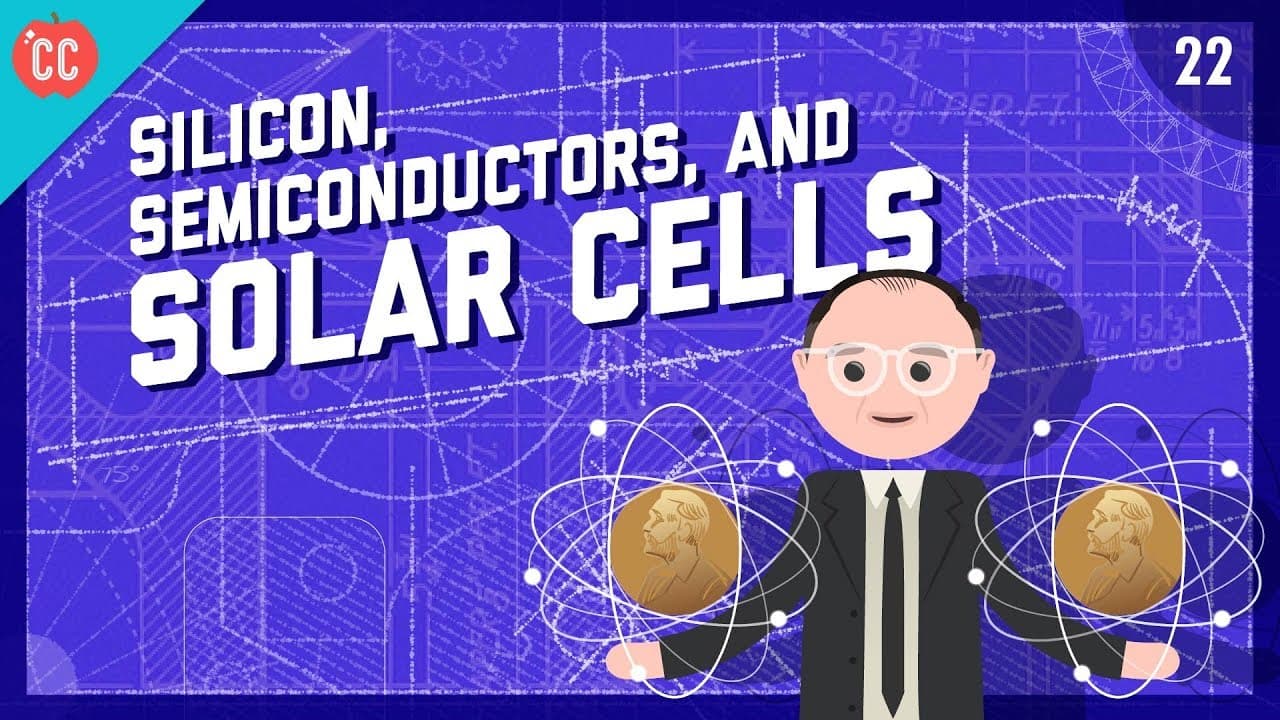
Sometimes, in the history of engineering, physicists make their way into the story. Consider, for example: John Bardeen. You might not have heard of him, but Bardeen is the only person in all of history to win the Nobel Prize in Physics twice. He shared the prize once in 1956 and again in 1972. Both times, he was involved in discoveries that made c... Read More
Key Insights
- John Bardeen is the only person to win the Nobel Prize in Physics twice for advancements in electrical engineering.
- Silicon is a widely used semiconductor that can be altered on an atomic level to conduct electricity.
- N-type semiconductors are created by adding phosphorus to silicon, introducing free electrons, or negative charges.
- P-type semiconductors result from adding boron to silicon, creating holes that act as positive charges.
- Combining P-type and N-type semiconductors forms a diode, allowing current to flow in only one direction.
- Transistors, made from semiconductor layers, act as electrical switches, controlling larger currents with smaller ones.
- Solar cells use semiconductors to convert light into electricity, utilizing the energy absorbed by electrons.
- Semiconductors are pivotal in modern technology, forming the basis of computer chips and renewable energy solutions.
Install to Summarize YouTube Videos and Get Transcripts
Explore YouTube Video Summarizer or Get YouTube Transcript Extractor
Questions & Answers
Q: How do semiconductors work in solar cells?
Semiconductors in solar cells generate electricity by converting light into electrical energy. When light strikes the semiconductor material, it energizes electrons, freeing them from atoms. These electrons then flow through the material, creating an electric current. This process, facilitated by the electric field in the semiconductor, enables solar cells to power devices using sunlight.
Q: What is the role of silicon in semiconductors?
Silicon is a key material in semiconductors due to its ability to be doped with other elements, altering its electrical properties. By introducing elements like phosphorus or boron, silicon becomes either an N-type or P-type semiconductor, which can conduct electricity. This property makes silicon essential in creating electronic components like diodes and transistors.
Q: How do P-type and N-type semiconductors differ?
P-type and N-type semiconductors differ in their charge carriers. N-type semiconductors, created by adding phosphorus to silicon, have an abundance of free electrons, which are negative charge carriers. P-type semiconductors, formed by adding boron, have an abundance of holes, which act as positive charge carriers. Together, they form components like diodes and transistors.
Q: What is the function of a diode in electronics?
A diode, formed by combining P-type and N-type semiconductors, functions as a one-way valve for electrical current. It allows current to flow in one direction while blocking it in the opposite direction. This property is critical for converting alternating current (AC) to direct current (DC) and for protecting circuits from reverse voltage.
Q: How do transistors control electrical current?
Transistors control electrical current by using a small input current to regulate a larger output current, acting as an electronic switch or amplifier. Made from semiconductor layers, transistors can switch currents on and off, forming the basis of binary logic in computers. This ability to control current flow is fundamental to modern electronic devices.
Q: Why are semiconductors important in computing?
Semiconductors are vital in computing because they enable the creation of transistors, the building blocks of computer chips. Transistors use semiconductor properties to switch and amplify electrical signals, allowing computers to perform calculations and process data. This capability underpins the binary system of 1s and 0s that computers use to operate.
Q: What advancements did John Bardeen contribute to semiconductors?
John Bardeen significantly advanced semiconductors by co-inventing the transistor, a fundamental component in modern electronics. His work earned him two Nobel Prizes in Physics, the first for the transistor and the second for his theory of superconductivity. Bardeen's contributions revolutionized electrical engineering and paved the way for the development of modern computing technology.
Q: How do solar panels use semiconductors to generate power?
Solar panels use semiconductors to generate power by converting sunlight into electricity. When light hits the semiconductor material in a solar cell, it energizes electrons, freeing them to move and create an electric current. This current flows through the circuit, providing electrical power. The efficiency of this process makes solar panels a key technology in renewable energy.
Summary & Key Takeaways
-
Semiconductors, especially silicon, are integral to modern electronics. By doping silicon with elements like phosphorus and boron, P-type and N-type semiconductors are formed, enabling the creation of diodes and transistors. These components control electrical currents and are essential in devices like solar cells, which convert light into electricity.
-
Transistors, made from semiconductor layers, act as switches, allowing small currents to control larger ones. This capability forms the foundation of the binary system in computing. Meanwhile, diodes, another semiconductor component, ensure current flows in one direction, crucial for converting AC to DC currents.
-
Solar cells utilize semiconductors to generate electricity from light. When light hits the semiconductor, it energizes electrons, creating a flow of electricity. This process is fundamental in solar panels, providing a clean, renewable energy source by harnessing sunlight.
Read in Other Languages (beta)
Share This Summary 📚
Summarize YouTube Videos and Get Video Transcripts with 1-Click
Try YouTube Summary with ChatGPT & Claude or YouTube Transcript Generator
Explore More Summaries from CrashCourse 📚




Summarize YouTube Videos and Get Video Transcripts with 1-Click
Try YouTube Summary with ChatGPT & Claude or YouTube Transcript Generator