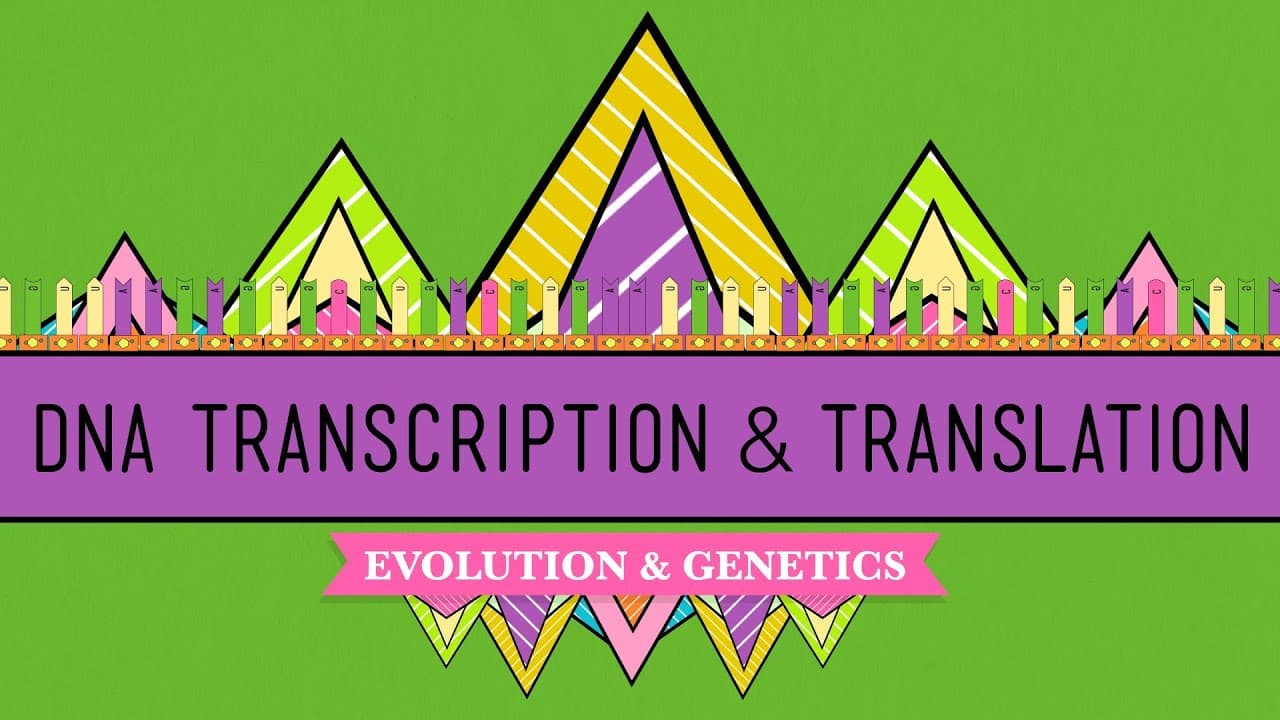
DNA, Hot Pockets, & The Longest Word Ever: Crash Course Biology #11
TL;DR
The video explains DNA transcription and translation processes in protein synthesis.
Transcript
Ok, roll it. You know what this is? It is the longest word in the world. Like, anywhere, in any language, ever. More than 189,000 letters. If you were to write it down, though I don't know why you would, it'd fill up more than 100 pages! And if you could actually say it without, like, breaking your face, it'd take about FIVE hours! So what the fric... Read More
Key Insights
- The longest word in the world is the name of a protein called Titin, which is crucial for muscle elasticity.
- DNA transcription and translation are key processes in protein synthesis, using DNA and RNA to create proteins.
- DNA transcription occurs in the cell nucleus, where DNA is copied onto RNA, specifically mRNA, through the action of RNA polymerase.
- RNA splicing involves removing non-coding regions (introns) from mRNA, leaving only the coding regions (exons) for protein synthesis.
- Translation is the process by which mRNA is decoded by ribosomes to produce a specific polypeptide, forming proteins.
- The structure of proteins is determined by the sequence of amino acids, which fold into specific shapes to perform various functions.
- Proteins have four levels of structure: primary, secondary, tertiary, and quaternary, each contributing to their function.
- The video uses the analogy of making Hot Pockets to explain the complexity of DNA transcription and translation processes.
Install to Summarize YouTube Videos and Get Transcripts
Explore YouTube Video Summarizer or Get YouTube Transcript Extractor
Questions & Answers
Q: What is the longest word in the world mentioned in the video?
The longest word mentioned in the video is the name of a protein called Titin. It has more than 189,000 letters and would take about five hours to pronounce. Titin is a protein that contributes to the elasticity and springiness of muscles.
Q: What role does RNA polymerase play in transcription?
RNA polymerase is an enzyme that binds to DNA at the promoter region, specifically the TATA box, to start the transcription process. It unzips the DNA double helix and synthesizes a complementary strand of mRNA by reading the DNA sequence and matching RNA nucleotides to the DNA template.
Q: What is RNA splicing and why is it important?
RNA splicing is the process of removing non-coding regions, called introns, from the pre-mRNA transcript, leaving only the coding regions, known as exons. This process is essential for creating a mature mRNA molecule that can be translated into a functional protein. It ensures that only the necessary genetic information is expressed.
Q: How does translation occur in the ribosome?
Translation occurs in the ribosome, where mRNA is decoded to synthesize proteins. The ribosome reads the mRNA sequence in sets of three nucleotides, called codons. Transfer RNA (tRNA) molecules with complementary anticodons bring specific amino acids to the ribosome, where they are joined together to form a polypeptide chain, eventually folding into a protein.
Q: What are the four levels of protein structure?
Proteins have four levels of structure: primary, secondary, tertiary, and quaternary. The primary structure is the sequence of amino acids in a polypeptide chain. The secondary structure involves local folding into alpha-helices and beta-pleated sheets. The tertiary structure is the overall 3D shape of a single polypeptide, and the quaternary structure involves the arrangement of multiple polypeptides in a protein complex.
Q: Why is the analogy of making Hot Pockets used in the video?
The analogy of making Hot Pockets is used to simplify and explain the complex processes of DNA transcription and translation. It illustrates how genetic instructions are copied, processed, and used to synthesize proteins, similar to following a recipe to make a product. This analogy helps viewers understand the intricate steps involved in protein synthesis.
Q: What is the significance of the TATA box in transcription?
The TATA box is a DNA sequence found in the promoter region of genes, crucial for initiating transcription. It serves as a binding site for RNA polymerase and other transcription factors, marking the start of a gene. The TATA box helps position the RNA polymerase correctly, ensuring accurate transcription of the gene into mRNA.
Q: How do amino acids determine protein function?
Amino acids determine protein function through their sequence and chemical properties. The sequence of amino acids, known as the primary structure, dictates how the protein will fold into its final 3D shape, which is critical for its function. The chemical properties of amino acids, such as hydrophobicity and charge, influence interactions within the protein and with other molecules, affecting its activity and role in biological processes.
Summary & Key Takeaways
-
The video discusses the processes of DNA transcription and translation, using the analogy of making Hot Pockets to explain how proteins are synthesized in cells. It covers the roles of mRNA, tRNA, and rRNA in translating genetic information into proteins.
-
Key components of protein synthesis, such as the TATA box, RNA polymerase, and ribosomes, are explained. The video highlights the complexity and precision of these biological processes, which involve transcription, RNA splicing, and translation.
-
The structure of proteins, including primary, secondary, tertiary, and quaternary structures, is examined. The video emphasizes the importance of protein folding and the role of amino acids in determining protein function and structure.
Read in Other Languages (beta)
Share This Summary 📚
Summarize YouTube Videos and Get Video Transcripts with 1-Click
Try YouTube Summary with ChatGPT & Claude or YouTube Transcript Generator
Explore More Summaries from CrashCourse 📚


Summarize YouTube Videos and Get Video Transcripts with 1-Click
Try YouTube Summary with ChatGPT & Claude or YouTube Transcript Generator