How Do T-Cells Learn in the Thymus?
TL;DR
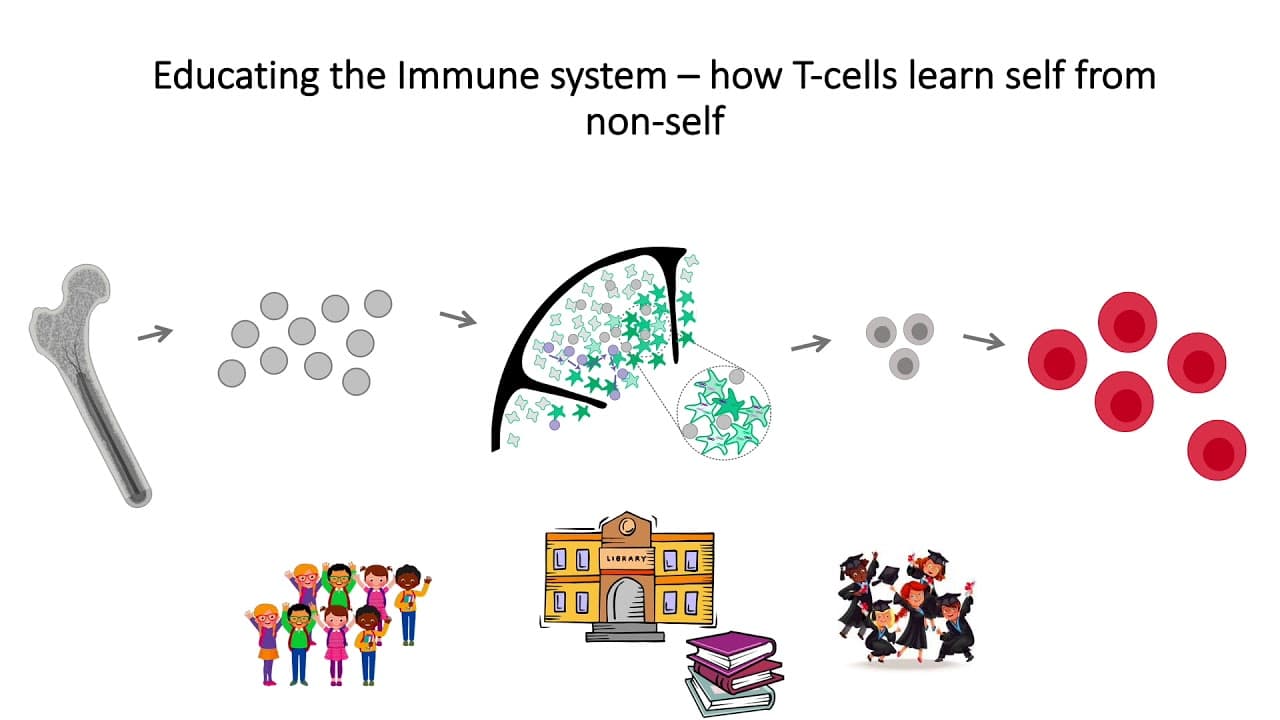
T-cells are educated in the thymus, where they learn to differentiate between healthy body cells and foreign pathogens. This education process involves interactions with thymus cells, which help T-cells recognize various proteins. Understanding these mechanisms can provide insights into autoimmune diseases and improve treatment strategies.
Transcript
Hi yeah as I've just been I've introduced I have actually just started it's been only three months and I use both computational mathematics and a little bit of biology to understand how we educate our immune system and while I don't expect all of you to know how the new system works in detail I'm sure most of you have heard about instances where th... Read More
Key Insights
- T-cells are a crucial component of the immune system, responsible for identifying and attacking foreign pathogens.
- The thymus is an organ where T-cells undergo education to learn the difference between self and non-self proteins.
- During their education, T-cells interact with thymus cells that present a variety of body proteins.
- The thymus can be likened to a library where T-cells learn the 'words' or proteins present in the body.
- T-cell education is most active in young individuals, as the thymus becomes less active with age.
- Mathematical models and simulations are used to study T-cell behavior and interactions in the thymus.
- Understanding T-cell education can lead to insights into autoimmune diseases and potential therapeutic approaches.
- Research involves both computational models and experimental work using mouse models to study T-cell migration and interaction patterns.
Install to Summarize YouTube Videos and Get Transcripts
Explore YouTube Video Summarizer or Get YouTube Transcript Extractor
Questions & Answers
Q: How do T-cells learn to differentiate between self and non-self proteins?
T-cells learn to differentiate between self and non-self proteins in the thymus, an organ where they interact with thymus cells that present various body proteins. This interaction helps T-cells recognize self-proteins and avoid attacking them. The process is akin to learning a language, where T-cells are exposed to the 'words' or proteins of the body, allowing them to identify foreign invaders effectively.
Q: Why is the thymus important for the immune system?
The thymus is crucial for the immune system because it is where T-cells undergo their education. This organ teaches T-cells to recognize self-proteins and differentiate them from foreign pathogens. A well-functioning thymus ensures that T-cells do not mistakenly attack the body's own cells, preventing autoimmune diseases and maintaining immune system balance.
Q: What role do thymus cells play in T-cell education?
Thymus cells play a vital role in T-cell education by presenting a diverse array of body proteins to developing T-cells. These interactions allow T-cells to learn which proteins are part of the body and which are foreign, ensuring that they do not attack self-cells. This process is essential for developing a properly functioning immune system capable of distinguishing self from non-self.
Q: How does the thymus change with age?
The thymus is most active during childhood and adolescence, playing a significant role in T-cell education during these periods. As individuals age, the thymus gradually becomes less active and shrinks, reducing its capacity to educate new T-cells. This decrease in thymic activity can affect the immune system's ability to respond to new infections and may contribute to age-related immune decline.
Q: How do researchers study T-cell education in the thymus?
Researchers study T-cell education in the thymus using a combination of mathematical models, simulations, and experimental work. Computational models help simulate T-cell interactions and migration patterns, while experimental work in mouse models provides insights into the physical processes involved. This integrated approach allows scientists to understand how T-cells learn to distinguish between self and non-self proteins.
Q: What insights can T-cell education provide into autoimmune diseases?
Understanding T-cell education can provide valuable insights into autoimmune diseases by identifying where the process goes wrong. Autoimmune diseases occur when T-cells mistakenly attack the body's own cells. By studying how T-cells learn to differentiate between self and non-self in the thymus, researchers can pinpoint potential failures in this education process, leading to improved diagnostic and therapeutic strategies for autoimmune conditions.
Q: What is the significance of using mathematical models in T-cell research?
Mathematical models are significant in T-cell research because they allow scientists to simulate and analyze complex interactions within the thymus. These models help researchers understand how T-cells migrate, interact with thymus cells, and learn to recognize proteins. By providing a theoretical framework, mathematical models can generate hypotheses that guide experimental research and lead to a deeper understanding of T-cell education and immune function.
Q: How does T-cell education impact immune system function?
T-cell education impacts immune system function by ensuring that T-cells can accurately identify and target foreign pathogens without attacking the body's own cells. This education process, which occurs in the thymus, is essential for maintaining immune balance and preventing autoimmune diseases. Properly educated T-cells contribute to a robust immune response, protecting the body from infections while avoiding damage to self-tissues.
Summary & Key Takeaways
-
T-cells, a type of immune cell, are educated in the thymus, where they learn to distinguish between healthy body cells and foreign invaders. This education involves interactions with thymus cells that present various proteins, allowing T-cells to recognize self-proteins and avoid attacking them. Understanding this process is crucial for insights into autoimmune diseases.
-
The thymus acts as a 'library' where T-cells learn the 'words' or proteins of the body. This education is most active in younger individuals, as the thymus becomes less active with age. Mathematical models and simulations help researchers understand T-cell behavior and interactions within the thymus.
-
Research combines computational and experimental approaches to study T-cell education. By understanding healthy T-cell education, scientists aim to identify where the process goes wrong in autoimmune diseases, potentially leading to improved treatment strategies.
Read in Other Languages (beta)
Share This Summary 📚
Summarize YouTube Videos and Get Video Transcripts with 1-Click
Try YouTube Summary with ChatGPT & Claude or YouTube Transcript Generator
Explore More Summaries from Cold Spring Harbor Laboratory 📚
Summarize YouTube Videos and Get Video Transcripts with 1-Click
Try YouTube Summary with ChatGPT & Claude or YouTube Transcript Generator