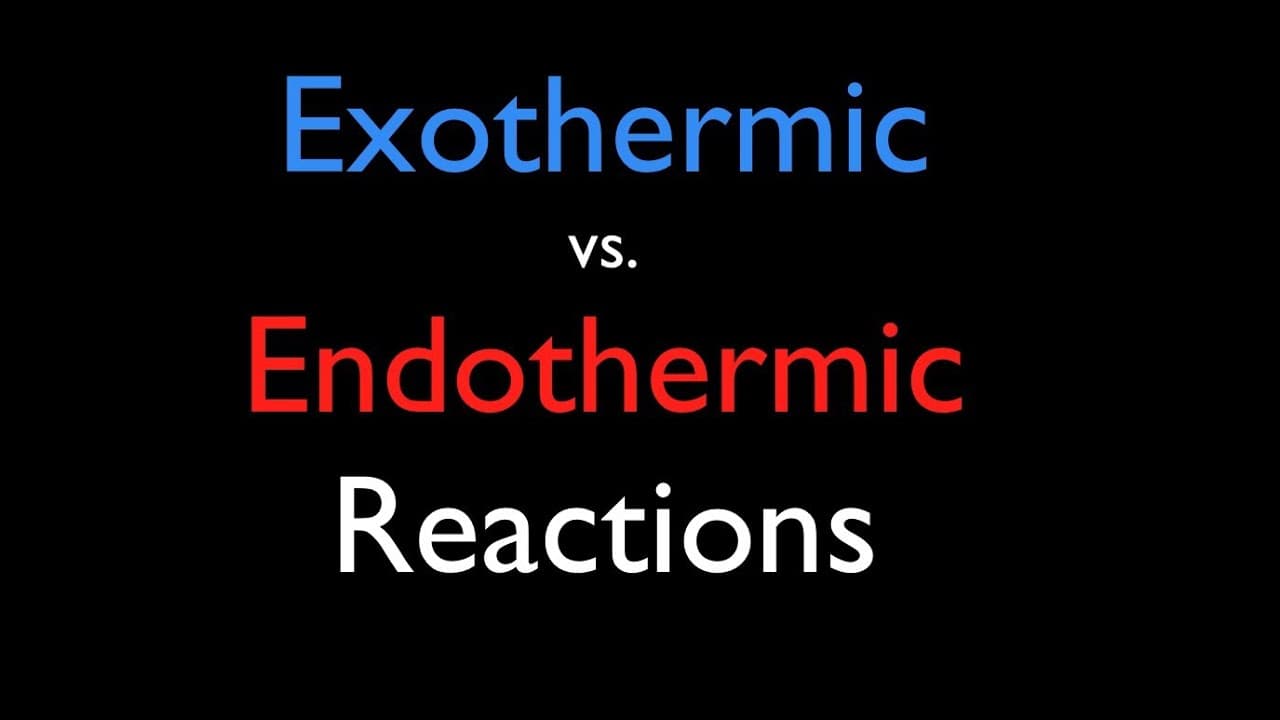
Exothermic vs. Endothermic Reactions
TL;DR
Energy, enthalpy, and heat play key roles in exothermic and endothermic reactions where one releases heat and the other absorbs it.
Transcript
okay in today's video I am going to go through the difference between exothermic and endothermic reactions and before that I do that I'd like to go through a couple of the important terms I think should be familiar with first one is energy energy is the ability to do work you can think about it if you're going to do some work you're going to need s... Read More
Key Insights
- 🥵 Energy, enthalpy, and heat are fundamental concepts in chemistry.
- 🥵 Exothermic reactions release heat and feel hot, while endothermic reactions absorb heat and feel cold.
- 💱 The change in energy (ΔQ) is negative for exothermic reactions and positive for endothermic reactions.
- 😘 Products in exothermic reactions have lower energy than reactants, while in endothermic reactions, they have higher energy.
- ❓ Energy diagrams illustrate the differences between exothermic and endothermic reactions.
- 💐 High temperature to low temperature is the direction of heat flow.
- 📈 James Prescott Joule's name is associated with the metric unit Joule.
Install to Summarize YouTube Videos and Get Transcripts
Explore YouTube Video Summarizer or Get YouTube Transcript Extractor
Questions & Answers
Q: What are the key terms related to energy in chemistry?
Energy, enthalpy, and heat are vital terms, with energy being the ability to do work, enthalpy measuring total energy, and heat being the transfer of energy.
Q: How can one differentiate between exothermic and endothermic reactions?
Exothermic reactions release heat, feeling hot, and have a negative change in energy (ΔQ), while endothermic reactions absorb heat, feeling cold, and have a positive ΔQ.
Q: Why do products have less energy in exothermic reactions?
In exothermic reactions, products have less energy than reactants because energy is released during the reaction, leading to a decrease in overall energy.
Q: How does one measure the change in temperature in endothermic reactions?
In endothermic reactions, one can measure the change in temperature using a calorimeter, where the temperature decreases as heat is absorbed by the reaction.
Summary & Key Takeaways
-
Energy, enthalpy, and heat are crucial terms in chemistry, defining the ability to do work and the total energy within a system.
-
Exothermic reactions release heat, making them feel hot, while endothermic reactions absorb heat, making them feel cold.
-
The change in energy (ΔQ) for exothermic reactions is negative as they release energy, while for endothermic reactions, it's positive as they absorb energy.
Read in Other Languages (beta)
Share This Summary 📚
Summarize YouTube Videos and Get Video Transcripts with 1-Click
Try YouTube Summary with ChatGPT & Claude or YouTube Transcript Generator
Explore More Summaries from Step by Step Science 📚

Summarize YouTube Videos and Get Video Transcripts with 1-Click
Try YouTube Summary with ChatGPT & Claude or YouTube Transcript Generator