Products
Features
YouTube Video Summarizer
Summarize YouTube videos
Web & PDF Highlighter
Highlight web pages & PDFs
Chat with PDF
Ask any PDF questions with AI
Ask AI Clone
Chat with your highlights & memories
Audio Transcriber
Transcribe audio files to text
Glasp Reader
Read and highlight articles
Kindle Highlight Export
Export your Kindle highlights
Idea Hatch
Hatch ideas from your highlights
Integrations
Obsidian Plugin
Notion Integration
Pocket Integration
Instapaper Integration
Medium Integration
Readwise Integration
Snipd Integration
Hypothesis Integration
Apps & Extensions
Chrome Extension
Safari Extension
Edge Add-ons
Firefox Add-ons
iOS App
Android App
Discover
Discover
Ideas
Discover new ideas and insights
Articles
Curated articles and insights
Books
Book recommendations by great minds
Posts
Essays and notes from readers
Quotes
Inspiring quotes collection
Videos
Curated videos and summaries
Explore Glasp
Glasp Newsletter
Weekly insights and updates
Glasp Talk
Interview series with great minds
Glasp Blog
Latest news and articles
Glasp Use Cases
Learn how others use Glasp
Build & Support
Glasp API
Access Glasp's API for developers
MCP Connector
Connect Glasp to Claude & ChatGPT
Community
Glasp Reddit Community
Students
Student discount and benefits
FAQs
Frequently Asked Questions
AboutPricing
DashboardLog inSign up

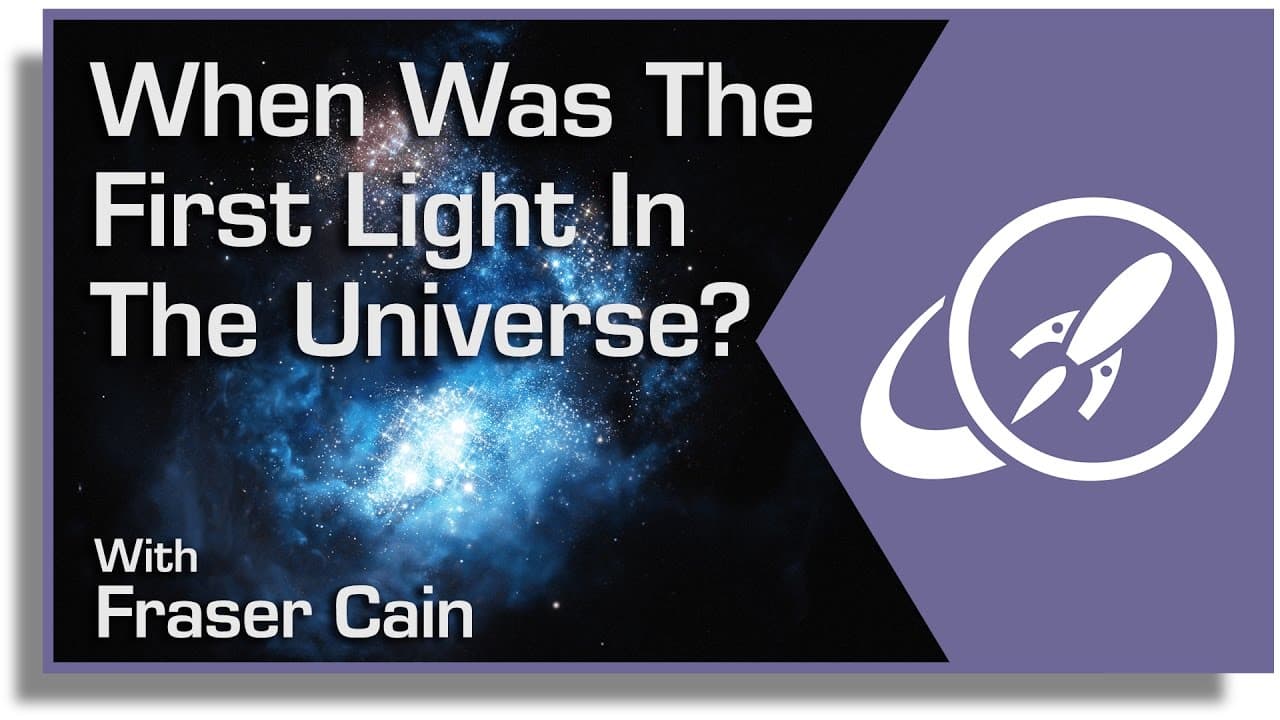
When Was the First Light in the Universe? Seeing As Far Back As Possible
40.2K views
•
November 4, 2016
by
Fraser Cain
YouTube video player
When Was the First Light in the Universe? Seeing As Far Back As Possible

TL;DR

Observing distant objects allows us to look back in time, seeing the Universe's evolution.

Transcript

The speed of light gives us an amazing tool for studying the Universe. Because light only travels a mere 300,000 kilometers per second, when we see distant objects, we’re looking back in time. You’re not seeing the Sun as it is today, you’re seeing an 8 minute old Sun. You’re seeing 642 year-old Betelgeuse. 2.5 million year-old Andromeda. In fact, ... Read More

Key Insights

  • 👻 Observing distant objects allows us to witness the Universe's past.
  • 😅 The Universe began as a hot, dense environment before cooling and expanding.
  • 🖐️ Photons of gamma radiation played a crucial role in the Universe's evolution.
  • 💦 Liquid water may have been present across the Universe, potentially fostering early life.
  • 💋 The era of recombination marked the transition of the Universe to transparency.
  • 🤩 The first stars formed about 560 million years after the Big Bang.
  • 😅 The early Universe was a hot plasma, illuminated by the explosions of massive stars.

Install to Summarize YouTube Videos and Get Transcripts

Explore YouTube Video Summarizer or Get YouTube Transcript Extractor

Questions & Answers

Q: How does the speed of light enable us to look back in time?

Light takes time to reach us from distant objects, allowing us to see events as they were in the past, showing us the evolution of the Universe.

Q: What was the state of the Universe shortly after the Big Bang?

Initially, the Universe was densely packed with particles, resembling the conditions in the core of a star, eventually cooling down to form hydrogen and helium.

Q: How did the first light in the Universe come about?

The era of recombination marked the point when atoms could form and photons could travel freely, turning the Universe from opaque to transparent.

Q: Could life have existed in the early Universe?

The presence of liquid water for a significant period in the early Universe raises the possibility of primitive life forming, known as the habitable Epoch of the Universe.

Summary & Key Takeaways

  • Light travels at a finite speed, allowing us to witness ancient events in the Universe's history.

  • The Universe's beginning was a hot, dense soup of particles before expanding and cooling.

  • The first light in the Universe marked the era of neutral atoms, allowing photons to travel freely.


Read in Other Languages (beta)

English

Share This Summary 📚

Summarize YouTube Videos and Get Video Transcripts with 1-Click

Download browser extensions on:

Try YouTube Summary with ChatGPT & Claude or YouTube Transcript Generator

Explore More Summaries from Fraser Cain 📚
Are We Living in a Simulation? Understanding the Simulation Hypothesis thumbnail
Are We Living in a Simulation? Understanding the Simulation Hypothesis
Fraser Cain
Why Isn't the Asteroid Belt a Planet? thumbnail
Why Isn't the Asteroid Belt a Planet?
Fraser Cain
Why Did Mars Lose Its Atmosphere? And How Can We Get It Back? thumbnail
Why Did Mars Lose Its Atmosphere? And How Can We Get It Back?
Fraser Cain
Exploring Space Lava Tubes: How To Prepare For It thumbnail
Exploring Space Lava Tubes: How To Prepare For It
Fraser Cain / Universe Today Podcast
What's On The Far Side Of The Moon? thumbnail
What's On The Far Side Of The Moon?
Fraser Cain

Summarize YouTube Videos and Get Video Transcripts with 1-Click

Download browser extensions on:

Try YouTube Summary with ChatGPT & Claude or YouTube Transcript Generator

Apps & Extensions

  • Chrome Extension
  • Safari Extension
  • Edge Add-ons
  • Firefox Add-ons
  • iOS App
  • Android App

Key Features

  • YouTube Video Summarizer
  • Web & PDF Summarizer
  • Web & PDF Highlighter
  • Chat with PDF
  • Ask AI Clone
  • Audio Transcriber
  • Glasp Reader
  • Kindle Highlight Export
  • Idea Hatch

Integrations

  • Obsidian Plugin
  • Notion Integration
  • Pocket Integration
  • Instapaper Integration
  • Medium Integration
  • Readwise Integration
  • Snipd Integration
  • Hypothesis Integration

More Features

  • APIs
  • MCP Connector
  • Blog & Post
  • Embed Links
  • Image Highlight
  • Personality Test
  • Quote Shots

Company

  • About us
  • Blog
  • Community
  • FAQs
  • Job Board
  • Newsletter
  • Pricing
Terms

•

Privacy

•

Guidelines

© 2026 Glasp Inc. All rights reserved.