Products
Features
YouTube Video Summarizer
Summarize YouTube videos
Web & PDF Highlighter
Highlight web pages & PDFs
Chat with PDF
Ask any PDF questions with AI
Ask AI Clone
Chat with your highlights & memories
Audio Transcriber
Transcribe audio files to text
Glasp Reader
Read and highlight articles
Kindle Highlight Export
Export your Kindle highlights
Idea Hatch
Hatch ideas from your highlights
Integrations
Obsidian Plugin
Notion Integration
Pocket Integration
Instapaper Integration
Medium Integration
Readwise Integration
Snipd Integration
Hypothesis Integration
Apps & Extensions
Chrome Extension
Safari Extension
Edge Add-ons
Firefox Add-ons
iOS App
Android App
Discover
Discover
Ideas
Discover new ideas and insights
Articles
Curated articles and insights
Books
Book recommendations by great minds
Posts
Essays and notes from readers
Quotes
Inspiring quotes collection
Videos
Curated videos and summaries
Explore Glasp
Glasp Newsletter
Weekly insights and updates
Glasp Talk
Interview series with great minds
Glasp Blog
Latest news and articles
Glasp Use Cases
Learn how others use Glasp
Build & Support
Glasp API
Access Glasp's API for developers
MCP Connector
Connect Glasp to Claude & ChatGPT
Community
Glasp Reddit Community
Students
Student discount and benefits
FAQs
Frequently Asked Questions
AboutPricing
DashboardLog inSign up

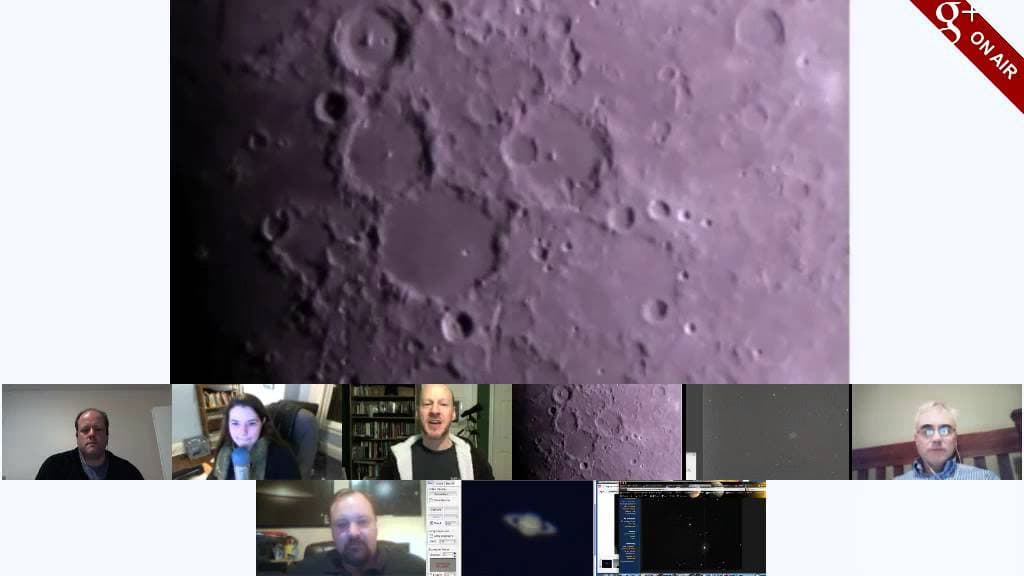
Virtual Star Party - Jan. 31, 2012
2.1K views
•
January 31, 2012
by
Fraser Cain
YouTube video player
Virtual Star Party - Jan. 31, 2012

TL;DR

Astronomers gather virtually to view the Moon, planets, and nebulas through telescopes in real-time.

Transcript

I am going to be starting up the virtual star party in a second just waiting for Gary ganella and uh Roy are going to be joining us we got Phil and pamel and John voyy and uh Mike Phillips is here although he doesn't have any seeing we've got um see who else we got so you're still showing is limited so I've so I've put this live so this will give p... Read More

Key Insights

  • 🤩 Virtual star parties enable real-time observations of celestial objects through multiple telescopes from different locations.
  • 🍝 The size and shape of impact craters on the Moon offer clues about past geological events and astronomical phenomena.
  • 🥳 Planetary nebulae display intricate structures, showcasing the final stages of stellar evolution and the birth of new cosmic elements.

Install to Summarize YouTube Videos and Get Transcripts

Explore YouTube Video Summarizer or Get YouTube Transcript Extractor

Questions & Answers

Q: What telescopes are being used in the virtual star party?

Various astronomers are using different telescopes to showcase celestial objects, including the Moon, planets like Jupiter and Saturn, and deep-sky objects like nebulae and galaxies.

Q: How do planetary nebulae form?

Planetary nebulae form when a star's outer layers are expelled into space, creating beautiful glowing clouds of gas, often with intricate shapes and structures as seen in the Owl Nebula.

Q: Why are some craters on the Moon flat with central peaks?

Impact craters on the Moon can exhibit central peaks due to rebounding of material after a large collision, resulting in the uplift of the center of the crater.

Q: What is the significance of observing the central peaks of craters?

Central peaks provide insights into the geological processes of impact events, helping astronomers understand the formation and dynamics of celestial bodies like the Moon.

Summary & Key Takeaways

  • Astronomers host a virtual star party with multiple telescopes live streaming different celestial views.

  • Participants discuss various cosmic objects, including the moon, planets like Jupiter and Saturn, nebulae such as the Owl Nebula, and galaxies like M81 and M82.

  • Observations range from craters and peaks on the Moon to stunning spiral structures of galaxies and intriguing features of planetary nebulae.


Read in Other Languages (beta)

English

Share This Summary 📚

Summarize YouTube Videos and Get Video Transcripts with 1-Click

Download browser extensions on:

Try YouTube Summary with ChatGPT & Claude or YouTube Transcript Generator

Explore More Summaries from Fraser Cain 📚
What's On The Far Side Of The Moon? thumbnail
What's On The Far Side Of The Moon?
Fraser Cain
Why Did Mars Lose Its Atmosphere? And How Can We Get It Back? thumbnail
Why Did Mars Lose Its Atmosphere? And How Can We Get It Back?
Fraser Cain
Why Isn't the Asteroid Belt a Planet? thumbnail
Why Isn't the Asteroid Belt a Planet?
Fraser Cain
Exploring Space Lava Tubes: How To Prepare For It thumbnail
Exploring Space Lava Tubes: How To Prepare For It
Fraser Cain / Universe Today Podcast
Are We Living in a Simulation? Understanding the Simulation Hypothesis thumbnail
Are We Living in a Simulation? Understanding the Simulation Hypothesis
Fraser Cain

Summarize YouTube Videos and Get Video Transcripts with 1-Click

Download browser extensions on:

Try YouTube Summary with ChatGPT & Claude or YouTube Transcript Generator

Apps & Extensions

  • Chrome Extension
  • Safari Extension
  • Edge Add-ons
  • Firefox Add-ons
  • iOS App
  • Android App

Key Features

  • YouTube Video Summarizer
  • Web & PDF Summarizer
  • Web & PDF Highlighter
  • Chat with PDF
  • Ask AI Clone
  • Audio Transcriber
  • Glasp Reader
  • Kindle Highlight Export
  • Idea Hatch

Integrations

  • Obsidian Plugin
  • Notion Integration
  • Pocket Integration
  • Instapaper Integration
  • Medium Integration
  • Readwise Integration
  • Snipd Integration
  • Hypothesis Integration

More Features

  • APIs
  • MCP Connector
  • Blog & Post
  • Embed Links
  • Image Highlight
  • Personality Test
  • Quote Shots

Company

  • About us
  • Blog
  • Community
  • FAQs
  • Job Board
  • Newsletter
  • Pricing
Terms

•

Privacy

•

Guidelines

© 2026 Glasp Inc. All rights reserved.