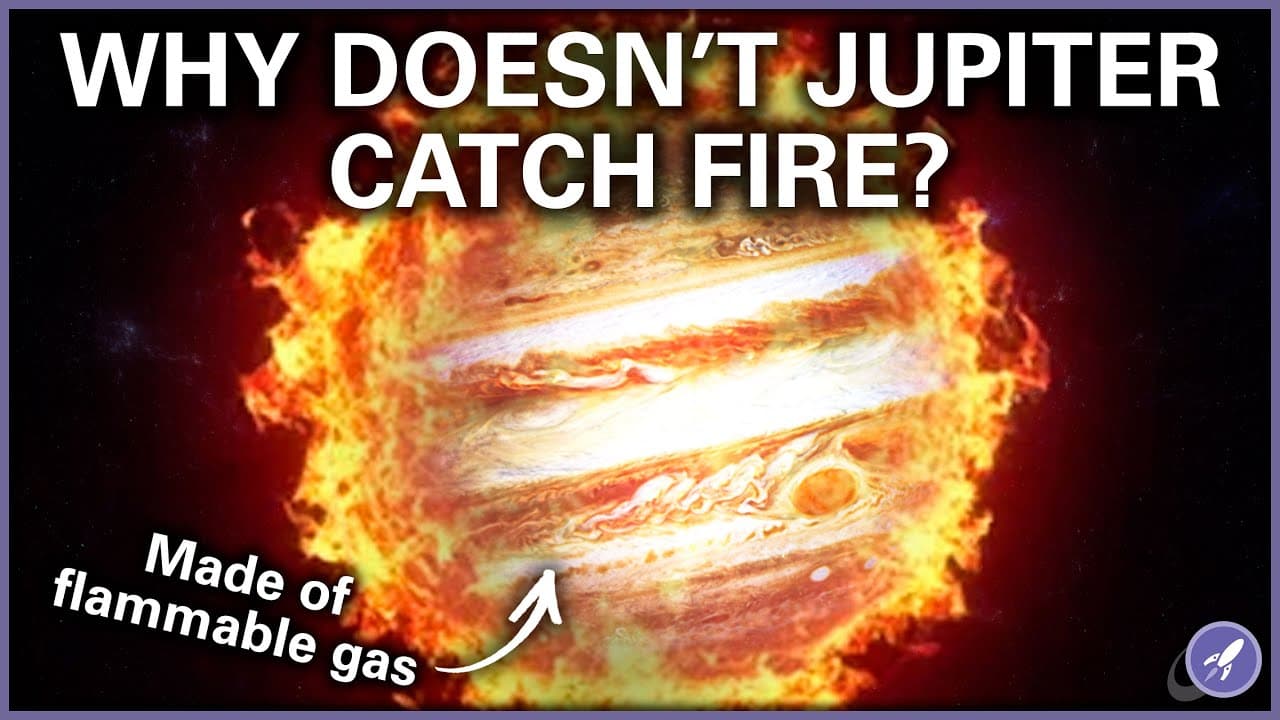
Milky Way from ISS, Jupiter Catching Fire, Best Sci-Fi Novel | Q&A 215
TL;DR
Exploring questions on Venus' atmosphere, gravitational lenses, rocket facilities, and more in a weekly show.
Transcript
why does Venus have an atmosphere if it doesn't have a magnetosphere what's the best Target for a gravitational lens telescope and where is the best place to put a rocket facility all this and more in this week's question show it's time for the question show your questions my answers now wherever you are across my channel if a question Pops in your... Read More
Key Insights
- 🖤 Venus's dense atmosphere results from lacking hydrogen due to solar wind stripping.
- 🎯 Gravitational lenses offer unique imaging capabilities but require careful target selection.
- 🚀 Equatorial launch sites provide velocity benefits but involve geographical limitations.
- 👾 Microgravity is a more accurate term for weightlessness in space compared to zero gravity.
- ⌛ Space-time dilation impacts time scales for near-light speed travel, influencing voyages.
- 🕵️ Challenges in detecting life on cosmic bodies emphasize the need for thorough exploration.
- 😥 Discrepancies in measuring the Hubble constant point to unknown physics in cosmology.
Install to Summarize YouTube Videos and Get Transcripts
Explore YouTube Video Summarizer or Get YouTube Transcript Extractor
Questions & Answers
Q: How does Venus maintain its atmosphere without a magnetosphere?
Venus's dense atmosphere is due to lacking hydrogen, which has been stripped away by the Sun's solar wind over time, making it bone dry.
Q: What is the primary challenge in selecting targets for a gravitational lens telescope?
The main drawback is the limitation imposed by selecting a target as it requires positioning the spacecraft precisely to observe a single target effectively.
Q: Why are equatorial launch sites considered advantageous?
Equatorial locations provide a velocity boost due to Earth's rotation, enhancing payload capabilities; however, compromises in site choice exist.
Q: Why is it essential to use the term "microgravity" over "zero gravity" in space?
Astronauts in orbit are still affected by gravity but are in a state of free fall, leading to the more accurate term "microgravity" to describe weightlessness.
Q: How does space-time dilation affect space travel near light speeds?
Space-time dilation alters the experience of time for travelers nearing light speeds, allowing for faster voyages to destinations; however, it raises concerns about relative time scales.
Q: What challenges arise from exploring celestial bodies for signs of life?
The complexity of detecting life requires gradual exploration and hypothesis testing, as definitive proof remains elusive due to uncertainties in detection methods.
Q: Is there a relation between the Hubble tension crisis and expanding universe acceleration?
The Hubble tension crisis highlights discrepancies in measuring the expansion rate today versus in the past, indicating unknown physics at play in cosmology.
Summary & Key Takeaways
-
Venus' atmosphere is dense due to its composition lacking hydrogen, essential for holding onto gases.
-
Gravitational lens telescopes offer unique imaging but require careful target selection.
-
Equatorial launch sites provide a velocity boost, but various compromises are involved.
Read in Other Languages (beta)
Share This Summary 📚
Summarize YouTube Videos and Get Video Transcripts with 1-Click
Try YouTube Summary with ChatGPT & Claude or YouTube Transcript Generator
Explore More Summaries from Fraser Cain / Universe Today Podcast 📚
Summarize YouTube Videos and Get Video Transcripts with 1-Click
Try YouTube Summary with ChatGPT & Claude or YouTube Transcript Generator