Cell Notation Practice Problems, Voltaic Cells - Electrochemistry
TL;DR
Learn how to write cell notation for electrochemical reactions, including identifying the anode and cathode, oxidation and reduction reactions, and representing the concentrations and phases of the species involved.
Transcript
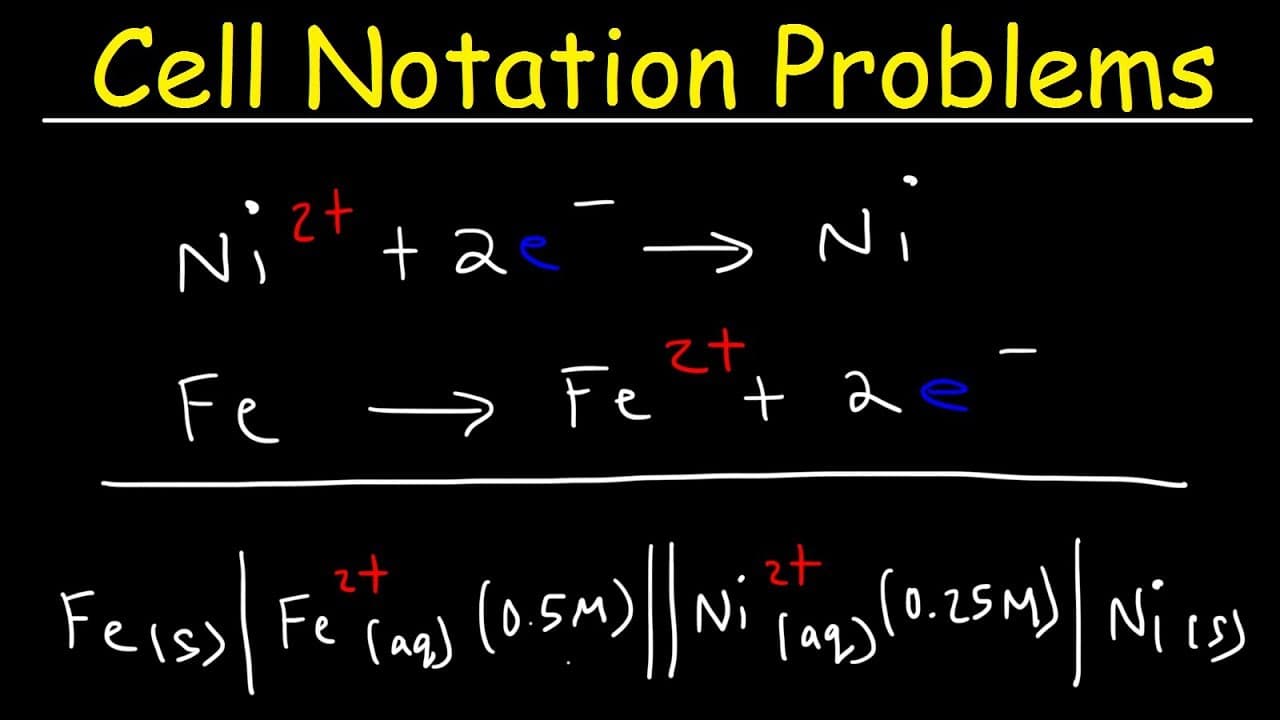
in this video we're going to talk about how to write the cell notation for an electrochemical reaction so i'm going to draw a galvanic cell and let's say this is an iron electrode so i'm going to put fe and on this side we have a nickel electrode and both containers are filled with fluid and let's say in this solution it's a 0.5 molar iron sulfate ... Read More
Key Insights
- 💐 Electrons flow from the anode to the cathode in electrochemical reactions.
- ❓ Oxidation occurs at the anode, while reduction occurs at the cathode.
- ❓ The cell notation represents the anode, cathode, and their species, as well as the concentrations and phases of the species involved.
- ❓ In the absence of a solid phase, an inert electrode like platinum or graphite can be used as the cathode.
- 🫡 The oxidation and reduction half-reactions can be determined based on the arrangement of electrons with respect to the reaction arrow.
- 💨 The cell notation is a useful way to represent electrochemical reactions and compare different reactions.
- ❓ Each species in the cell notation should be accompanied by its concentration in the aqueous solution, except for solid phases.
- 🫢 Different phases (solid, aqueous, gas) are represented using vertical lines in the cell notation.
Install to Summarize YouTube Videos and Get Transcripts
Explore YouTube Video Summarizer or Get YouTube Transcript Extractor
Questions & Answers
Q: How do electrons flow in an electrochemical reaction?
Electrons flow from the anode to the cathode in an electrochemical reaction. Oxidation occurs at the anode, where electrons are released, while reduction occurs at the cathode, where electrons are gained.
Q: How are the oxidation and reduction half-reactions determined?
The half-reaction with electrons on the right side is the oxidation half-reaction, and the one with electrons on the left side is the reduction half-reaction. Oxidation involves an increase in oxidation number, while reduction involves a decrease.
Q: How is the cell notation written for a galvanic cell?
Start with the anode species on the left, followed by its concentration in the aqueous solution. Use a double vertical line to separate the two half-cells, and write the cathode species on the right. Solid phases are represented without concentration.
Q: What should be done when there is no solid phase in the reaction?
In the absence of a solid phase, an inert electrode like platinum or graphite can be used as the cathode. The cell notation should specify the electrode chosen and its phase.
Summary & Key Takeaways
-
Electrochemical reactions involve the flow of electrons from the anode to the cathode, with oxidation occurring at the anode and reduction at the cathode.
-
To write the cell notation, start with the anode and its species, separated by a vertical line, followed by the concentration of the species in the aqueous solution. Use a double vertical line to separate the two half-cells, and write the cathode species on the right.
-
The cell notation includes representing the phases (solid, aqueous, gas) and the concentrations of the species involved.
Read in Other Languages (beta)
Share This Summary 📚
Summarize YouTube Videos and Get Video Transcripts with 1-Click
Try YouTube Summary with ChatGPT & Claude or YouTube Transcript Generator
Explore More Summaries from The Organic Chemistry Tutor 📚





Summarize YouTube Videos and Get Video Transcripts with 1-Click
Try YouTube Summary with ChatGPT & Claude or YouTube Transcript Generator