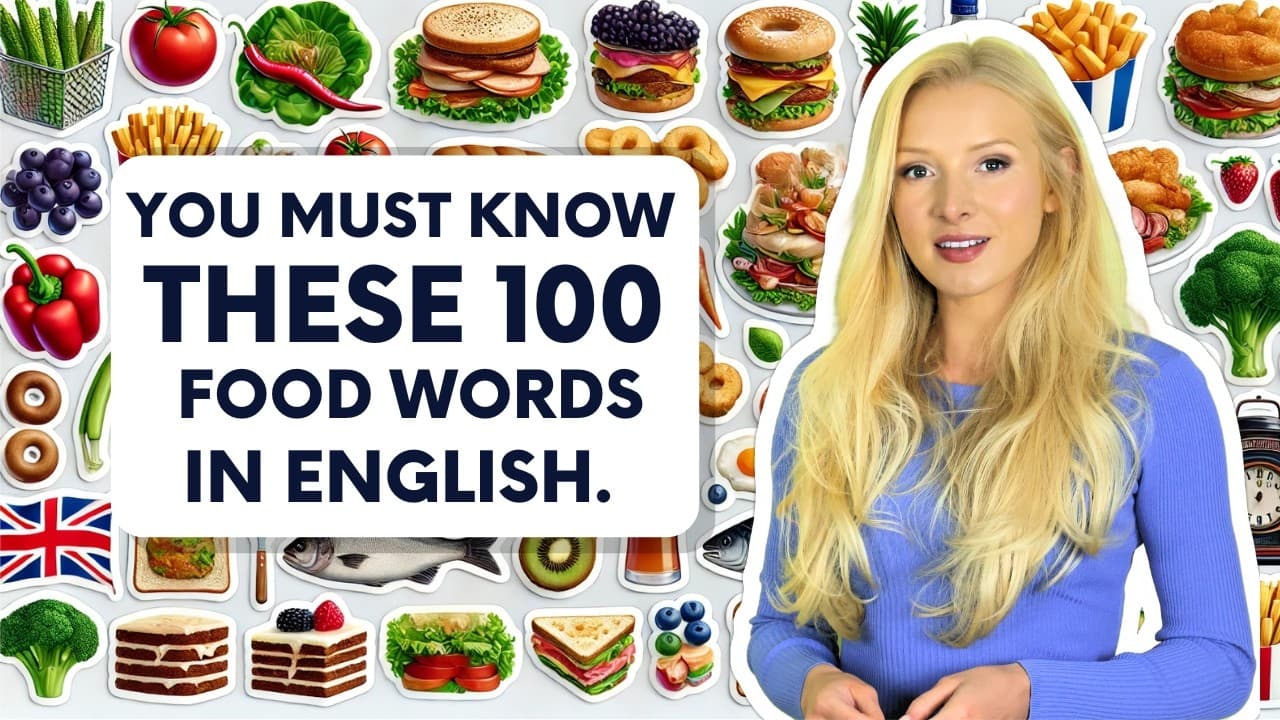
Learn 100+ Common Foods & Dishes in English in 20 Minutes | Food Vocabulary
TL;DR
Learn 100 food words in English, including pronunciation and cultural insights.
Transcript
hello lovely students and welcome back to English with Lucy I hope you're hungry because I have a delicious video for you today I am going to teach you 100 food words and phrases but I'm not just going to give you a list of 100 Foods no no we are going to learn in a much better way I have divided this video into categories we... Read More
Key Insights
- The video covers 100 food-related words, focusing on pronunciation, commonly confused terms, and cultural differences in naming foods.
- It includes a free PDF with all 100 words, pictures, and additional exercises to aid learning.
- The lesson is categorized into sections like vegetables, silent letters, British foods, and international food comparisons.
- Viewers learn about British Christmas foods, commonly mispronounced words, and homophones related to food.
- The video explains differences in food terminology across English-speaking countries, such as 'sweets' in the UK versus 'candy' in the US.
- Commonly confused food-related terms like 'bake' versus 'roast' and 'dessert' versus 'pudding' are clarified.
- The lesson includes interactive exercises, such as matching silent letters to food items and identifying homophones.
- British cuisine is highlighted, showcasing popular dishes like fish and chips, Sunday roast, and afternoon tea.
Install to Summarize YouTube Videos and Get Transcripts
Explore YouTube Video Summarizer or Get YouTube Transcript Extractor
Questions & Answers
Q: What is the structure of the lesson provided in the video?
The lesson is structured into several categories, each focusing on different aspects of food vocabulary. It begins with vegetables, moves on to silent letters in food names, explores varieties of English in naming foods, and highlights British favorites. It also covers commonly confused words, pronunciation exercises, protein and carbohydrate categorization, world foods, traditional British Christmas foods, and concludes with fruits.
Q: How does the video address pronunciation challenges?
The video addresses pronunciation challenges by focusing on commonly mispronounced words and providing clear examples of correct pronunciation. It discusses the schwa sound in words like 'carrot' and 'asparagus,' and highlights silent letters in words like 'salmon' and 'sandwich.' The lesson also includes exercises on homophones, such as 'muscles' versus 'mussels,' to help learners distinguish between similarly sounding words.
Q: What cultural insights are provided about British food?
The video provides cultural insights into British food by showcasing popular dishes such as fish and chips, Sunday roast, and afternoon tea. It explains the significance of these meals in British culture and highlights traditional Christmas foods like turkey, stuffing, and mince pies. The lesson also discusses regional variations in meal terminology, such as 'tea' being used for dinner in some parts of the UK.
Q: What interactive elements are included in the lesson?
The lesson includes several interactive elements to engage learners. These include exercises where viewers match silent letters to food items, identify homophones, and categorize foods based on protein and carbohydrate content. The video also encourages viewers to pause and reflect on questions, such as naming fruits or identifying the origins of international dishes, to reinforce learning.
Q: How does the lesson help with understanding international food terminology?
The lesson helps with understanding international food terminology by comparing how different English-speaking countries name certain foods. For example, it explains that 'sweets' in British English is equivalent to 'candy' in American English and 'lollies' in Australian English. It also covers regional names for foods like 'eggplant' versus 'aubergine' and 'bell pepper' versus 'capsicum.'
Q: What resources are offered to complement the video lesson?
To complement the video lesson, viewers are offered a free downloadable PDF that includes all 100 food words, pictures, and additional exercises. This PDF provides more detailed explanations and examples to reinforce learning. By signing up for the mailing list, viewers also gain access to weekly PDFs, news updates, and course offers from the instructor.
Q: How does the video address commonly confused food-related terms?
The video addresses commonly confused food-related terms by providing clear explanations and examples. It differentiates between terms like 'bake' and 'roast,' explaining the contexts in which each is used. It also clarifies the difference between 'dessert' and 'pudding,' noting regional variations in usage. These explanations help learners understand the nuances of food vocabulary in English.
Q: What is the significance of the PDF offered in the lesson?
The PDF offered in the lesson is significant as it provides a comprehensive resource for learners to review and practice the food vocabulary covered in the video. It includes all 100 words with pictures, detailed explanations, and exercises to reinforce learning. By downloading the PDF, learners can access additional information that couldn't be included in the video, enhancing their understanding of English food terminology.
Summary & Key Takeaways
-
This video lesson teaches 100 food-related words in English, focusing on pronunciation, commonly confused terms, and cultural variations in naming foods. It includes interactive exercises and a free downloadable PDF with additional resources.
-
Viewers learn about British Christmas foods, commonly mispronounced words, and homophones related to food. The lesson covers differences in food terminology across English-speaking countries, such as 'sweets' in the UK versus 'candy' in the US.
-
The video explains commonly confused food-related terms like 'bake' versus 'roast' and 'dessert' versus 'pudding.' It also highlights British cuisine, showcasing popular dishes like fish and chips, Sunday roast, and afternoon tea.
Read in Other Languages (beta)
Share This Summary 📚
Summarize YouTube Videos and Get Video Transcripts with 1-Click
Try YouTube Summary with ChatGPT & Claude or YouTube Transcript Generator
Explore More Summaries from English with Lucy 📚
Summarize YouTube Videos and Get Video Transcripts with 1-Click
Try YouTube Summary with ChatGPT & Claude or YouTube Transcript Generator