Why Is Ackerman’s Function So Difficult to Compute? - Computerphile
TL;DR
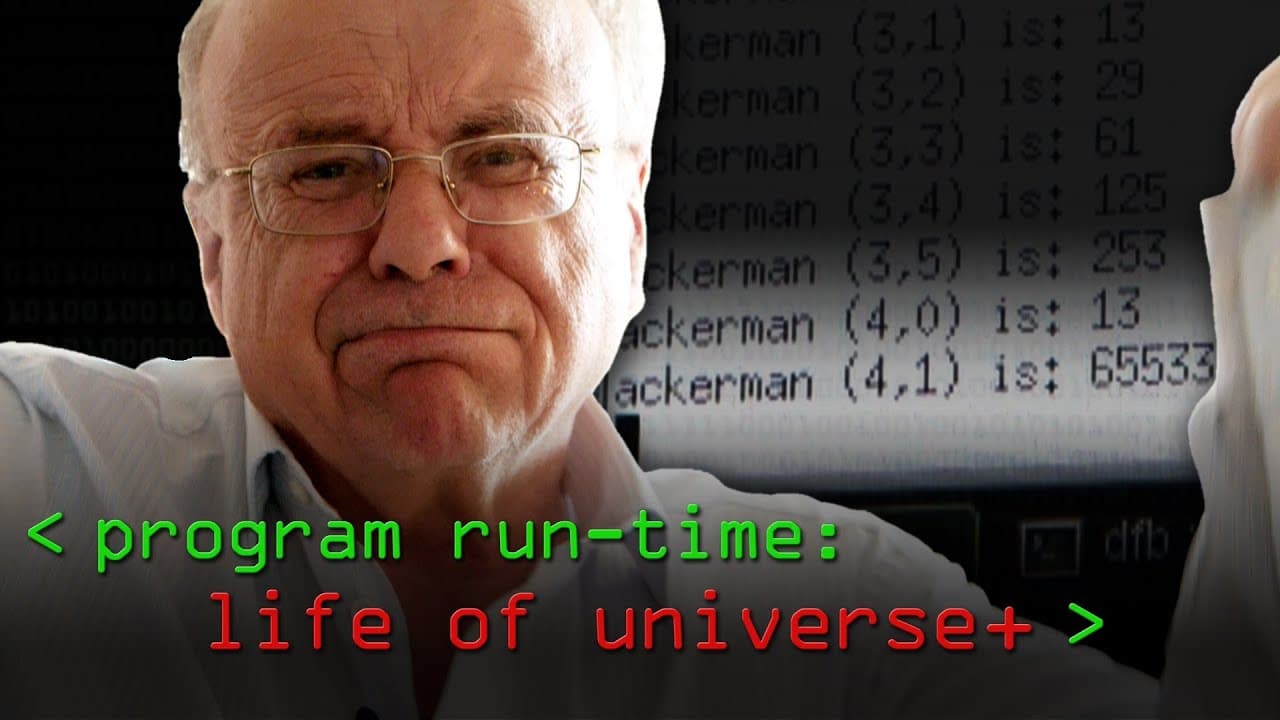
Ackerman’s function is difficult to compute because it is fundamentally recursive and its general case places one Ackerman call inside another. Unlike factorial and Fibonacci, which are primitive recursive and can be converted into iterative for loops, this function sits in the next layer of the program hierarchy. The base case A(0, 2) returns 3, but the nested calls quickly become harder to follow. Read on for the rules and hierarchy.
Transcript
so far we've looked at primitive recursion things where you can use recursion if you want to but you don't have to because it can be dearie cursed and turned into an iterative four loop and we did factorial and we did Fibonacci both of which are primitive recursive in this sense and there would be a great danger in thinking well surely you can do a... Read More
Key Insights
- ❓ Recursive functions, like Ackerman's function, are necessary for solving certain computational problems that cannot be efficiently tackled with iteration.
- 🅰️ Ackerman's function highlights the existence of a hierarchy of program types, including primitive recursive functions, recursively enumerable functions, and undecidable problems.
- 🌥️ Recursive functions, such as Ackerman's function, incur significant computation and can generate incredibly large numbers.
- ❓ While the values produced by Ackerman's function may be practically unattainable due to the complexity of computation, they are not computationally unachievable.
- 🦸 The behavior of Ackerman's function demonstrates the concept of super-exponential growth, which is characteristic of functions that cannot be efficiently calculated using iterative approaches.
- ❓ Ackerman's function showcases the importance of reasoning about programs and their behavior without necessarily executing them.
Install to Summarize YouTube Videos and Get Transcripts
Explore YouTube Video Summarizer or Get YouTube Transcript Extractor
Questions & Answers
Q: Why is Ackerman’s function so difficult to compute?
Its general case uses an Ackerman call as the second argument of another Ackerman call. This nested recursion creates what the speaker calls the function’s “recursive horrors” and makes it difficult to transform into iteration.
Q: What is Ackerman’s function?
Ackerman’s function is presented as an integer function with two incoming integer arguments and an integer result. The version commonly used in the discussion was modified by Peter and Robinson and is defined through recursive cases.
Q: What happens when the first argument m is zero?
When m is zero, the function returns n plus one. For example, A(0, 2) returns 3.
Q: What happens when n is zero but m is not zero?
The function calls itself recursively after reducing m by one and uses 1 as the other argument. This moves the calculation toward the base case where m equals zero.
Q: What happens in the general case when neither m nor n is zero?
The function reduces m by one for the outer call. Its second argument is itself another Ackerman call, creating the nested recursion that makes the definition hard to follow.
Q: How does Ackerman’s function differ from factorial and Fibonacci?
Factorial and Fibonacci are described as primitive recursive functions. Their recursion can be removed and replaced with iterative for loops, whereas Ackerman’s function is introduced as something that must be defined recursively.
Q: Where does Ackerman’s function fit in the hierarchy of program types?
It belongs to the recursive layer immediately above primitive recursive programs. Above that are recursively enumerable programs, which may stop for some arguments but continue forever for others, followed by undecidable problems that no algorithm can decide in general.
Q: What does Ackerman’s function teach about analyzing programs?
It illustrates how computer scientists can reason about whether a program gives an answer without executing it. The speaker distinguishes it from recursively enumerable programs that may keep repeating stack frames forever for some inputs.
Summary & Key Takeaways
-
Ackerman's function, developed by a research student of mathematician David Hilbert, is an example of a function that must be defined recursively.
-
Recursive functions, like Ackerman's function, exist in a hierarchy above primitive recursive functions and recursive enumerable functions.
-
Ackerman's function is a prime example of a function that requires significant computation and has the potential to produce astronomically large numbers.
Read in Other Languages (beta)
Share This Summary 📚
Summarize YouTube Videos and Get Video Transcripts with 1-Click
Try YouTube Summary with ChatGPT & Claude or YouTube Transcript Generator
Explore More Summaries from Computerphile 📚



Summarize YouTube Videos and Get Video Transcripts with 1-Click
Try YouTube Summary with ChatGPT & Claude or YouTube Transcript Generator