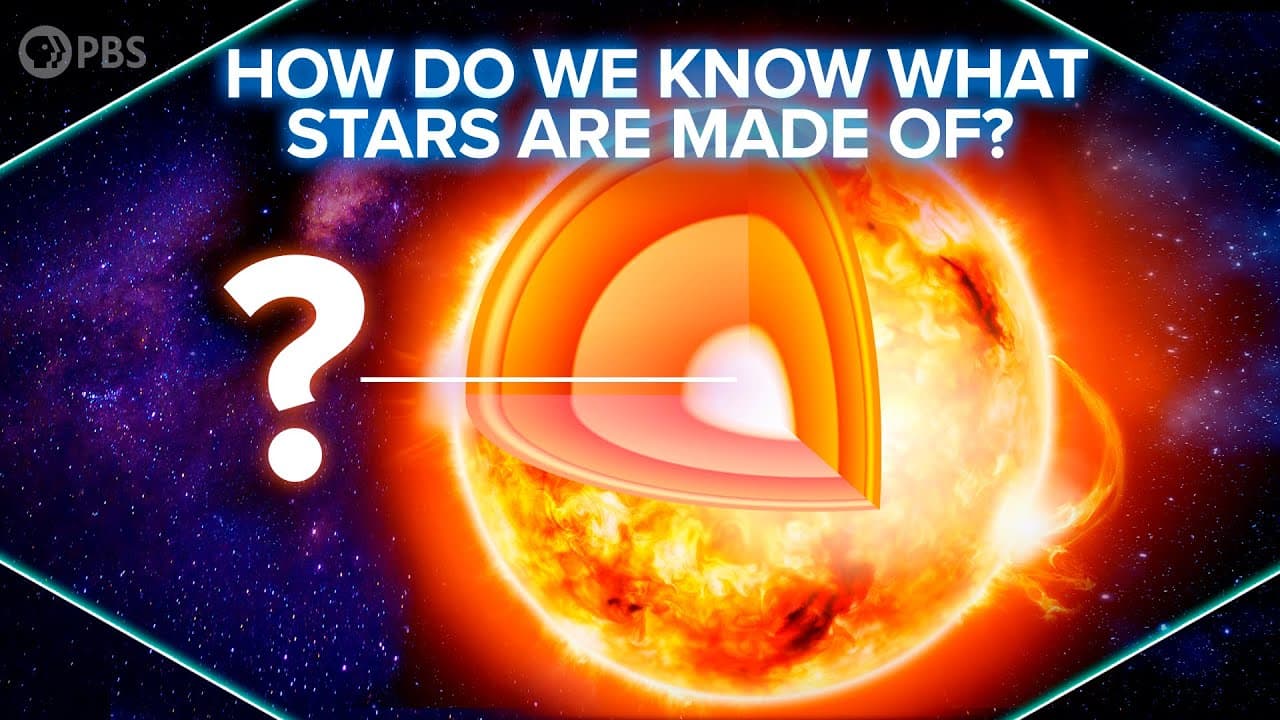
How Do We Know What Stars Are Made Of?
TL;DR
Cecilia Payne discovered stars are mostly hydrogen and helium.
Transcript
Thank you to Target for supporting PBS. Pin-pricks in the celestial sphere, through which shines the light of heaven? Or gods and heroes looking down from their constellations? Or lights kindled above middle earth by Varda Elbereth and brightened with the dew of the trees of Valinor? Science has long pondered the mysteries of the stars. And this is... Read More
Key Insights
- Cecilia Payne revolutionized our understanding of stars, discovering they are primarily composed of hydrogen and helium, contrary to previous beliefs that they were Earth-like in composition.
- Payne's work was pivotal in the 1920s, a time when the scientific community was beginning to explore quantum mechanics and relativity, yet had little understanding of stellar composition.
- The absorption lines in a star's spectrum, which represent missing light frequencies, are key to determining the elements present in stars, as each element has a unique spectral fingerprint.
- Payne's research was initially downplayed due to its contradiction with the prevailing scientific consensus, but her findings were later validated, earning her recognition for her groundbreaking work.
- The discovery of hydrogen and helium as the primary components of stars allowed scientists to develop a detailed theory of stellar physics, including the understanding of nuclear fusion.
- Cecilia Payne's contributions extended beyond her discovery; she also developed a method to calculate stellar temperatures using absorption lines, improving the precision of previous methods.
- Despite facing gender-based barriers in academia, Payne became the first female professor and department chair at Harvard, paving the way for future women in science.
- PBS's American Portrait Series, supported by Target, encourages storytelling and sharing of personal experiences, highlighting the importance of diverse narratives in understanding broader scientific and cultural contexts.
Install to Summarize YouTube Videos and Get Transcripts
Explore YouTube Video Summarizer or Get YouTube Transcript Extractor
Questions & Answers
Q: What was the prevailing belief about the composition of stars before Cecilia Payne's discovery?
Before Cecilia Payne's work, the prevailing belief was that stars were composed of the same elements found on Earth's surface, just at much higher temperatures. This assumption was based on the observation of prominent absorption lines that matched common Earth elements. Payne's research overturned this belief by showing that stars are primarily made of hydrogen and helium.
Q: How did Cecilia Payne determine the composition of stars?
Cecilia Payne determined the composition of stars by analyzing their spectral absorption lines. Each element has a unique set of lines corresponding to its energy levels. By studying these lines and incorporating quantum mechanics, Payne was able to calculate the relative abundances of elements in stars, revealing that hydrogen and helium were the most common.
Q: What challenges did Cecilia Payne face in her scientific career?
Cecilia Payne faced significant gender-based challenges in her career. Despite her groundbreaking work, she was advised to downplay her findings in her thesis due to its contradiction with established scientific beliefs. Additionally, she could not receive a degree from Cambridge because they did not award degrees to women at the time. Nonetheless, she persevered and became the first female professor and department chair at Harvard.
Q: How did Payne's findings influence the development of stellar physics?
Payne's discovery that stars are primarily composed of hydrogen and helium was crucial for the development of stellar physics. It provided the foundation for understanding nuclear fusion, the process that powers stars. Her work enabled scientists like Arthur Eddington to develop detailed theories on how stars generate energy, transforming them from mysterious objects to well-understood astronomical bodies.
Q: What role did quantum mechanics play in Payne's research?
Quantum mechanics played a pivotal role in Payne's research by providing the theoretical framework needed to understand the complex patterns of absorption lines in stellar spectra. The early ideas of quantum theory allowed Payne to account for different ionization states of elements, which was essential for accurately determining the composition of stars based on their spectral lines.
Q: Why are absorption lines important in understanding stellar composition?
Absorption lines are crucial for understanding stellar composition because they represent specific wavelengths of light absorbed by elements in a star's atmosphere. Each element has a unique pattern of absorption lines, or spectral fingerprint, allowing astronomers to identify which elements are present in a star and in what relative abundances. This information is key to determining the star's chemical makeup.
Q: How did Payne's work impact the role of women in science?
Cecilia Payne's work had a significant impact on the role of women in science by breaking gender barriers in academia. Her achievements at Harvard, where she became the first female professor and department chair, demonstrated the capabilities of women in scientific fields and inspired future generations of female scientists to pursue careers in astronomy and physics, promoting greater gender equality.
Q: What is PBS's American Portrait Series, and how does it relate to the video content?
PBS's American Portrait Series is a nationwide storytelling project that invites individuals to share their personal stories and experiences, reflecting the diverse narratives that shape America today. This initiative relates to the video content by emphasizing the importance of sharing diverse perspectives, much like how Cecilia Payne's groundbreaking work and personal journey in science provide valuable insights into the history of astronomy and gender equality.
Summary & Key Takeaways
-
Cecilia Payne discovered that stars are primarily composed of hydrogen and helium, challenging the previous belief that they were similar to Earth's composition. Her work in the 1920s, alongside the emergence of quantum mechanics, revolutionized our understanding of stellar physics.
-
Payne's analysis of stellar spectra revealed the presence of absorption lines, which indicated the elements present in stars. Her findings, initially downplayed, were later confirmed, solidifying her legacy as a pioneering astrophysicist.
-
Despite gender-based challenges, Payne's achievements at Harvard, including becoming the first female professor and department chair, paved the way for future generations of women in science, highlighting her enduring impact on both astronomy and gender equality.
Read in Other Languages (beta)
Share This Summary 📚
Summarize YouTube Videos and Get Video Transcripts with 1-Click
Try YouTube Summary with ChatGPT & Claude or YouTube Transcript Generator
Explore More Summaries from PBS Space Time 📚




Summarize YouTube Videos and Get Video Transcripts with 1-Click
Try YouTube Summary with ChatGPT & Claude or YouTube Transcript Generator