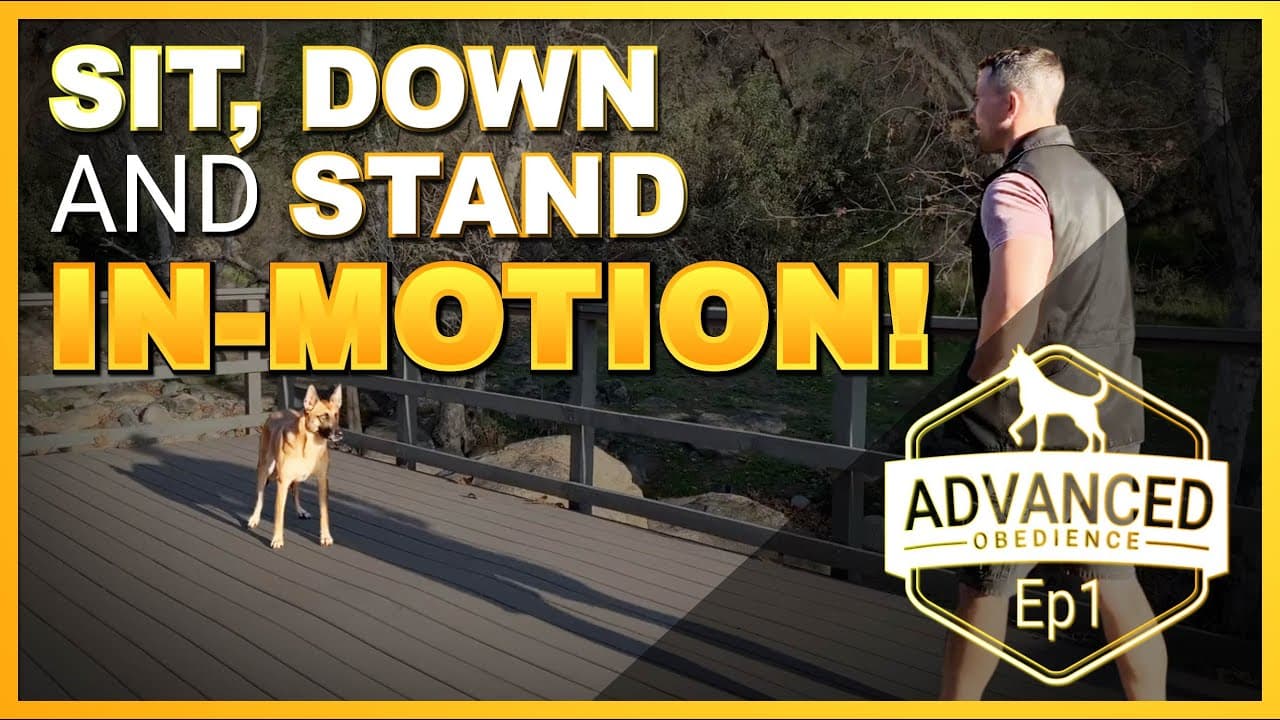
Teach your Dog to Perform a Sit, Down, or Stand IN-MOTION.
TL;DR
Learn sit, down, and stand in-motion dog commands.
Transcript
all right so first I want to demonstrate how we're going to teach our dog the in motion exercises using reward-based training okay so we'll do the sit first heel walking and then what we're going to do is we're gonna say sit then lift free then reward okay I'm gonna buy my dog back watch again I say sit I lift free good sit then lift free good girl... Read More
Key Insights
- Reward-based training is effective for teaching dogs in-motion commands like sit, down, and stand, encouraging them to stop when instructed.
- Using reflections or mirrors helps trainers ensure dogs perform commands correctly without needing to constantly observe them directly.
- Leash pressure techniques provide a structured method for reinforcing in-motion commands, helping dogs understand and respond to cues reliably.
- Anticipation of rewards can cause dogs to preemptively perform commands, so varying training patterns is crucial to avoid this behavior.
- The use of a belly band can aid in teaching the stand in-motion command, providing dogs with a physical cue similar to leash pressure.
- Dogs are highly aware of their trainer's focus, so utilizing mirrors or partners can help maintain the dog's attention on performing commands.
- Repetition and consistency are key in training, but over-repetition can lead to dogs anticipating commands, requiring trainers to mix up routines.
- Reward-based training can be effectively used alone for in-motion commands, but a partner can enhance training with techniques like the belly band.
Install to Summarize YouTube Videos and Get Transcripts
Explore YouTube Video Summarizer or Get YouTube Transcript Extractor
Questions & Answers
Q: How does reward-based training help in teaching in-motion commands?
Reward-based training helps teach in-motion commands by encouraging dogs to stop and perform the command when instructed. By offering a reward, dogs are motivated to follow the command promptly and accurately. The use of a terminal marker signals the end of the command, while a continuation marker helps maintain the dog's focus.
Q: What role do mirrors play in dog training?
Mirrors play a crucial role in dog training by allowing trainers to observe their dogs' actions without direct eye contact. This helps ensure the dog performs the command correctly while maintaining forward motion. Mirrors enable trainers to verify the dog's response to commands and make necessary adjustments without breaking the flow of training.
Q: How does leash pressure aid in training?
Leash pressure aids in training by providing a structured method for reinforcing commands. It helps dogs understand and respond to cues reliably by applying gentle pressure to guide them into the desired position. This technique is particularly useful for in-motion commands, ensuring the dog stops and performs the command as instructed.
Q: Why is it important to vary training patterns?
Varying training patterns is important to prevent dogs from anticipating commands prematurely. Over-repetition can lead to dogs performing commands before being instructed, undermining the training process. By mixing up routines, trainers keep dogs attentive and responsive, ensuring they wait for the specific command before acting.
Q: What is a belly band and how is it used in training?
A belly band is a tool used in training, particularly for the stand in-motion command. It is a leash that goes around the dog's waist, providing a physical cue similar to leash pressure. Trainers lift the band slightly to signal the dog to stand, helping them respond to the command without moving forward.
Q: How can anticipation of rewards affect training?
Anticipation of rewards can lead to dogs performing commands prematurely, expecting a reward without being instructed. This behavior can disrupt training, as dogs may stop following commands accurately. Trainers need to vary routines and reward placements to minimize anticipation and ensure dogs respond correctly to cues.
Q: What challenges are associated with the stand in-motion command?
The stand in-motion command is challenging because it requires the dog to halt and remain standing without moving forward. Dogs often anticipate the down command, making it difficult to maintain the stand position. Trainers can use reward-based training and tools like the belly band to help dogs understand and execute the command.
Q: Can reward-based training be effective without a partner?
Yes, reward-based training can be effective without a partner. While having a partner can enhance training, especially for commands like the stand in-motion, trainers can achieve success using reward-based techniques alone. Consistency, varied routines, and proper use of rewards are key to successful training without additional assistance.
Summary & Key Takeaways
-
The video demonstrates how to teach dogs sit, down, and stand in-motion commands using both reward-based and pressure-based training techniques. Trainers are encouraged to use mirrors or reflections to ensure dogs perform commands correctly without needing constant direct observation.
-
Leash pressure is introduced as a method to reinforce commands, helping dogs understand and respond to cues reliably. The video emphasizes the importance of varying training routines to prevent dogs from anticipating commands prematurely, which can occur with repetitive patterns.
-
The stand in-motion command is highlighted as more challenging, with the use of a belly band suggested to aid in training. Trainers are advised to ensure dogs are comfortable with this tool, using it to provide physical cues similar to those used in leash pressure training.
Read in Other Languages (beta)
Share This Summary 📚
Summarize YouTube Videos and Get Video Transcripts with 1-Click
Try YouTube Summary with ChatGPT & Claude or YouTube Transcript Generator
Explore More Summaries from Nate Schoemer 📚



Summarize YouTube Videos and Get Video Transcripts with 1-Click
Try YouTube Summary with ChatGPT & Claude or YouTube Transcript Generator