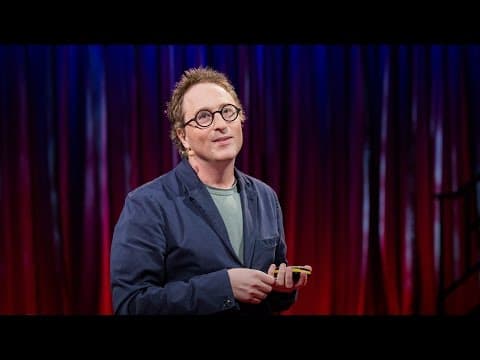
Jennifer Golbeck: The curly fry conundrum: Why social media "likes" say more than you might think

TL;DR
The web has evolved from a static place to a highly interactive platform where average users generate massive amounts of personal data, leading to a lack of control and understanding of how this data is used, and this article explores potential solutions.
Transcript
If you remember that first decade of the web, it was really a static place. You could go online, you could look at pages, and they were put up either by organizations who had teams to do it or by individuals who were really tech-savvy for the time. And with the rise of social media and social networks in the early 2000s, the web was completely chan... Read More
Key Insights
- 💻 The rise of social media has transformed the web into a more interactive space where average users create and share content. Facebook, with its 1.2 billion users per month, has allowed people to create online personas and share personal data on an unprecedented scale.
- 💻 Computer scientists can use this data to build models that predict hidden attributes about users, such as political preference, personality score, and even intelligence. These predictions are based on patterns of behavior, such as liking certain pages on Facebook.
- 💻 The ability to predict personal attributes based on seemingly unrelated information raises concerns about users' understanding and control over how their data is used. Many users are unaware of the techniques used and have little control over the process.
- 💼 Companies like Target use customers' purchase history to make predictions, such as pregnancy status and due dates, based on patterns of behavior. This kind of data analysis has far-reaching implications beyond just social media.
- 🔒 Users have limited control over how their data is used, which raises ethical and privacy concerns. It is problematic that users could potentially have their personal attributes predicted and sold to businesses without their consent.
- 📚 Finding a solution to this problem requires a multi-faceted approach. Policy and law changes could give users more control over their data, but this is unlikely to happen quickly due to the complexity of the issue and the political process.
- 🔬 Investing in more scientific research can help develop mechanisms that inform users about the potential risks of their actions and give them more control over their information. This research can also explore encryption methods to protect user data.
- 🌍 Encouraging scientific research and empowering users will lead to an educated and empowered user base, which is essential for the future of online interactions. It is crucial to prioritize user understanding and control in the development of new tools and technologies.
Install to Summarize YouTube Videos and Get Transcripts
Explore YouTube Video Summarizer or Get YouTube Transcript Extractor
Questions & Answers
Q: How has the internet changed since its first decade?
The internet has transformed from a static place where only organizations and tech-savvy individuals could put up content to a dynamic and interactive platform driven by average users. Social media and social networks, such as YouTube, blogs, product reviews, and social media postings, have become the primary means of content creation and interaction.
Q: Which platform has the largest user base on the internet?
Facebook currently holds the largest user base on the internet, with 1.2 billion users per month. This massive user population represents half of the Earth's internet population. Facebook serves as an illustration of the significant number of users who have created an online persona with little technical skill and willingly shared vast amounts of personal data.
Q: How do companies like Target predict personal attributes and behaviors?
Companies like Target use patterns of behavior and purchase history to predict personal attributes and behaviors. For example, by analyzing data such as buying more vitamins than usual or purchasing a handbag big enough to hold diapers, companies can infer a woman's pregnancy status and due date. It is the combination of seemingly insignificant actions and behaviors among millions of people that reveals insights and predicts hidden attributes.
Q: What attributes can computer scientists accurately predict about individuals using social media data?
Computer scientists can accurately predict attributes such as political preference, personality score, gender, sexual orientation, religion, age, intelligence, and the strength of relationships and trust among individuals. Surprisingly, these predictions do not rely on obvious information but rather on small behavioral patterns observed among millions of people, enabling the detection of connections and insights that individuals might not even be aware of.
Q: How can users regain control over their personal data?
There are two potential paths to giving users more control over their personal data. The first is through policy and law changes, which would require significant shifts in intellectual property law and the willingness of social media companies to relinquish control over user data. The second path is through scientific advancements that focus on developing mechanisms to inform users about the risks associated with their actions and allowing for increased data encryption and selective access. By empowering users with knowledge and control, we can create a more informed and consent-driven online environment.
Summary & Key Takeaways
-
The rise of social media has transformed the web into a more interactive and user-generated content space.
-
Facebook, with 1.2 billion users per month, has allowed people to create online personas and share large amounts of personal data.
-
Computer scientists can predict hidden attributes of users based on their online behavior, but users have little control over how their data is used, which is a problem that needs to be addressed.
Read in Other Languages (beta)
Share This Summary 📚
Summarize YouTube Videos and Get Video Transcripts with 1-Click
Try YouTube Summary with ChatGPT & Claude or YouTube Transcript Generator
Explore More Summaries from TED 📚





Summarize YouTube Videos and Get Video Transcripts with 1-Click
Try YouTube Summary with ChatGPT & Claude or YouTube Transcript Generator