Imaging at a trillion frames per second | Ramesh Raskar
TL;DR
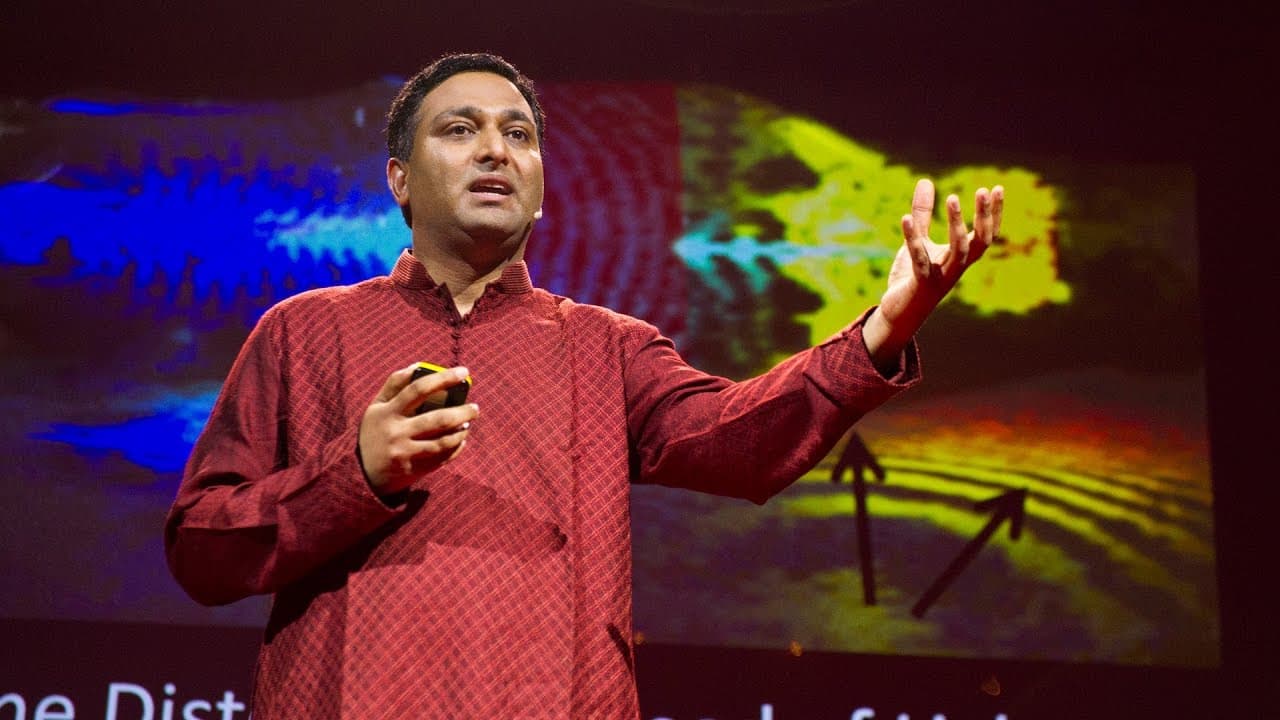
Femto-photography is an imaging technique that captures light in motion at one trillion frames per second, enabling cameras to visualize phenomena like light traveling around corners and inside objects. This technology could revolutionize fields like health imaging and collision avoidance in vehicles by reconstructing hidden objects in 3D from light reflections.
Transcript
Translator: Joseph Geni Reviewer: Thu-Huong Ha Doc Edgerton inspired us with awe and curiosity with this photo of a bullet piercing through an apple, and exposure just a millionth of a second. But now, 50 years later, we can go a million times faster and see the world not at a million or a billion, but one trillion frames per second. I present to y... Read More
Key Insights
- 📸 Femto-photography is a new imaging technique that can create slow-motion videos of light in motion, allowing cameras to look around corners and see inside the body without an x-ray.
- 💡 By creating a packet of photons and firing it into a bottle, we can see how light shatters and travels inside an object. This slow-motion view shows ripples of waves and explosions in different directions. ⏳ The femto-camera captures events happening in less than a nanosecond, slowing them down by a factor of 10 billion, allowing us to see light in motion.
- 🍅 Light bouncing around inside a ripe tomato causes it to continue glowing even after the initial light exposure has stopped. This can have implications for future camera technology in supermarkets.
- 🔍 The femto-camera created by the MIT team works by sending millions of packets of photons and recording their movements with clever synchronization, allowing the creation of femto-videos.
- 🌌 The ability to see around corners is not science fiction. MIT researchers have built a femto-camera that can bounce light off a door and capture the scattered light to determine the distances of hidden objects.
- 🚗 In the future, femto-photography could be used to create collision-avoidance systems for cars, search for survivors in hazardous conditions, and improve health imaging techniques.
- 🎨 Femto-photography can also be used for computational photography, allowing for new visualizations and the creation of artistic time-lapse videos. The order of events can appear reversed in the camera, but this distortion can be corrected with space and time warping.
Install to Summarize YouTube Videos and Get Transcripts
Explore YouTube Video Summarizer or Get YouTube Transcript Extractor
Questions & Answers
Q: What is femto-photography?
Femto-photography is a new imaging technique that can capture one trillion frames per second, allowing for slow-motion videos of light in motion.
Q: How does femto-photography challenge the concept of a camera?
Femto-photography challenges the idea of a camera by enabling cameras to look around corners, beyond the line of sight, and even see inside the human body without the use of an x-ray.
Q: How does light look in slow motion according to the video?
In slow motion, light appears to create ripples and waves as it enters a bottle and scatters inside. It can also create focused reflections and cause objects like bubbles to bounce around.
Q: How did the researchers at MIT develop femto-photography?
The researchers at MIT developed femto-photography by sending a packet of photons (created by a laser) millions of times and recording the data with synchronization. They then computationally weave together the data to create slow-motion videos of light in motion.
Q: What are some potential applications of femto-photography?
Some potential applications of femto-photography include creating collision-avoidance systems for cars, searching for survivors in hazardous conditions, and solving health imaging problems with endoscopes and cardioscopes.
Q: What is the effect of recording images nearly at the speed of light?
When recording images nearly at the speed of light, there can be a distortion in the order of events captured by the camera. The ripples under a cap, for example, may appear to be moving away from the viewer instead of towards them. This distortion can be corrected using space and time warping.
Summary
In this video, Ramesh Raskar introduces the concept of femto-photography, a new type of imaging technique that can capture one trillion frames per second. He demonstrates how these ultra-fast cameras can create slow motion videos of light in motion, allowing us to see phenomena that are invisible to the naked eye. Raskar explains how the camera works and showcases its potential applications, such as looking around corners and seeing inside the human body without x-rays.
Questions & Answers
Q: What is femto-photography and how is it different from traditional photography?
Femto-photography is a new imaging technique that can capture one trillion frames per second, enabling us to see the world in slow motion. Unlike traditional photography, which captures images at a much slower rate, femto-photography can reveal phenomena that are invisible to the naked eye.
Q: How does the camera in femto-photography work?
The femto-camera works by sending a packet of photons, like a bullet of light, into the scene multiple times and recording the scattered light. The camera then combines these recordings to create a slow motion video of the event. This technique requires capturing and processing a large amount of data, but it allows us to visualize the behavior of light in incredible detail.
Q: What can femto-photography be used for?
Femto-photography has numerous potential applications. For example, it can be used to create cameras that can look around corners or see beyond line of sight, allowing us to observe hidden objects or rooms. Additionally, it can be utilized in medical imaging to see inside the human body without the use of x-rays, enabling non-invasive examinations and diagnostics.
Q: How can femto-photography help in collision avoidance for cars?
Femto-photography could potentially be integrated into car systems to help avoid collisions. By detecting light reflected off objects around bends or obstacles, the camera can provide real-time data on the environment, allowing cars to take appropriate actions to prevent accidents.
Q: What are some challenges in using femto-photography for medical imaging?
One of the challenges in medical imaging with femto-photography is dealing with the presence of tissue and blood, which can distort the captured images. Overcoming these challenges would require further research and innovation to develop advanced imaging techniques that can see through occlusions and accurately visualize internal structures.
Q: How does femto-photography open up new possibilities for computational photography?
Femto-photography not only provides scientific imaging capabilities but also offers opportunities for computational photography. By analyzing the data captured by the camera and applying techniques like time-lapse and color coding, new visualizations and artistic representations can be created, adding another dimension to traditional photography.
Q: What is the significance of open-sourcing the data and details of femto-photography?
By open-sourcing the data and details of femto-photography, Raskar and his team hope to encourage collaboration and innovation within the DIY, creative, and research communities. They believe that focusing on the next dimension in imaging, rather than simply obsessing over megapixels, will lead to groundbreaking advancements in photography and visualization.
Takeaways
Femto-photography is a revolutionary imaging technique that allows us to see the world at an unprecedented speed and detail. By capturing one trillion frames per second, this technology enables slow motion visualization of fast-moving events, such as the behavior of light. With applications ranging from looking around corners and avoiding collisions to non-invasive medical imaging, femto-photography has the potential to transform various industries. By open-sourcing the data and details, Raskar and his team hope to inspire collaboration and creativity in the pursuit of new imaging possibilities.
Summary & Key Takeaways
-
Femto-photography is a new imaging technique that can capture slow motion videos of light in motion at a trillion frames per second.
-
This technology can be used to create cameras that can look around corners, see inside the body without x-rays, and challenge traditional camera concepts.
-
The femto-camera works by recording packets of photons bouncing off objects and analyzing the multiple bounces of light to reconstruct hidden objects in full 3D.
Read in Other Languages (beta)
Share This Summary 📚
Summarize YouTube Videos and Get Video Transcripts with 1-Click
Try YouTube Summary with ChatGPT & Claude or YouTube Transcript Generator
Explore More Summaries from TED 📚



Summarize YouTube Videos and Get Video Transcripts with 1-Click
Try YouTube Summary with ChatGPT & Claude or YouTube Transcript Generator