Should you trust unanimous decisions? - Derek Abbott
TL;DR
Agreement may not always indicate truth due to human error, bias, or system faults.
Transcript
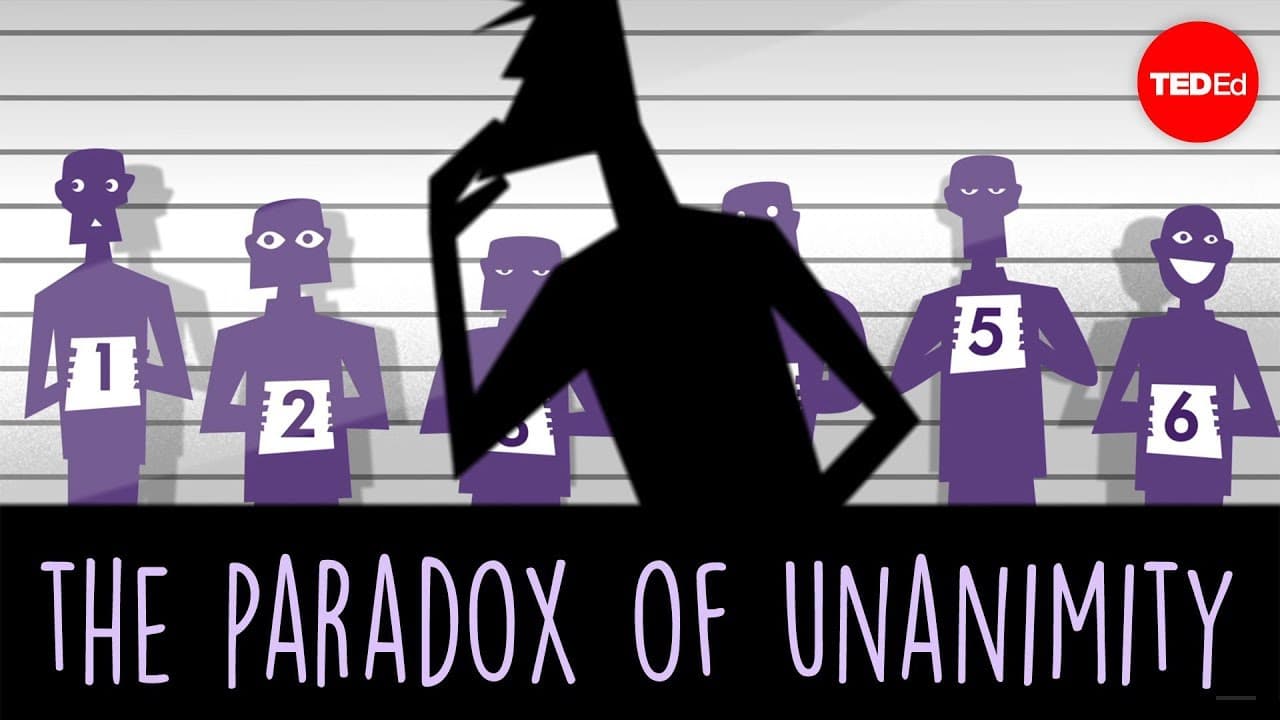
Imagine a police lineup where ten witnesses are asked to identify a bank robber they glimpsed fleeing the crime scene. If six of them pick out the same person, there's a good chance that's the real culprit, and if all ten make the same choice, you might think the case is rock solid, but you'd be wrong. For most of us, this sounds pretty strange. ... Read More
Key Insights
- 🪪 Witness identifications can be unreliable due to memory errors and overconfidence in judgments.
- 🥺 Systematic errors, whether accidental or deliberate, can lead to consistent but wrong conclusions.
- 🧑🏭 The paradox of unanimity highlights the complexity of achieving true consensus and the presence of hidden factors in decision-making.
- 💯 Perfect agreement may not always indicate truth but could signal underlying issues in the system.
- ❓ Varied distribution in judgments may be more realistic than unanimous agreement in situations with uncertainty.
- ❓ Unanimous agreement should be critically evaluated in contexts where variability and disagreement are natural.
- ❓ Human judgment and forensic evidence can be susceptible to errors, bias, and manipulation, impacting the reliability of unanimous decisions.
Install to Summarize YouTube Videos and Get Transcripts
Explore YouTube Video Summarizer or Get YouTube Transcript Extractor
Questions & Answers
Q: Why is unanimous agreement not always reliable in witness identifications?
Unanimous identifications can be influenced by memory errors and biases, leading to faulty judgments even when many are confident in their choice.
Q: How can systematic errors affect forensic evidence like DNA samples?
Systematic errors, such as contamination in DNA samples, can lead to consistent but inaccurate results, like the case of the Phantom of Heilbronn where contaminated swabs incriminated an innocent woman.
Q: What can deliberate fraud reveal about the paradox of unanimity?
Deliberate fraud, as seen in Saddam Hussein's 2002 referendum, demonstrates how perfect agreement may indicate manipulation rather than genuine consensus, highlighting the limitations of unanimity.
Q: Why should hidden factors be considered when interpreting unanimous agreement?
Hidden factors, such as human error, bias, or system flaws, can influence unanimous agreement, making it necessary to critically analyze the context and likelihood of variability.
Summary & Key Takeaways
-
Unanimous identification in witness lineups can be flawed due to human memory inaccuracies.
-
Systematic errors can arise from contaminated evidence, deliberate fraud, or biased judgments.
-
Perfect agreement may signal hidden factors affecting the system rather than actual truth.
Read in Other Languages (beta)
Share This Summary 📚
Summarize YouTube Videos and Get Video Transcripts with 1-Click
Try YouTube Summary with ChatGPT & Claude or YouTube Transcript Generator
Explore More Summaries from TED-Ed 📚






Summarize YouTube Videos and Get Video Transcripts with 1-Click
Try YouTube Summary with ChatGPT & Claude or YouTube Transcript Generator