Gravitation (4 of 17) Calculating Acceleration Due to Gravity (g)
TL;DR
Learn how to calculate acceleration due to gravity on Earth, the Moon, and above Earth's surface.
Transcript
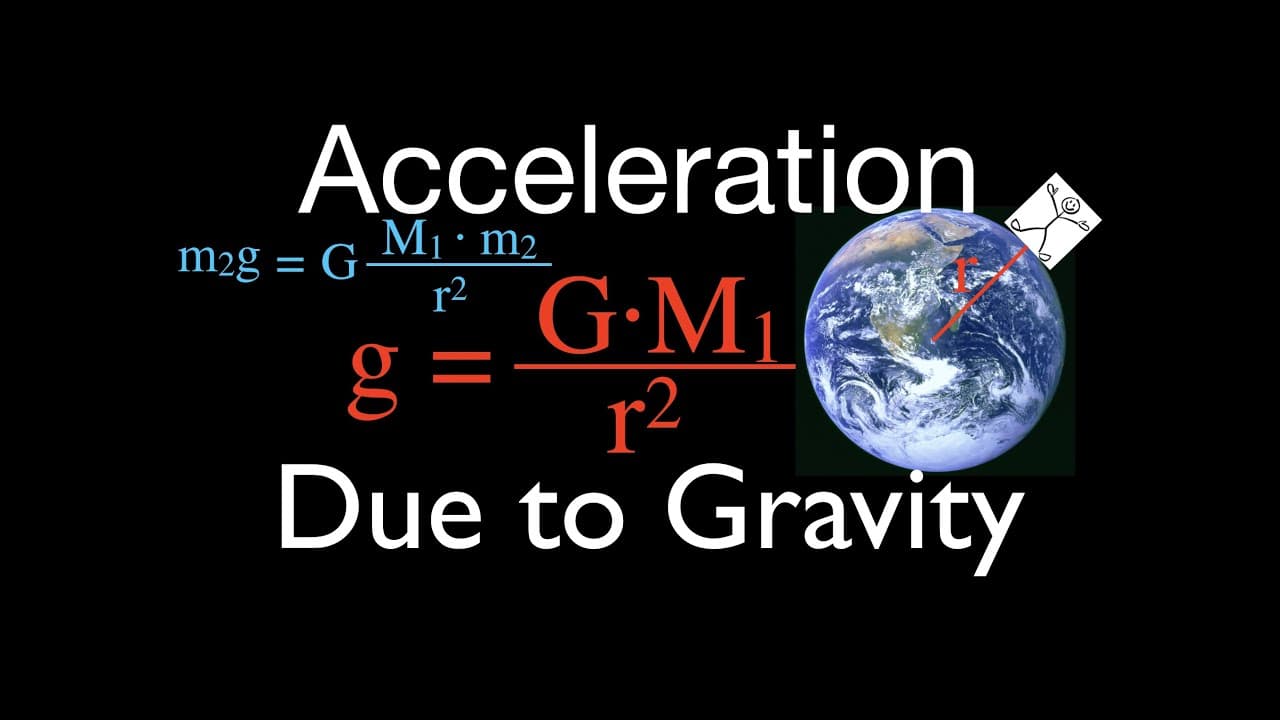
okay into this video I'm gonna go over how to calculate the acceleration due to gravity now most people know or you should know that the acceleration due to gravity on this earth or near the surface of the earth is actually 9.81 m/s^2 that's G that's abbreviation for the excited new gravity and on the Earth's surface the accelerate due to gravity i... Read More
Key Insights
- 💆 Acceleration due to gravity formula: G = (Gravitational constant * mass of object) / (distance from center squared).
- 🌎 Earth's acceleration due to gravity is 9.81 m/s^2 at its surface.
- 😀 The Moon's acceleration due to gravity is about 1.62 m/s^2, approximately one-sixth of Earth's.
- 💆 The acceleration due to gravity decreases as distance from the center of mass increases.
- 😀 Calculations for the International Space Station show a value of 8.29 m/s^2 due to the distance from Earth's center and orbital height.
- 💆 Gravity is directly proportional to the mass of the central object and inversely proportional to distance squared.
- 🦻 Understanding acceleration due to gravity aids in weight calculations on different celestial bodies.
Install to Summarize YouTube Videos and Get Transcripts
Explore YouTube Video Summarizer or Get YouTube Transcript Extractor
Questions & Answers
Q: How is acceleration due to gravity calculated?
Acceleration due to gravity is calculated using the formula G = (Gravitational constant * mass of object) / (distance from center squared), where G is the acceleration due to gravity.
Q: What is the significance of the mass of the object in the acceleration due to gravity calculation?
The mass of the object directly influences the magnitude of acceleration due to gravity; a greater mass results in a stronger gravitational pull.
Q: How does the distance from the center of the object impact acceleration due to gravity?
The distance from the center of the object, when squared, inversely affects acceleration due to gravity; as distance increases, acceleration due to gravity decreases.
Q: Why does the acceleration due to gravity differ between Earth, the Moon, and above Earth's surface?
The different values for acceleration due to gravity are due to variations in the masses and distances from the center of the respective objects.
Summary & Key Takeaways
-
Explained the formula for calculating acceleration due to gravity as G = (Gravitational constant * mass of object) / (distance from center squared).
-
Demonstrated calculations for Earth, Moon, and above Earth's surface using the formula.
-
Highlighted the inverse relationship between acceleration due to gravity and distance from the center of the object.
Read in Other Languages (beta)
Share This Summary 📚
Summarize YouTube Videos and Get Video Transcripts with 1-Click
Try YouTube Summary with ChatGPT & Claude or YouTube Transcript Generator
Explore More Summaries from Step by Step Science 📚
Summarize YouTube Videos and Get Video Transcripts with 1-Click
Try YouTube Summary with ChatGPT & Claude or YouTube Transcript Generator