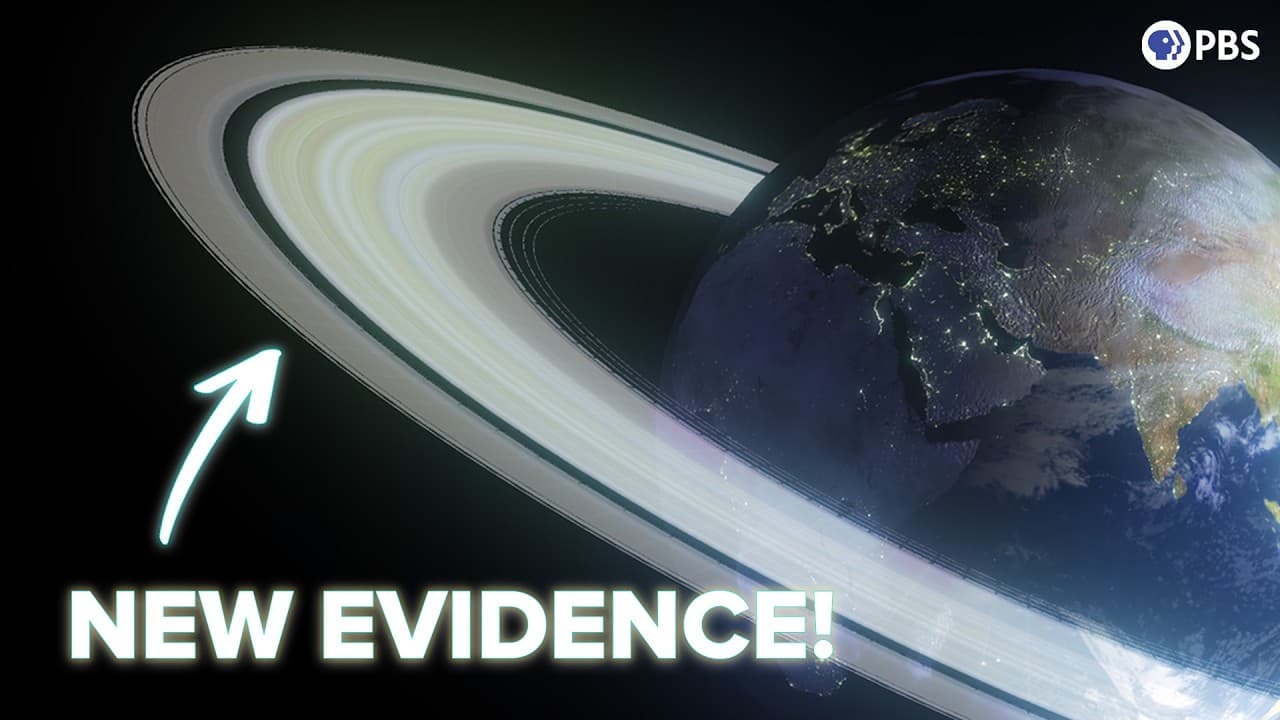
NEW EVIDENCE: Earth Had Rings (and Might Regain Them)
TL;DR
Earth may have had rings, and might regain them.
Transcript
Planet Earth is the jewel of the solar system—the shimmery blue oceans, the verdant green forests, the wispy whimsical cloud formations. Saturn would be the only competitor for most gorgeous planet with that giant ring system. But you know what? If we could put the jewel of the Earth in its own ring? There'd be no contest. Well, there’s an extr... Read More
Key Insights
- Earth possibly had a ring system around 466 million years ago, suggested by a study from Monash University.
- Planetary rings can form through tidal forces or collisions, and may eventually transform into moons.
- Earth's past ring system might have resulted from a near-miss with a large asteroid, creating debris captured by Earth's gravity.
- The Ordovician impact spike suggests a significant influx of L-chondrite meteorites, potentially from a collapsed planetary ring.
- Evidence for Earth's ancient rings includes impact craters located near the equator, traced back through tectonic movements.
- A planetary ring could have contributed to the Hirnantian glaciation by acting as a sunshade, intensifying winters.
- Testing the ring hypothesis involves finding more impact craters and analyzing their distribution relative to the equator.
- Future possibilities of Earth regaining rings involve similar asteroid events, potentially leading to dramatic meteor activity and climate changes.
Install to Summarize YouTube Videos and Get Transcripts
Explore YouTube Video Summarizer or Get YouTube Transcript Extractor
Questions & Answers
Q: What evidence supports the hypothesis that Earth once had a ring system?
The hypothesis is supported by a study indicating a significant influx of L-chondrite meteorites during the Ordovician period, suggesting a collapsed planetary ring. Impact craters traced back to the equator further support this idea, indicating the debris originated from a ring rather than the asteroid belt.
Q: How might a planetary ring have contributed to the Hirnantian glaciation?
A planetary ring could have acted as a sunshade, reducing sunlight reaching certain hemispheres during winter. This would result in harsher winters, potentially triggering the growth of glaciers and initiating the Hirnantian glaciation, which was a significant ice age during the Ordovician period.
Q: What are the potential ways for Earth to regain a ring system?
Earth could potentially regain a ring system through a near-miss with a large asteroid, similar to the event hypothesized to have occurred 466 million years ago. Such an event could create debris captured by Earth's gravity, forming a temporary ring system that might eventually collapse onto the planet.
Q: What methods can be used to test the hypothesis of Earth's ancient rings?
Testing the hypothesis involves finding more impact craters from the Ordovician period and analyzing their distribution relative to the equator. If additional craters are found within the equatorial region, it would support the ring hypothesis. Conversely, craters far from the equator would challenge the idea.
Q: What are the implications of a planetary ring on Earth's climate?
A planetary ring could significantly impact Earth's climate by providing a sunshade effect, particularly during winter months. This could lead to more severe winters and potentially trigger ice ages, as hypothesized for the Hirnantian glaciation during the Ordovician period.
Q: How do planetary rings form and disappear?
Planetary rings can form from tidal forces or collisions that create debris around a planet. These rings may eventually disappear as particles fall onto the planet or coalesce into moons. The Roche limit determines whether particles remain as rings or form moons, depending on their proximity to the planet.
Q: What role did tectonic movements play in supporting the ring hypothesis?
Tectonic movements allowed researchers to trace the locations of Ordovician impact craters back to their original positions, revealing that they were located near the equator. This supports the hypothesis that the meteorites originated from a planetary ring rather than from random asteroid belt impacts.
Q: What are the challenges in confirming the hypothesis of Earth's ancient rings?
Challenges include the difficulty in accurately determining the original locations of impact craters and the need for additional evidence to confirm the equatorial distribution of meteorite impacts. Further research and discoveries of new craters are necessary to strengthen or refute the hypothesis.
Summary & Key Takeaways
-
A recent study proposes that Earth might have had a ring system around 466 million years ago, evidenced by a spike in meteor activity. This ancient ring system could have formed from a near-miss with an asteroid, leading to debris captured by Earth's gravity.
-
The Ordovician impact spike, characterized by an influx of L-chondrite meteorites, could be linked to a collapsed planetary ring. Evidence includes impact craters near the equator, traced back through tectonic movements, supporting the ring hypothesis.
-
A planetary ring might have contributed to the Hirnantian glaciation by providing a sunshade effect, intensifying winters. Testing this hypothesis involves finding more impact craters and analyzing their distribution relative to the equator.
Read in Other Languages (beta)
Share This Summary 📚
Summarize YouTube Videos and Get Video Transcripts with 1-Click
Try YouTube Summary with ChatGPT & Claude or YouTube Transcript Generator
Explore More Summaries from PBS Space Time 📚




Summarize YouTube Videos and Get Video Transcripts with 1-Click
Try YouTube Summary with ChatGPT & Claude or YouTube Transcript Generator