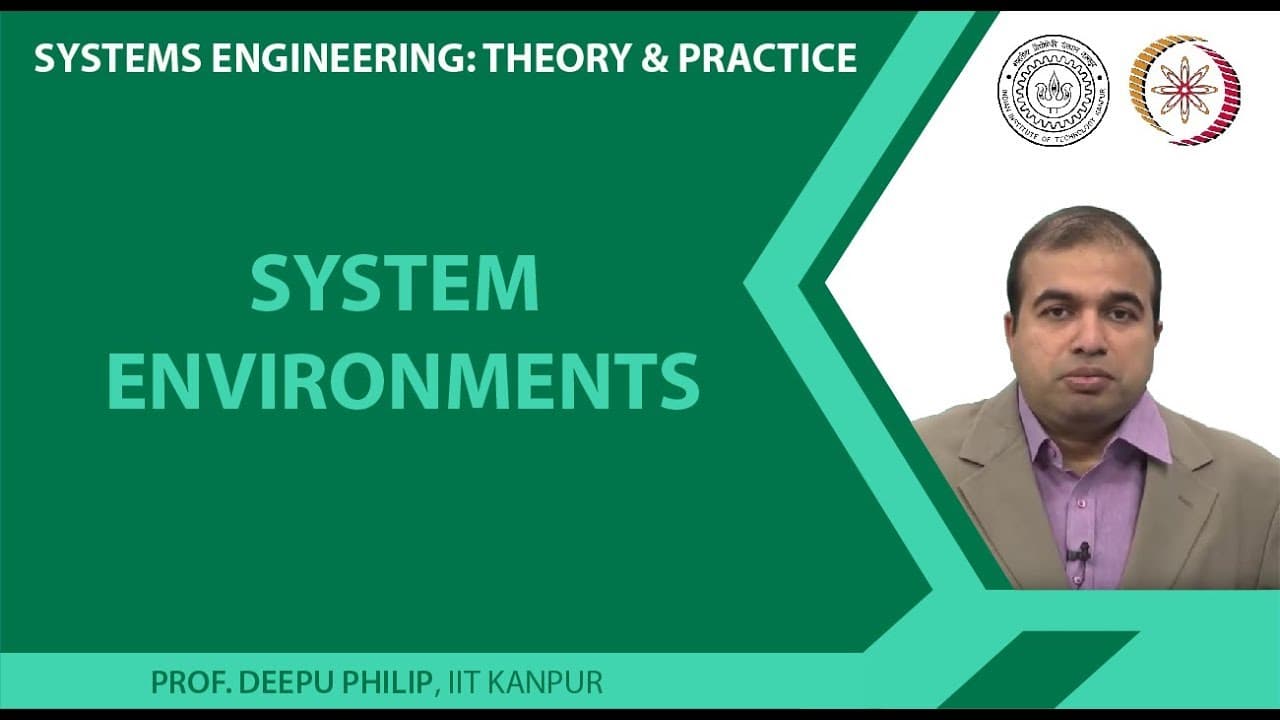
System Environments
TL;DR
Explains systems environments and context diagrams for effective systems engineering.
Transcript
good morning we will I welcome you to the tenth lecture of systems engineering today titled systems environment so we will be discussing about the environment and within which the system operates and I'm dr. beautifully from IIT Kanpur so we've been studying quite a lot about systems engineering and we slowly started understanding t... Read More
Key Insights
- Systems environments encompass everything outside a system that interacts with it, crucial for developing system requirements.
- Identifying system boundaries is challenging yet essential to understand what is inside and outside the system.
- Context diagrams serve as communication tools, illustrating external entities and their interactions with the system.
- Primary interactions involve elements interacting with a system's primary functions, such as inputs and outputs.
- Secondary interactions are indirect, like ambient temperature affecting a heating system's operation.
- Operational maintenance can be both primary and secondary, depending on its interaction with the system over time.
- Physical environments include support systems, system housing, threats, and shipping, impacting system operations.
- Operators are typically external to systems; systems engineers focus on interfaces for successful operations.
Install to Summarize YouTube Videos and Get Transcripts
Explore YouTube Video Summarizer or Get YouTube Transcript Extractor
Questions & Answers
Q: What is the significance of understanding system environments?
Understanding system environments is crucial as it involves everything outside the system that interacts with it. This understanding helps in developing system requirements by identifying, specifying, and detailing the interactions between the system and its environment. It ensures that the system can operate effectively under various conditions and within its lifecycle.
Q: Why are context diagrams important in systems engineering?
Context diagrams are vital communication tools in systems engineering. They help illustrate the external entities and their interactions with the system. By providing a pictorial representation, context diagrams facilitate understanding among users, systems engineers, and designers. They focus on the system's environment, entities, and interactions, rather than the internal system details.
Q: How do primary and secondary interactions differ?
Primary interactions involve elements that directly interact with a system's primary functions, such as inputs, outputs, and controls. These interactions are essential for the system's operation. In contrast, secondary interactions are indirect and non-functional, like ambient temperature affecting a heating system. They influence the system but are not part of its primary functions.
Q: What role do operators play in system environments?
Operators, typically external to the system, interact with it through interfaces. Systems engineers focus on these interfaces since operators can vary and have different operating styles. By ensuring effective interfaces, systems engineers enhance the system's success and usability, regardless of the operator's individual characteristics or methods.
Q: How does operational maintenance impact system interactions?
Operational maintenance can be both primary and secondary. It becomes primary when maintenance tasks are necessary for the system's continued function, directly influencing its primary functions. At other times, when maintenance is not ongoing, it is secondary. The interaction varies over time, depending on the system's maintenance schedule and requirements.
Q: What constitutes the physical environment of a system?
The physical environment includes support systems, system housing, threats, and shipping and handling. Support systems are infrastructure elements the system relies on to execute missions. System housing provides protection or a platform for system elements. Threats can be natural or man-made, affecting the system's operation. Shipping and handling involve moving the system from manufacturing to operational sites.
Q: Why is defining system boundaries challenging?
Defining system boundaries is challenging because it requires clear and specific identification of what is inside and outside the system. Misrepresentation or miscalculation of boundaries can lead to system failures. Different organizations may define boundaries differently, adding complexity. Accurate boundary definition is crucial for understanding system environments and interactions.
Q: What is the role of threats in system environments?
Threats in system environments can be natural, like seawater corroding a ship, or man-made, such as an ATM being robbed. They are part of the physical environment and can significantly impact system operations. Understanding and mitigating these threats are essential for ensuring the system's integrity, functionality, and security.
Summary & Key Takeaways
-
The lecture discusses the concept of systems environments, emphasizing the importance of understanding interactions between a system and its environment. It highlights the necessity of defining system boundaries to distinguish what is internal and external. This understanding aids in developing system requirements effectively.
-
Context diagrams are introduced as essential tools for systems engineers. They visually represent external entities and their interactions with the system, facilitating communication among users, engineers, and designers. The diagrams focus on displaying the environment rather than detailing the system itself.
-
The lecture covers different types of interactions, including primary and secondary interactions, and explains the role of physical environments. It also addresses the significance of operators, operational maintenance, and the impact of support systems, housing, threats, and shipping on system functionality and success.
Read in Other Languages (beta)
Share This Summary 📚
Summarize YouTube Videos and Get Video Transcripts with 1-Click
Try YouTube Summary with ChatGPT & Claude or YouTube Transcript Generator
Explore More Summaries from Systems Engineering: Theory & Practice 📚


Summarize YouTube Videos and Get Video Transcripts with 1-Click
Try YouTube Summary with ChatGPT & Claude or YouTube Transcript Generator