What Is Quantum Randomness and How Does It Work?
TL;DR
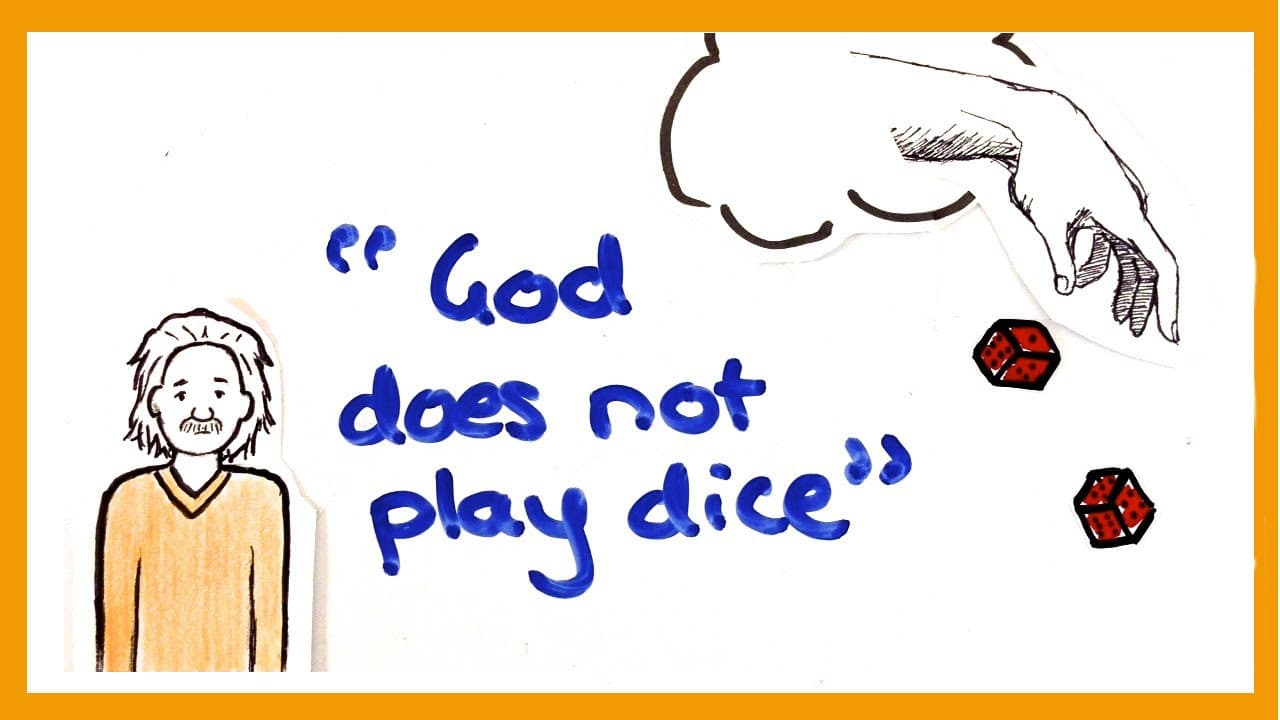
Quantum randomness is fundamentally different from classical randomness as it is truly unpredictable, with the outcome of events not determined by prior conditions. In quantum mechanics, measurement causes the wavefunction to collapse into a single state, resulting in distinct and observable behaviors that can only be predicted in probabilistic terms.
Transcript
The outcome of a coin flip is completely random. Only it’s not random at all. If I’d known exactly how the coin started and what forces acted on it, and if I could do the calculations quick enough I could have predicted the outcome. It only looked random because there were these hidden variables I didn’t take into account. We’ll call this classical... Read More
Key Insights
- 🏛️ Classical randomness is different from quantum randomness because quantum randomness is truly unpredictable.
- 🦾 The coefficients in the wavefunction determine the probability of particle behavior in quantum mechanics.
- 🥺 Measurement causes wavefunction collapse, leading to observable patterns in experiments.
- ♻️ Quantum superpositions are rare because they are easily disrupted by interactions with the environment.
- ✈️ Interaction with air, light, and other factors collapse the wavefunction, explaining why quantum weirdness is not commonly observed.
- 😀 Hidden variable alternatives to quantum mechanics exist but face challenges in explaining true randomness.
- ❓ Quantum randomness is a subject that has caused debates and difficulties for physicists.
Install to Summarize YouTube Videos and Get Transcripts
Explore YouTube Video Summarizer or Get YouTube Transcript Extractor
Questions & Answers
Q: What is the difference between classical randomness and quantum randomness?
Classical randomness is the result of hidden variables, while quantum randomness is truly unpredictable and does not allow for extra information or calculations to predict the outcome.
Q: In the double slit experiment with detectors behind each door, how does the particle behave?
Each particle goes through just one slit, but which slit it chooses is truly random according to standard quantum mechanics, with no underlying cause for its choice.
Q: In the double slit experiment, if one door is farther away, is the probability of the particle going through the closer door higher?
Yes, the probability is reflected in the coefficients of the wavefunction. The larger the coefficient, the more likely the corresponding state is to occur.
Q: If one person measures a particle and no one else knows the result, is the wavefunction collapsed for others?
Yes, the wavefunction is collapsed even if others are unaware of the measurement. This is because interactions with the particle cause the collapse, regardless of observer knowledge.
Summary & Key Takeaways
-
In classical physics, randomness appears because of hidden variables, but in quantum mechanics, true randomness exists due to the nature of wavefunctions.
-
The probability of a particle's behavior is determined by the coefficients in the wavefunction.
-
Measurement causes wavefunction collapse, and the particle is then in a single state, leading to observable patterns.
Read in Other Languages (beta)
Share This Summary 📚
Summarize YouTube Videos and Get Video Transcripts with 1-Click
Try YouTube Summary with ChatGPT & Claude or YouTube Transcript Generator
Explore More Summaries from Looking Glass Universe 📚




Summarize YouTube Videos and Get Video Transcripts with 1-Click
Try YouTube Summary with ChatGPT & Claude or YouTube Transcript Generator