United States v. Lopez | US government and civics | Khan Academy
TL;DR
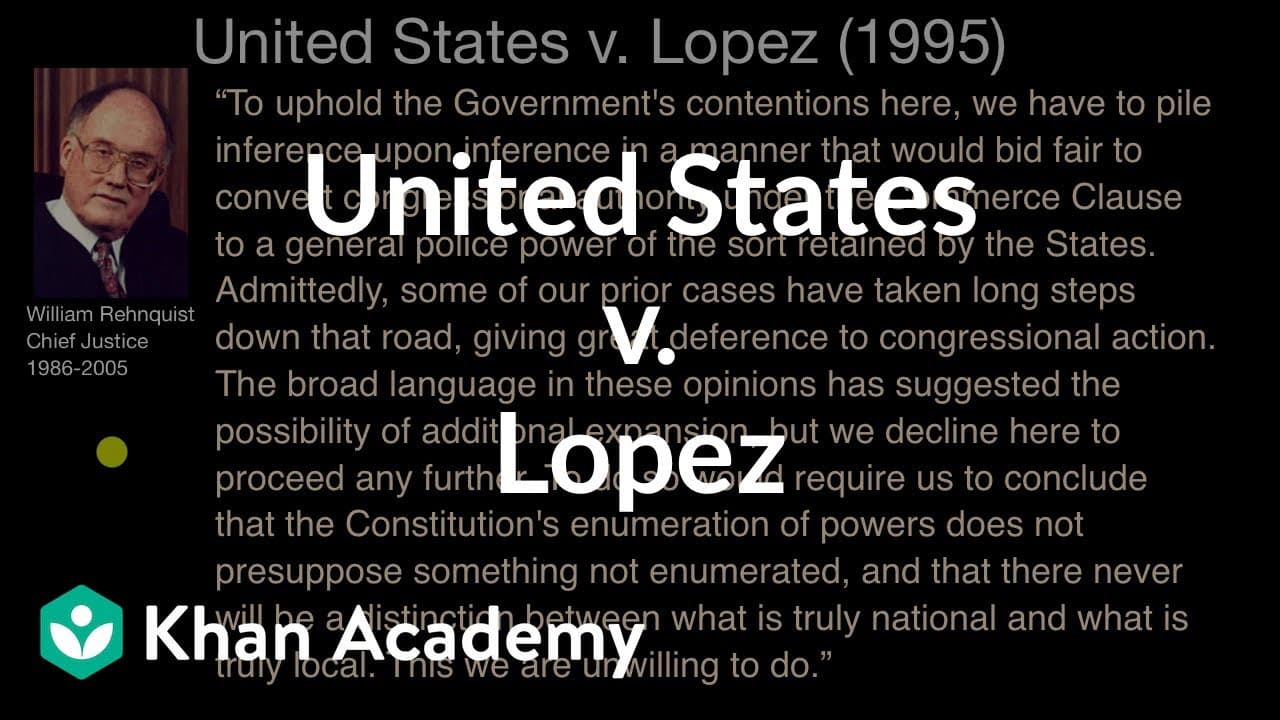
In the United States vs. Lopez case, the Supreme Court ruled that the Gun-Free School Zones Act of 1990 was unconstitutional, setting limits on federal power.
Transcript
- [Instructor] What we're going to do in this video is talk about a relatively recent U.S. Supreme Court case, and this is the United States versus Lopez, and the decision was made in 1995. And this is significant because many of the cases we have talked about are things that broadened the power of the federal government. While the decision in Unit... Read More
Key Insights
- 🇺🇸 The United States vs. Lopez case is significant as it established limits on federal power and prevented an unchecked expansion of Congressional authority.
- 🌍 The Supreme Court's ruling in favor of Lopez highlighted the importance of maintaining the distinction between what is truly national and what is truly local.
- 🤨 The case raised questions about the interpretation of the Commerce Clause and the extent of the federal government's authority.
Install to Summarize YouTube Videos and Get Transcripts
Explore YouTube Video Summarizer or Get YouTube Transcript Extractor
Questions & Answers
Q: What was the Gun-Free School Zones Act of 1990?
The Gun-Free School Zones Act made it unlawful to possess a firearm in a school zone. It was a federal law aimed at promoting school safety.
Q: Why did Lopez's lawyers claim the act was unconstitutional?
Lopez's lawyers argued that the act was an overreach of federal power because it connected the regulation of firearms in schools to interstate commerce, which they believed was a tenuous connection.
Q: What was the Supreme Court's ruling in the United States vs. Lopez case?
The Supreme Court ruled in favor of Lopez, stating that the Gun-Free School Zones Act, as it was originally written, exceeded Congress' authority under the Commerce Clause and was therefore unconstitutional.
Q: What was Chief Justice Rehnquist's reasoning behind the majority decision?
Chief Justice Rehnquist argued that accepting the government's contention that regulating firearms in schools falls under interstate commerce would give the federal government an unlimited police power, erasing the distinction between national and local powers.
Summary & Key Takeaways
-
The United States vs. Lopez case involved a high school student who was arrested and prosecuted under the Gun-Free School Zones Act of 1990 for carrying a concealed firearm into his school.
-
Lopez's lawyers argued that the federal government did not have the right to regulate firearms in schools.
-
The Supreme Court, in a split decision, ruled in favor of Lopez, finding the Gun-Free School Zones Act unconstitutional and setting limits on federal power.
Read in Other Languages (beta)
Share This Summary 📚
Summarize YouTube Videos and Get Video Transcripts with 1-Click
Try YouTube Summary with ChatGPT & Claude or YouTube Transcript Generator
Explore More Summaries from Khan Academy 📚





Summarize YouTube Videos and Get Video Transcripts with 1-Click
Try YouTube Summary with ChatGPT & Claude or YouTube Transcript Generator