Introduction to reaction quotient Qc | Chemical equilibrium | Chemistry | Khan Academy
TL;DR
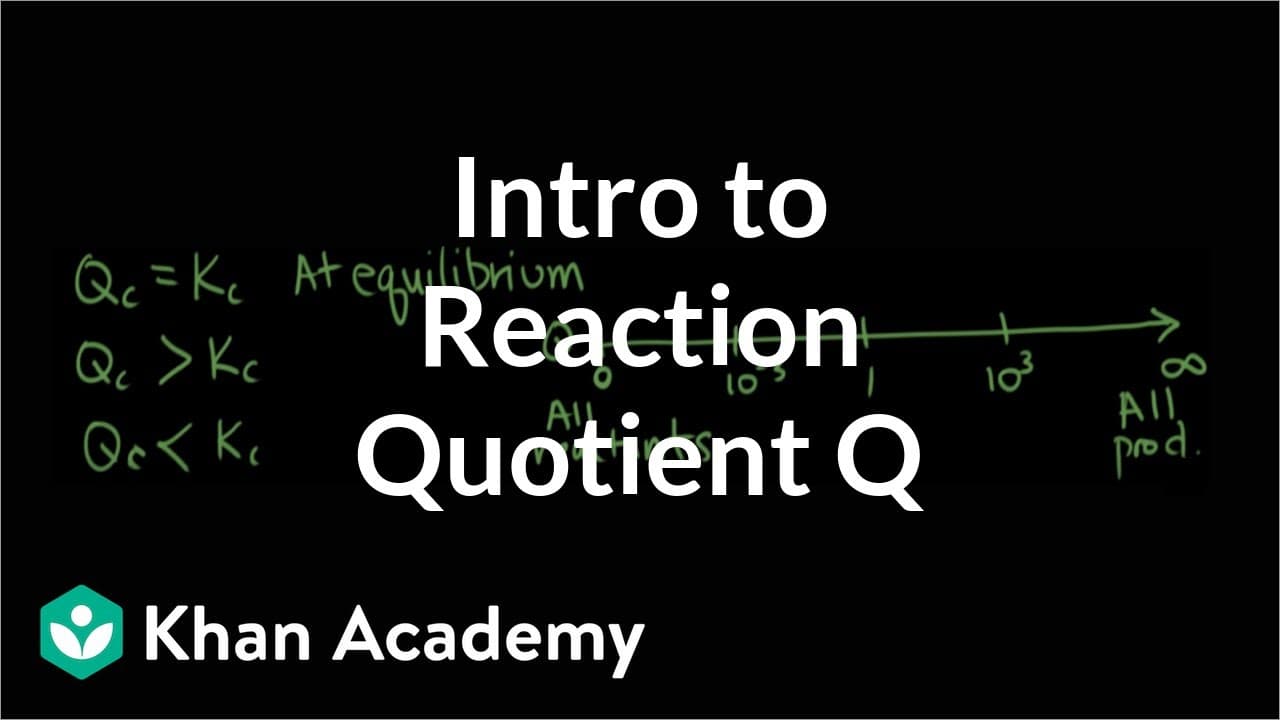
The Reaction Quotient (Q) is a tool used to determine if a reaction is at equilibrium. Q can be calculated using concentration values and compared to the equilibrium constant (K) to determine which direction the reaction will shift.
Transcript
- [Voiceover] Today we are going to be talking about the Reaction Quotient, Q. In this video, I'm going to go over, how you calculate Q and how you use it. We're gonna start with and example reaction between sulfur dioxide, S02 gas, which will react with oxygen gas, and this is a reversible reaction that makes sulfur trioxide or SO3. We should make... Read More
Key Insights
- ⚾ The Reaction Quotient (Q) is a calculation based on the concentrations of products and reactants in a chemical reaction.
- 😝 Q can be calculated at any point in the reaction, while the equilibrium constant (K) is calculated using only equilibrium concentrations.
- 👻 Comparing Q to K allows us to predict the direction in which a reaction will shift to reach equilibrium.
- 👌 If Q is greater than K, the reaction will favor the reactants. If Q is less than K, the reaction will favor the products.
- 💁 Q provides valuable information about the progress of a reaction and can help in understanding how the concentrations of reactants and products will shift over time.
- 👌 Analyzing Q and K can aid in determining the optimal conditions for a reaction to reach equilibrium.
- 😝 The relationship between Q and K can be represented on a number line, with Q values closer to K indicating a reaction closer to equilibrium.
Install to Summarize YouTube Videos and Get Transcripts
Explore YouTube Video Summarizer or Get YouTube Transcript Extractor
Questions & Answers
Q: What is the purpose of calculating the Reaction Quotient (Q) in a chemical reaction?
Q allows us to determine if a reaction is at equilibrium or in the process of reaching equilibrium. By comparing Q to the equilibrium constant (K), we can predict which direction the reaction will shift.
Q: How is the Reaction Quotient (Q) calculated?
Q is calculated using the concentrations of the products and reactants, raised to their stoichiometric coefficients. This can be done at any point in the reaction, unlike the equilibrium constant which is calculated using only equilibrium concentrations.
Q: How do you interpret the relationship between Q and K?
If Q is equal to K, the reaction is at equilibrium. If Q is greater than K, the reaction will favor the reactants and shift towards them. Conversely, if Q is less than K, the reaction will favor the products and shift towards them.
Q: Can you provide an example of using Q to analyze a reaction?
Let's say we have a reaction where Q is calculated to be 4,083 and the equilibrium constant K is 4.3. Since Q is greater than K, the reaction will favor the reactants and shift in that direction to reach equilibrium.
Summary & Key Takeaways
-
The Reaction Quotient (Q) is calculated using the concentrations of products and reactants in a chemical reaction.
-
Q is compared to the equilibrium constant (K) to determine if the reaction is at equilibrium.
-
If Q is greater than K, the reaction will shift towards the reactants, while if Q is less than K, the reaction will favor the products.
Read in Other Languages (beta)
Share This Summary 📚
Summarize YouTube Videos and Get Video Transcripts with 1-Click
Try YouTube Summary with ChatGPT & Claude or YouTube Transcript Generator
Explore More Summaries from Khan Academy 📚



Summarize YouTube Videos and Get Video Transcripts with 1-Click
Try YouTube Summary with ChatGPT & Claude or YouTube Transcript Generator