Capacitors (10 of 11) in Parallel, Calculating Charge Stored
TL;DR
Quick guide on calculating total charge in parallel capacitors using capacitance and voltage.
Transcript
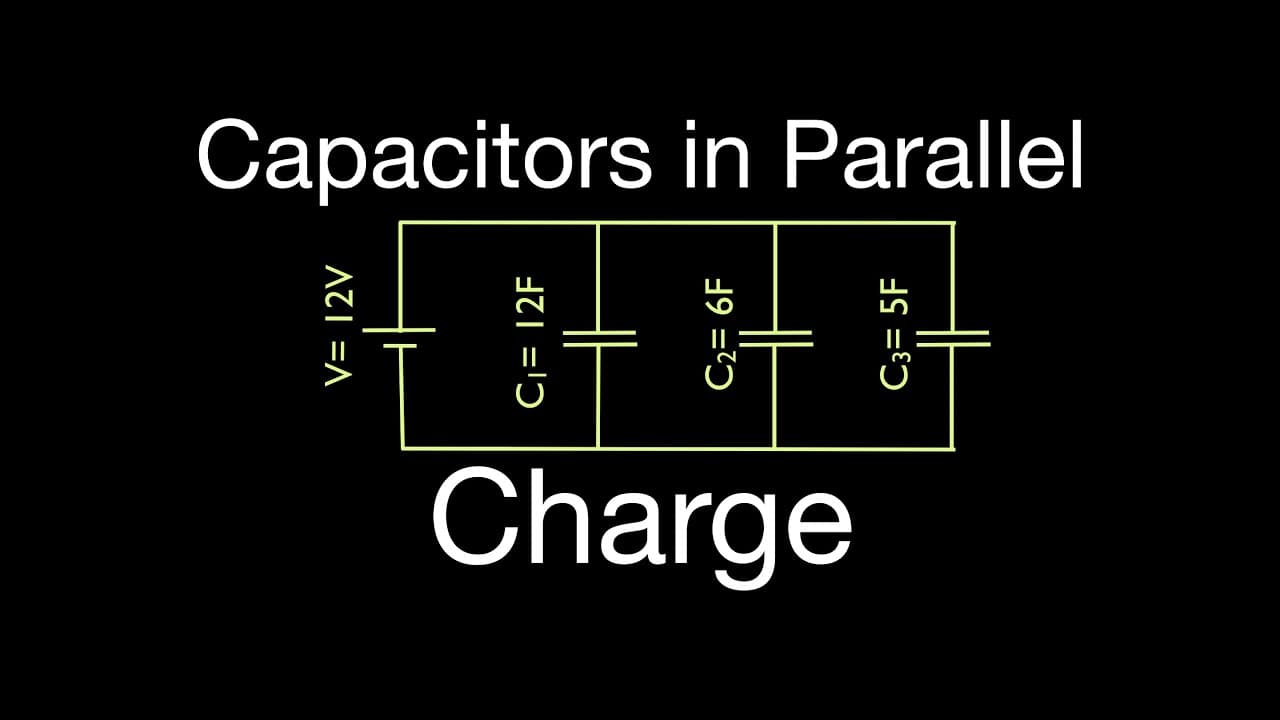
okay in today's video I'm going to go over how to determine the amount of stock George will shoot me the amount of charge that is stored on parallel capacitors this is the circuit we're going to use we have a 12 volt battery 12 volt voltage supply and we have C 1 C 2 and C 3 a 12 a 6 & a 5 farad capacitor respectively a farad is kind of a big numbe... Read More
Key Insights
- 🏪 Capacitance and voltage determine the charge stored in parallel capacitors.
- 🈂️ Total charge is the sum of charges on individual capacitors in parallel circuits.
- 🈂️ Capacitance values are additive in parallel circuits for total charge calculation.
- 🈂️ Simplify calculations by using Q = C * V for individual capacitor charges.
- ⚡ Understand the relationship between capacitance, voltage, and total charge in parallel circuits.
- ⚡ Consistency in voltage across parallel capacitors simplifies charge calculation.
- 🈂️ Two methods of calculating total charge: summing individual charges or using total capacitance and voltage.
Install to Summarize YouTube Videos and Get Transcripts
Explore YouTube Video Summarizer or Get YouTube Transcript Extractor
Questions & Answers
Q: How do you calculate the total charge in parallel capacitors?
To calculate total charge, sum the charge on individual capacitors using Q = C * V for each. Then add these charges together for the total.
Q: What is the relationship between capacitance and total charge in parallel circuits?
In parallel circuits, total charge is determined by the sum of individual capacitor charges, which are influenced by capacitance and voltage.
Q: Can capacitance in parallel circuits be directly added?
Yes, capacitance values in parallel circuits are directly added to find the total capacitance in the circuit, affecting the total charge stored.
Q: How does voltage play a role in determining capacitor charge?
In parallel circuits, the voltage across capacitors is equal to the supply voltage, simplifying calculation of charges using Q = C * V.
Summary & Key Takeaways
-
Explanation of calculating total charge in parallel capacitors using capacitance and voltage.
-
Total charge stored is sum of charges on individual capacitors in the circuit.
-
Two methods: calculating individual charges and adding, or using total capacitance and voltage.
Read in Other Languages (beta)
Share This Summary 📚
Summarize YouTube Videos and Get Video Transcripts with 1-Click
Try YouTube Summary with ChatGPT & Claude or YouTube Transcript Generator
Explore More Summaries from Step by Step Science 📚


Summarize YouTube Videos and Get Video Transcripts with 1-Click
Try YouTube Summary with ChatGPT & Claude or YouTube Transcript Generator