RLC Circuits (10 of 19) Series RC; Calculating Impedance, Current and Voltage
TL;DR
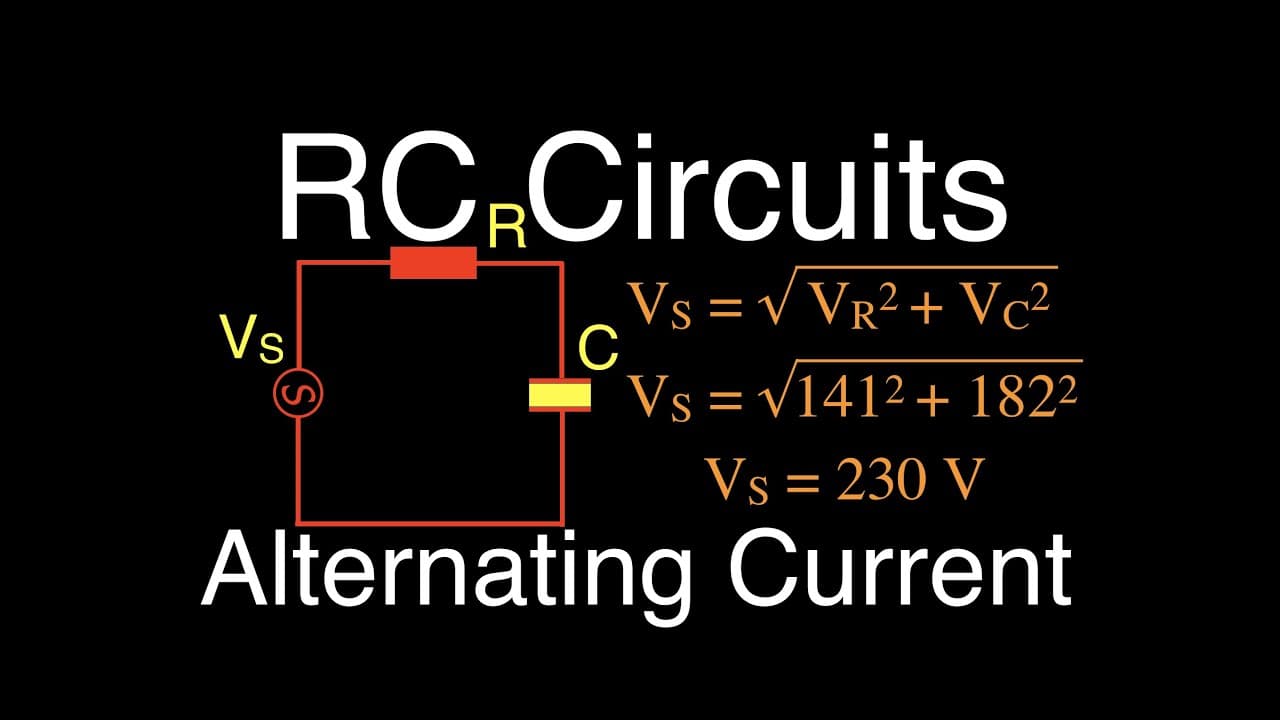
Analyzing an RC circuit with a 150 ohm resistor, 15 micro farad capacitor, 230V source at 55Hz, calculating impedance, current, voltage drops, and phase angle.
Transcript
okay today's video is entitled AC capacitive reactance part four in this video we're going to go over circuit analysis for a series our C circuit this is the circuit we have we have a resistor and a capacitor so we have an RC circuit and we have a time varying voltage source and the problem says here we have a 150 ohm resistor and a 15 micro farad ... Read More
Key Insights
- 💐 Calculation of impedance involves combining resistance and capacitive reactance in an AC circuit to determine total opposition to current flow.
- ⚡ Understanding phase angles in AC circuits reveals the phase relationship between voltage and current due to reactive components.
- 💦 Kirchhoff's laws apply to AC circuits, verifying the equality of voltage drops and gains to maintain energy conservation.
- 💦 Drawing phasor diagrams visually represents the magnitude and phase relationships of circuit parameters like impedance and voltage drops.
- 🔙 Phasor diagrams help in simplifying complex calculations and understanding the behavior of AC circuits with reactive elements.
- ⚡ Ensuring correct units and values for voltage sources, resistors, and capacitors are essential for accurate analysis of AC circuits.
- 💦 Checking calculations of current, voltage drops, and impedance through multiple methods ensures the accuracy of results in circuit analysis.
Install to Summarize YouTube Videos and Get Transcripts
Explore YouTube Video Summarizer or Get YouTube Transcript Extractor
Questions & Answers
Q: How is the impedance of an RC circuit calculated?
The impedance is calculated as the square root of the sum of the resistance squared and the capacitive reactance squared, determining the total opposition to current flow in the circuit.
Q: What is the significance of determining the phase angle in an AC circuit?
The phase angle indicates the relationship between voltage and current, showing the lag or lead of voltage relative to current in an RC circuit due to the capacitive reactance.
Q: Why is it essential to check for voltage drops equality in Kirchhoff's laws?
Kirchhoff's voltage law states that the sum of voltage drops must equal the voltage gains in a closed loop, ensuring conservation of energy and validating the calculations in an AC circuit analysis.
Q: How does drawing phasor diagrams help in visualizing circuit parameters?
Phasor diagrams represent the magnitude and phase relationships of voltage, current, and impedance vectors, aiding in understanding the complex interactions in an RC circuit.
Summary & Key Takeaways
-
Explaining circuit analysis for an RC circuit with specified components and a time-varying voltage source.
-
Calculating impedance using resistance and capacitive reactance, determining current flow, and voltage drops across components.
-
Drawing phasor diagrams to represent impedance, current, and voltage relationships in the circuit.
Read in Other Languages (beta)
Share This Summary 📚
Summarize YouTube Videos and Get Video Transcripts with 1-Click
Try YouTube Summary with ChatGPT & Claude or YouTube Transcript Generator
Explore More Summaries from Step by Step Science 📚



Summarize YouTube Videos and Get Video Transcripts with 1-Click
Try YouTube Summary with ChatGPT & Claude or YouTube Transcript Generator