How to Determine Optimum Solutions for Transportation Problems
TL;DR
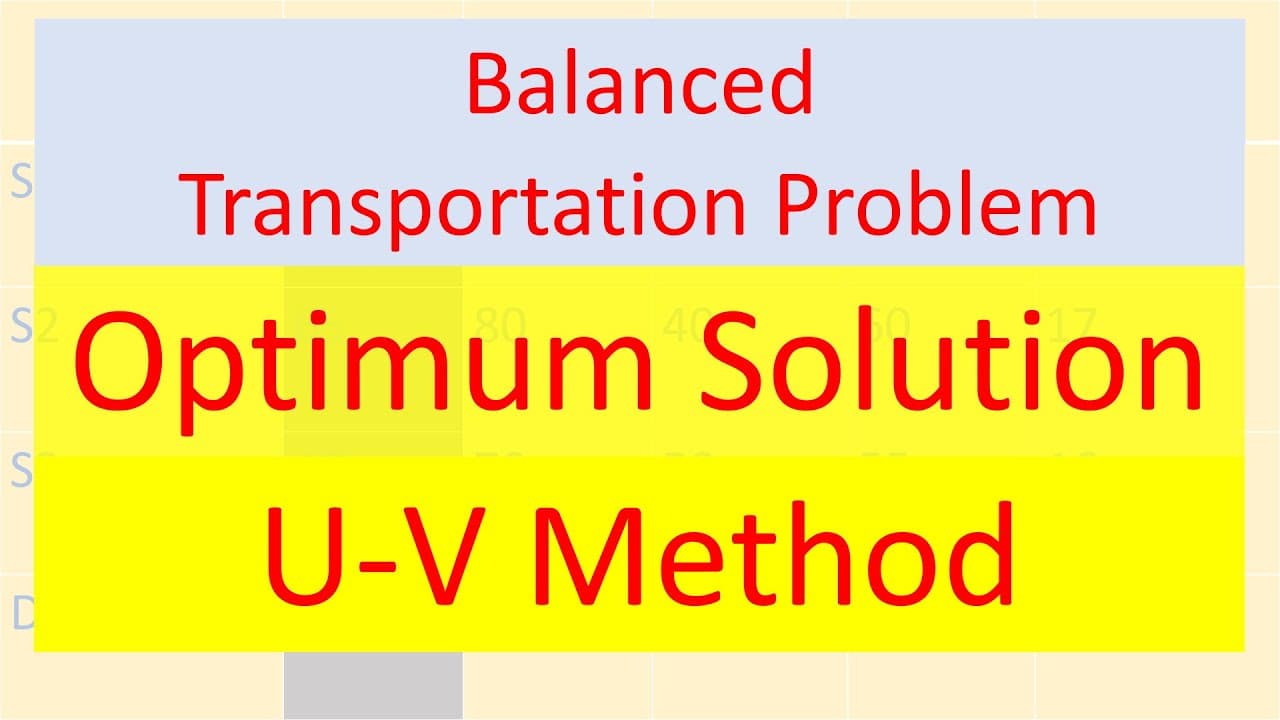
To find the optimum solution for transportation problems using the UV method, check the allocated cells and calculate UI and VJ values based on the initial feasible solution. Optimality is achieved when EIJ values for non-allocated cells are non-negative, indicating no further cost reduction is possible.
Transcript
hello everybody and welcome to lesson 15 transportation problem optimum solution in the previous lessons particularly in lesson 13 we have discussed about the feasible solutions of or we can say the initial feasible solutions of transportation problem and we solve it using three techniques that are the northwest corner the minimum sale cost method ... Read More
Key Insights
- ❓ Lesson 15 focuses on finding the optimum solution for transportation problems.
- ⏮️ The UV method is used, starting from the initial feasible solution obtained from previous methods.
- 😒 Checking the number of allocated cells is crucial to use the UV method.
- 🟰 UI and VJ values are determined by assuming UI equals 0 and solving equations.
- 🚱 Optimality is assessed by analyzing EIJ values for non-allocated cells.
- 😘 The optimal solution should have a lower cost compared to the initial feasible solutions.
Install to Summarize YouTube Videos and Get Transcripts
Explore YouTube Video Summarizer or Get YouTube Transcript Extractor
Questions & Answers
Q: What are the three methods discussed in Lesson 13 for finding initial feasible solutions?
The three methods are the northwest corner method, the minimum sale cost method, and Vogel's approximation method. They help determine initial feasible solutions for transportation problems.
Q: What is the UV method used for in transportation problems?
The UV method is used to find the optimum solution for transportation problems. It involves checking the number of allocated cells, finding UI and VJ values, and analyzing optimality conditions.
Q: How do you calculate the EIJ value for non-allocated cells?
EIJ is calculated by subtracting UI and VJ values from the per unit cost (CIJ) of non-allocated cells. A positive EIJ value means a cost increase, while a negative value signifies a reduction in per unit cost.
Q: How can you determine if the optimum solution has been achieved?
By checking the EIJ values, you can determine if the optimal solution has been achieved. If all EIJ values are positive or become positive, it means no further reduction in per unit cost is possible, and optimality has been achieved.
Summary & Key Takeaways
-
Lesson 13 discussed feasible solutions for transportation problems, using the northwest corner, minimum sale cost, and Vogel's approximation methods.
-
Lesson 14 covered solving the unbalanced transportation problem by adding dummy variables.
-
Lesson 15 focuses on finding the optimum solution through the UV method, involving checking the number of allocated cells, finding UI and VJ values, and analyzing the optimality conditions.
Read in Other Languages (beta)
Share This Summary 📚
Summarize YouTube Videos and Get Video Transcripts with 1-Click
Try YouTube Summary with ChatGPT & Claude or YouTube Transcript Generator
Explore More Summaries from Solomon Getachew 📚


Summarize YouTube Videos and Get Video Transcripts with 1-Click
Try YouTube Summary with ChatGPT & Claude or YouTube Transcript Generator