How to Determine Sample Size for Research
TL;DR
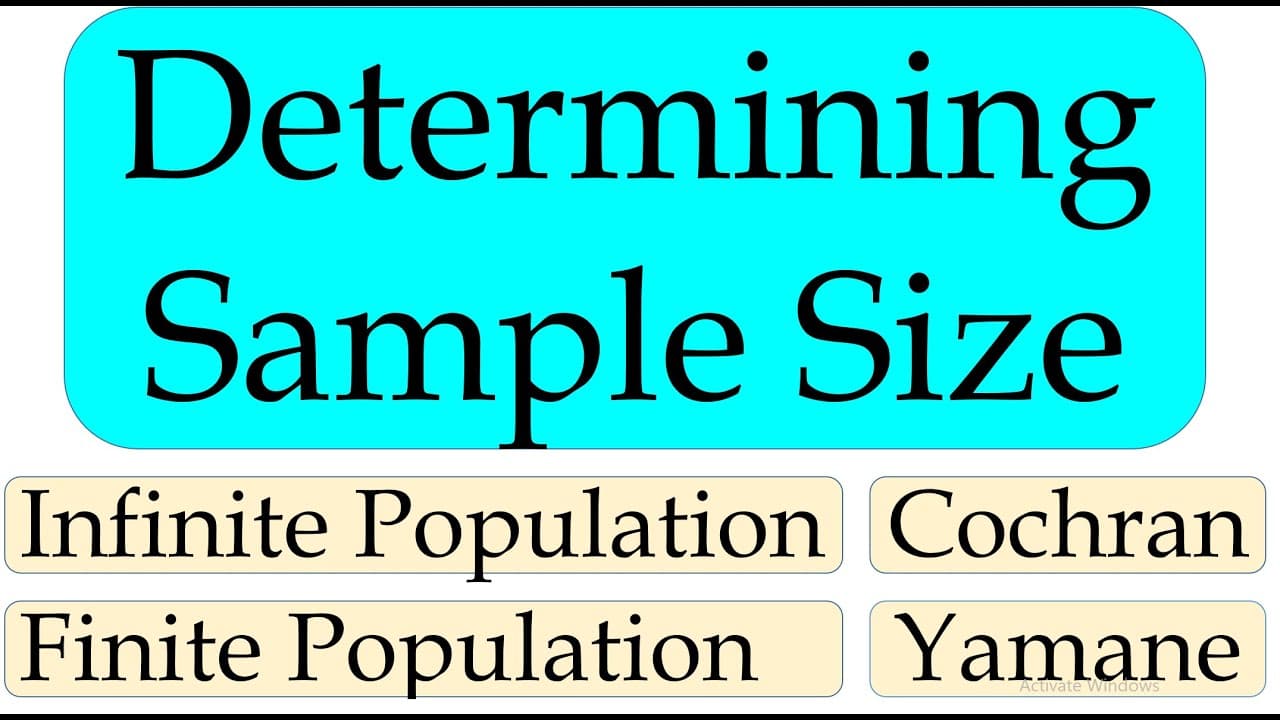
To accurately determine sample size for research, consider the desired precision, population variability, and confidence level. Using Cochran’s formula for infinite populations or Taro Iman’s formula for finite populations helps ensure that your sample represents the target population effectively.
Transcript
hello everybody and welcome to lesson 11 determining the sample size contents covered in this lesson are the first one is determining the sample size in the case of infinite population using Cochran formula and the second is determining the sample size in the case of finite population using Taro yemada formula if we want to conduct a research on a ... Read More
Key Insights
- 👨🔬 Conducting a census is resource-intensive and may be impractical for certain research studies.
- 🎚️ Determining sample size requires considering the margin of error, confidence level, and variability within the population.
- 🉑 Marginal error represents the acceptable variation between sample mean and population mean.
- 🎚️ The confidence level indicates the level of certainty that the confidence interval includes the true population mean.
- ❓ Variability within the population affects the required sample size.
- ❓ Cochran formula is used to determine sample size for infinite populations.
- ❓ Taro Iman formula provides a simplified approach for calculating sample size, assuming 95% confidence and a variability of 0.5.
Install to Summarize YouTube Videos and Get Transcripts
Explore YouTube Video Summarizer or Get YouTube Transcript Extractor
Questions & Answers
Q: What is the difference between conducting a census and taking a sample?
Conducting a census involves considering all sampling units in the population, resulting in a perfect representation but requiring significant resources. Taking a sample involves selecting a smaller representative group from the population, which is more practical and efficient.
Q: How is marginal error calculated, and why is it important?
Marginal error is the maximum acceptable variation or error between the sample mean and population mean, expressed as a percentage. It is determined based on research requirements and helps establish the confidence level and precision of the study.
Q: What does the confidence level indicate?
The confidence level indicates the level of certainty that the confidence interval, which includes the true score of the population, is correct. A 95% confidence level means that, if we repeatedly take samples, 95% of the time the corresponding confidence interval will be accurate.
Q: How does the degree of variability in the population affect sample size?
The degree of variability in the population, whether homogeneous or heterogeneous, impacts the sample size needed for a given level of precision. A more homogeneous population requires a smaller sample size, while a more heterogeneous population requires a larger sample size to achieve representative results.
Summary & Key Takeaways
-
Conducting a survey or research study on a population can be resource-intensive or infeasible, so sampling is often used instead.
-
Determining the sample size requires knowledge of the desired level of precision, variability within the population, and confidence level.
-
Marginal error represents the acceptable variation in sample mean from the population mean, expressed as a percentage, and is determined based on research requirements.
Read in Other Languages (beta)
Share This Summary 📚
Summarize YouTube Videos and Get Video Transcripts with 1-Click
Try YouTube Summary with ChatGPT & Claude or YouTube Transcript Generator
Explore More Summaries from Solomon Getachew 📚





Summarize YouTube Videos and Get Video Transcripts with 1-Click
Try YouTube Summary with ChatGPT & Claude or YouTube Transcript Generator