How to Solve Unbalanced Transportation Problems?
TL;DR
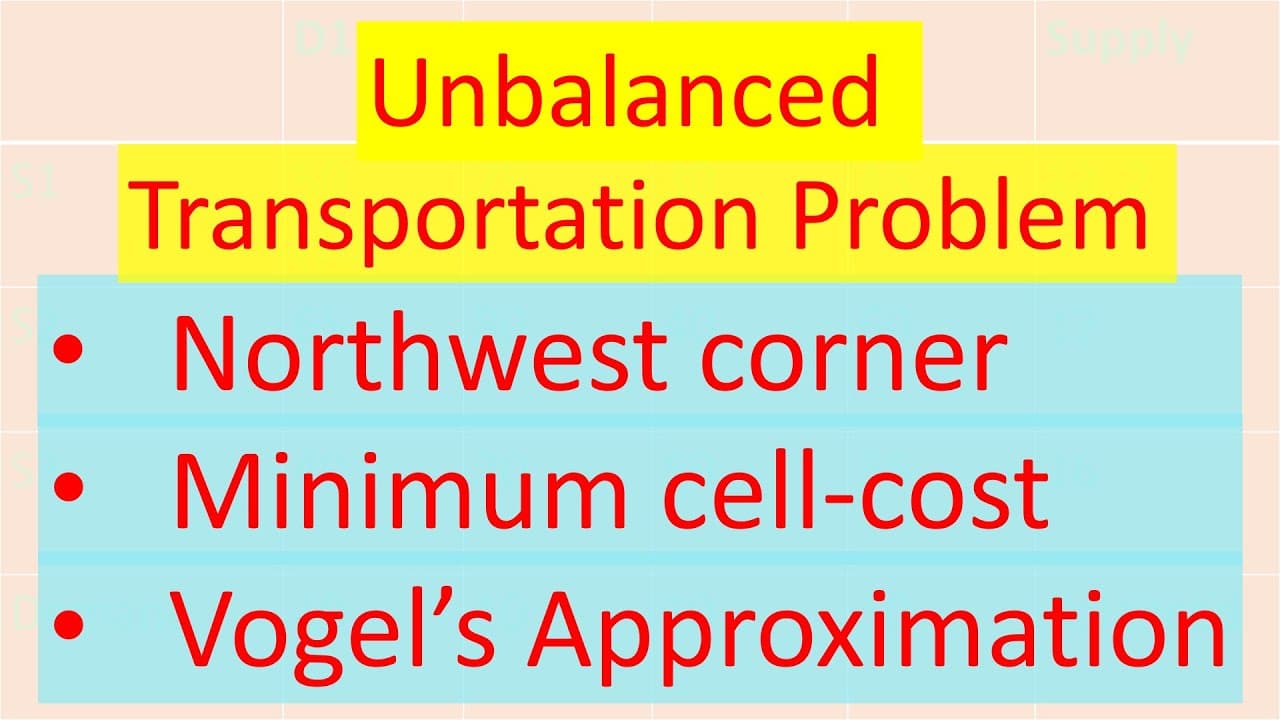
Use three effective methods to find initial feasible solutions for unbalanced transportation problems: the northwest corner method, the minimum sale cost method, and Vogel's approximation method. Each method includes steps for allocation and adjustments to supply and demand, with focus on converting unbalanced scenarios into balanced ones.
Transcript
hello everybody and welcome to lesson 14 unbalanced transportation problem solution previously in lesson 13 we have discussed about balanced transportation problem solution using the three meters and now we proceed with unbalanced transportation problem with three methods so the objective is finding the initial feasible solution for unbalanced tran... Read More
Key Insights
- 🇨🇷 Unbalanced transportation problems can be solved using various methods, including the northwest corner method, minimum sale cost method, and Vogel's approximation method.
- ⚖️ Adding dummy demand is necessary to balance an unbalanced transportation problem.
- 🇨🇷 Vogel's approximation method accounts for penalty costs or regret, resulting in a better initial solution.
- 🇨🇷 The northwest corner method is a simple approach to finding initial allocations, but it does not consider costs.
- 🇨🇷 The minimum sale cost method allocates based on the lowest costs, improving upon the northwest corner method.
- 🤨 Each method involves steps such as allocating supply and demand, adjusting values, and canceling out rows or columns with zero supply or demand.
- 🇨🇷 The total transportation cost can be calculated by multiplying the per unit cost by the number of items allocated to each cell.
- 😚 Vogel's approximation method tends to provide a solution that is closer to the optimal solution compared to the other methods.
Install to Summarize YouTube Videos and Get Transcripts
Explore YouTube Video Summarizer or Get YouTube Transcript Extractor
Questions & Answers
Q: What are the three methods discussed for finding initial feasible solutions to unbalanced transportation problems?
The three methods discussed are the northwest corner method, the minimum sale cost method, and Vogel's approximation method.
Q: How is an unbalanced transportation problem converted to a balanced problem?
To convert an unbalanced problem to a balanced problem, dummy demand is added to match the excess supply. The dummy demand value is equal to the difference between the total supply and total demand.
Q: How does Vogel's approximation method differ from the northwest corner and minimum sale cost methods?
Vogel's approximation method considers penalty costs or regret when selecting cells, resulting in a better starting solution compared to the other methods.
Q: What is the purpose of the northwest corner method?
The northwest corner method is used to find the initial allocation by starting from the top left corner of the transportation tableau and allocating as much as possible to the selected cell.
Summary & Key Takeaways
-
The content explains the three methods used to find initial feasible solutions for unbalanced transportation problems: northwest corner, minimum sale cost, and Vogel's approximation.
-
It demonstrates how to add dummy demand to make an unbalanced problem balanced.
-
The content provides step-by-step examples for each method, showing how to allocate supply and demand, adjust values, and cancel out rows or columns with zero supply or demand.
Read in Other Languages (beta)
Share This Summary 📚
Summarize YouTube Videos and Get Video Transcripts with 1-Click
Try YouTube Summary with ChatGPT & Claude or YouTube Transcript Generator
Explore More Summaries from Solomon Getachew 📚
Summarize YouTube Videos and Get Video Transcripts with 1-Click
Try YouTube Summary with ChatGPT & Claude or YouTube Transcript Generator