How to Calculate Mole Fraction in Solutions
TL;DR
To calculate the mole fraction of a component in a solution, divide the number of moles of that component by the total number of moles of all components. The mole fractions of all components in a solution should add up to one, and mole fractions are dimensionless quantities, meaning they have no units.
Transcript
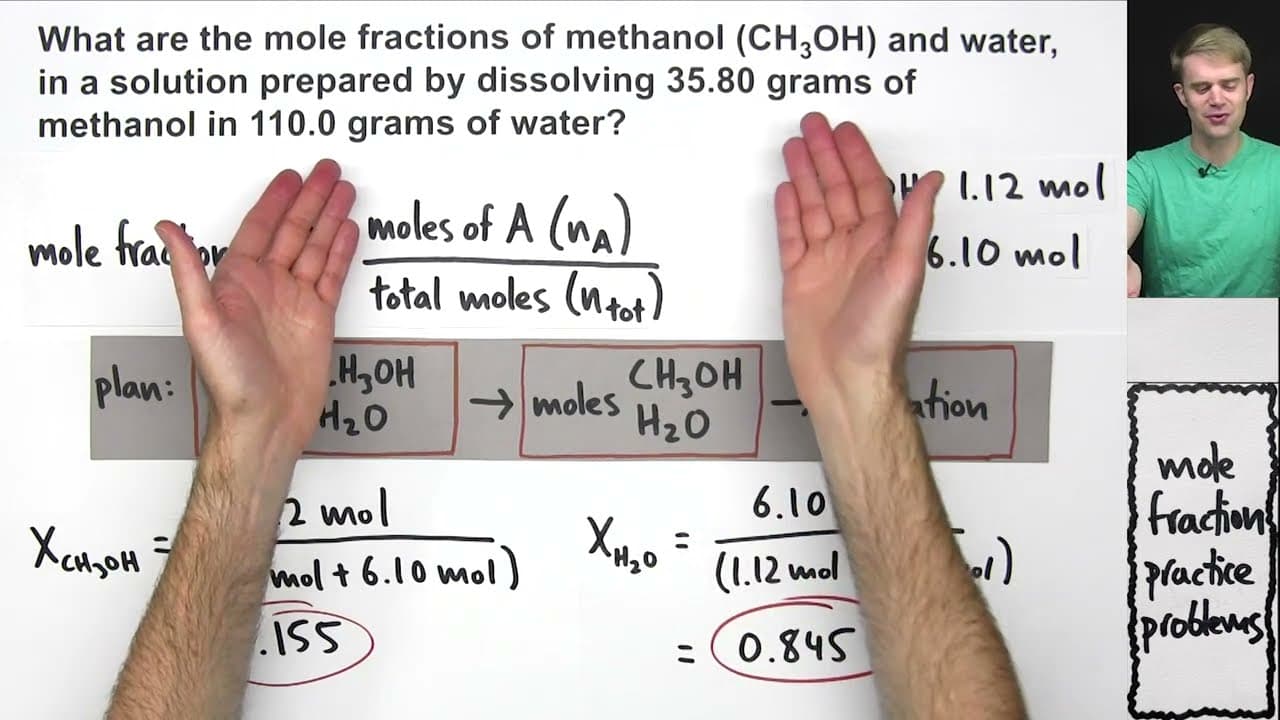
in this video we'll do some practice problems with mole fraction mole fraction is a way that we can calculate the concentration of different things in a solution here's the equation for mole fraction if we want to calculate the mole fraction of chemical a we'll take the number of moles of chemical a and we'll divide that by the total number of mole... Read More
Key Insights
- ❓ Mole fraction is used to calculate the concentration of components in a solution.
- 🗂️ Mole fraction is calculated by dividing the moles of a specific component by the total moles in the solution.
- 🪜 Mole fractions of all components in a solution should add up to one.
- 🇦🇪 Mole fraction is a dimensionless quantity and has no units.
- 🪡 If the amounts of components are given in grams, they need to be converted to moles before calculating mole fraction.
- 💆 The molar mass of a component is used to convert grams to moles.
- 🇦🇪 All the units of moles cancel out during the calculation of mole fraction.
Install to Summarize YouTube Videos and Get Transcripts
Explore YouTube Video Summarizer or Get YouTube Transcript Extractor
Questions & Answers
Q: What is mole fraction and how is it calculated?
Mole fraction is a way to measure the concentration of components in a solution. It is calculated by dividing the number of moles of a specific component by the total number of moles in the solution.
Q: Do the units matter when calculating mole fraction?
No, the units do not matter when calculating mole fraction. All the units of moles cancel out during the calculation, resulting in a dimensionless quantity with no units.
Q: What should the sum of all mole fractions in a solution add up to?
The sum of all mole fractions in a solution should add up to one. Mole fractions represent fractions of a whole, so when combined, they should equal one.
Q: Can mole fraction be calculated directly if the amounts of components are given in grams?
No, if the amounts of components are given in grams, they need to be converted to moles before calculating mole fraction. This conversion involves dividing the given grams by the molar mass of the component.
Summary & Key Takeaways
-
Mole fraction is calculated by dividing the number of moles of a specific component by the total number of moles in the solution.
-
Mole fractions of all components in a solution add up to one.
-
Mole fractions are dimensionless quantities with no units.
Read in Other Languages (beta)
Share This Summary 📚
Summarize YouTube Videos and Get Video Transcripts with 1-Click
Try YouTube Summary with ChatGPT & Claude or YouTube Transcript Generator
Explore More Summaries from Tyler DeWitt 📚



Summarize YouTube Videos and Get Video Transcripts with 1-Click
Try YouTube Summary with ChatGPT & Claude or YouTube Transcript Generator