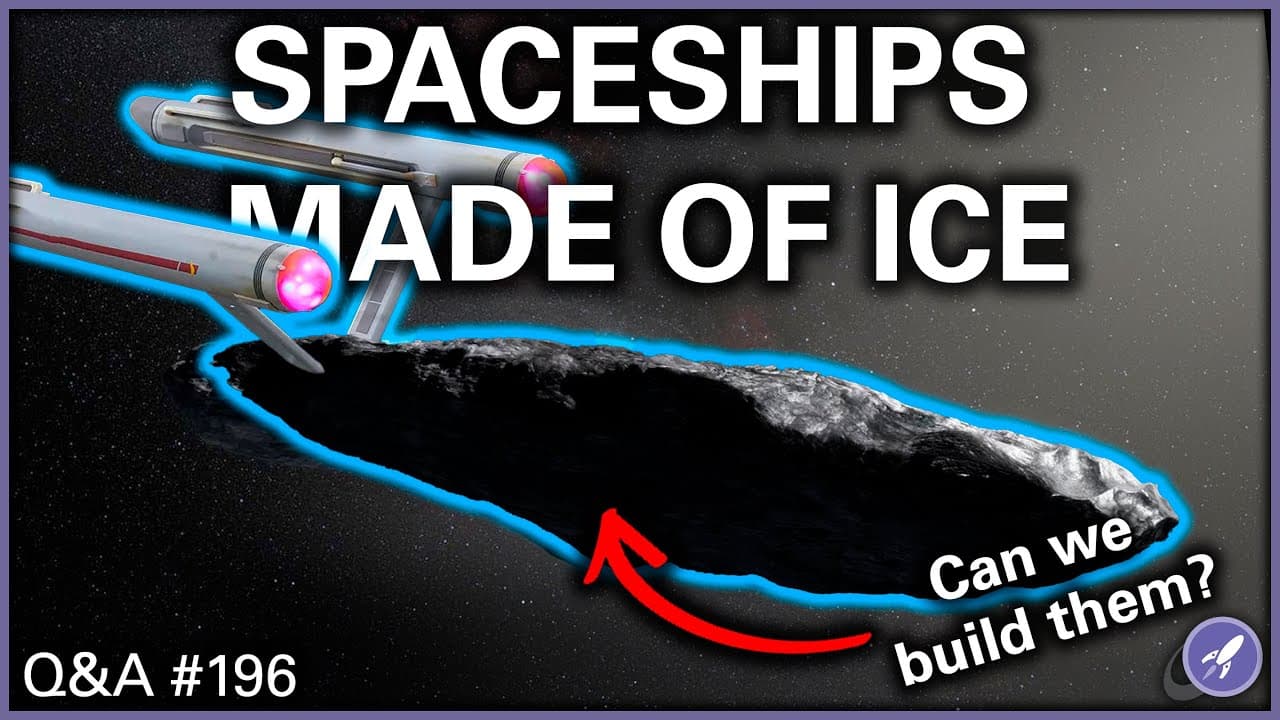
Spaceships Made of Ice, Best Space Pet, Astronomy and Photoshop | Q&A 196
TL;DR
- Fraser Kane answers live space and astronomy questions, including on telescopes, Mars missions, ice spaceships, and more.
Transcript
hi everyone I'm Fraser Kane I'm the publisher of universe today I've been a space and astronomy news journalist for over 20 years this is our question show your questions my answers now wherever you are across my channel if you're just watching any one of my videos If a question Pops in your brain just write it down I will gather a bunch of them up... Read More
Key Insights
- ❓ Cleaning up astronomical images involves extracting data for scientific or artistic purposes.
- 😀 Tidal locking explains why the Moon always shows the same face to Earth.
- 🚴 Potential habitable locations in the solar system extend beyond Earth, including Venus' upper atmosphere and icy moons' subsurfaces.
- 😀 SpaceX's Starship faces challenges for human Mars missions but aims to revolutionize space travel with reusable technology.
- 👨🚀 Ice structures could serve as multifunctional shields for astronauts in space.
- 🧑🔬 Exclusive data access for scientists ensures proper analysis prior to public dissemination.
- 🫒 Live Q&A sessions require spontaneous responses enriched by years of experience and knowledge.
Install to Summarize YouTube Videos and Get Transcripts
Explore YouTube Video Summarizer or Get YouTube Transcript Extractor
Questions & Answers
Q: What does it mean to have an astronomical image cleaned up?
Cleaning up an image in astronomy is a process to extract data from noise, either for scientific purposes or for artistic representation. Astronomers use various techniques to enhance data, while astrophotographers adjust image parameters for visual appeal.
Q: How does the Moon spin in the same ratio as the Earth?
The Moon's synchronous rotation means it always shows the same face to Earth, governed by tidal locking caused by gravitational forces. This phenomenon is common among large moons and their host planets in the solar system.
Q: How many habitable bodies are in the solar system?
While Earth remains the only truly habitable world, potential habitats are found in extreme environments like Venus' upper atmosphere, Mars' subsurface, and the oceans of icy moons. Such places offer conditions suitable for life as we know it.
Q: What are the odds of Starship's success?
Assessing Starship's success involves challenges like developing the super heavy booster, perfecting Starship's re-entry and landing capabilities, and ensuring the system's reliability for human spaceflight missions. SpaceX aims to revolutionize space travel with reusable rocket technology.
Q: Can spaceships be built out of ice for radiation protection?
Ice could serve as a protective shield against space radiation, though practicality hinges on accessing water sources in space. Building ice structures could provide multi-purpose benefits for shielding astronauts, managing resources, and facilitating future space missions.
Q: Why do scientists sit on data from telescopes?
Scientists reserve exclusive data access to analyze and make discoveries, preventing data theft or premature announcements. After a period, the data becomes publicly available, fostering collaboration and advancing scientific knowledge without jeopardizing original research goals.
Q: How long does it take to research and write a Q&A episode?
Fraser Kane's live Q&A sessions involve minimal pre-preparation, with questions chosen beforehand but answered spontaneously during the session. Years of experience and knowledge accumulation enable seamless responses to diverse space and astronomy inquiries.
Q: Are concerns and progress on Mars missions still ongoing?
Elon Musk and SpaceX aim to inaugurate human missions to Mars, though timelines have shifted due to technical challenges. Practical steps, like providing lunar landers for Artemis missions, enable incremental progress toward long-term Mars colonization goals.
Summary & Key Takeaways
-
Fraser Kane, an experienced space journalist, hosts live space and astronomy question and answer sessions.
-
The questions cover topics like cleaning up astronomical images, the Moon's rotation, Mars colonization, Starship's success, and building spaceships out of ice.
-
Kane shares insights on the importance of cleaning up images, the concept of tidal locking, potential habitable bodies in the solar system, Starship's odds of success, ice spaceships, and the handling of scientific data.
Read in Other Languages (beta)
Share This Summary 📚
Summarize YouTube Videos and Get Video Transcripts with 1-Click
Try YouTube Summary with ChatGPT & Claude or YouTube Transcript Generator
Explore More Summaries from Fraser Cain 📚

Summarize YouTube Videos and Get Video Transcripts with 1-Click
Try YouTube Summary with ChatGPT & Claude or YouTube Transcript Generator