GCSE Biology - What are Enzymes?
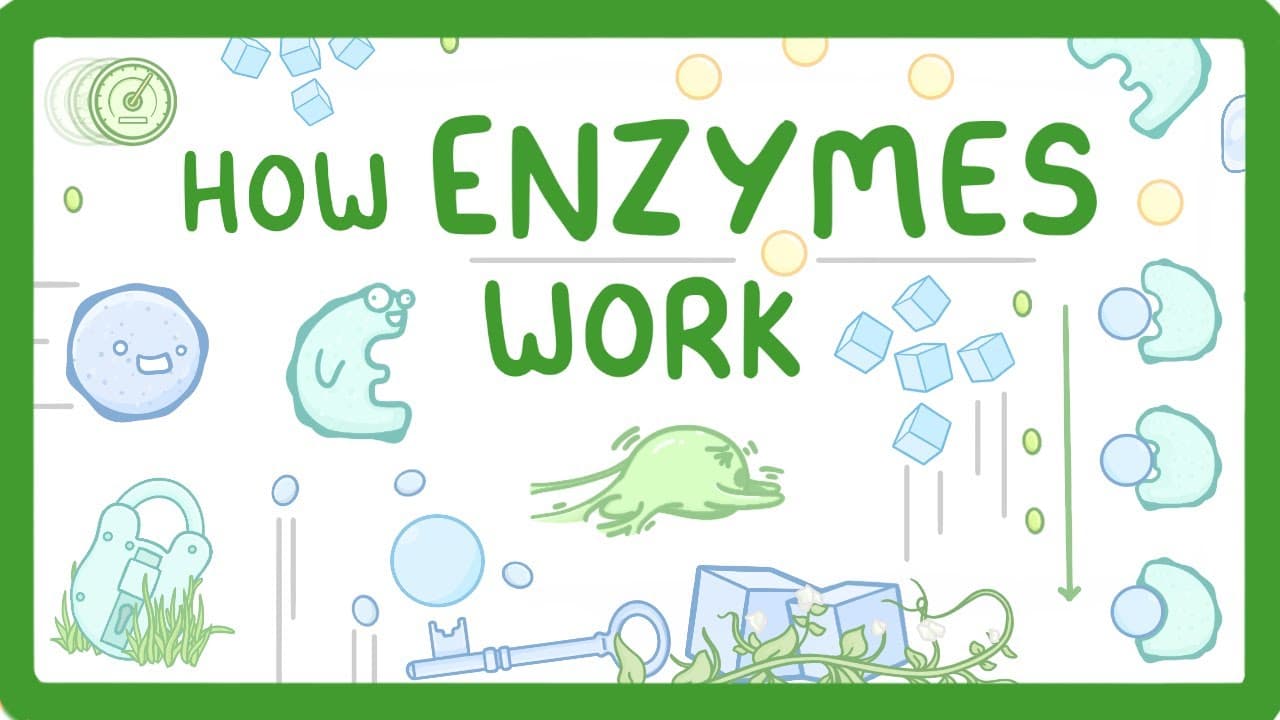
TL;DR
Enzymes are biological catalysts that increase the speed of chemical reactions without being consumed, and they are crucial for the proper functioning of living cells.
Transcript
in this video we're going to explore the world of enzymes so we'll take a look at what enzymes do and how they work and then at the differences between the two main models of enzyme action namely the lock and key model and the induced fit model before we get to enzymes themselves though we first of all need to understand why enzymes are so importan... Read More
Key Insights
- 🫒 Enzymes are necessary for living cells to carry out numerous chemical reactions.
- ☠️ Catalysts provide a better alternative to high temperatures for increasing reaction rates.
- ☢️ Enzymes, as biological catalysts, consist of proteins with unique active sites for substrate binding.
- ☢️ Enzymes exhibit specificity by only catalyzing reactions that match their active site.
- 🔐 The lock and key model initially described enzyme-substrate binding, but the induced fit model provides a more accurate representation.
- 👻 Enzymes are not consumed or altered during reactions, allowing them to be used repeatedly.
- ❓ Enzymes are crucial for maintaining cellular functions and are involved in various biological processes.
Install to Summarize YouTube Videos and Get Transcripts
Explore YouTube Video Summarizer or Get YouTube Transcript Extractor
Questions & Answers
Q: What is the role of enzymes in living cells?
Enzymes are essential for living cells as they catalyze a vast number of chemical reactions, ensuring the proper functioning of the cell's processes.
Q: How do enzymes increase the speed of chemical reactions?
Enzymes have a unique active site that binds to specific substrates, allowing for a more efficient collision between reactant molecules and increasing the reaction rate.
Q: Can enzymes be used up during a chemical reaction?
No, enzymes are not consumed or changed during reactions. They can be used repeatedly for multiple reactions, making them highly efficient catalysts.
Q: What is the difference between a catalyst and an enzyme?
While both catalysts and enzymes increase reaction rates, enzymes are a specific type of catalyst made by living organisms and are composed of proteins.
Key Insights:
- Enzymes are necessary for living cells to carry out numerous chemical reactions.
- Catalysts provide a better alternative to high temperatures for increasing reaction rates.
- Enzymes, as biological catalysts, consist of proteins with unique active sites for substrate binding.
- Enzymes exhibit specificity by only catalyzing reactions that match their active site.
- The lock and key model initially described enzyme-substrate binding, but the induced fit model provides a more accurate representation.
- Enzymes are not consumed or altered during reactions, allowing them to be used repeatedly.
- Enzymes are crucial for maintaining cellular functions and are involved in various biological processes.
- Understanding enzymes and their mechanisms is vital in fields such as biochemistry and cellular biology.
Summary & Key Takeaways
-
Enzymes are important because they increase the rate of chemical reactions in living cells, which constantly carry out numerous reactions.
-
High temperatures are not a feasible option to increase reaction rates due to energy requirements and potential cell damage, making catalysts a better alternative.
-
Enzymes are a type of catalyst that consist of large proteins made up of amino acids and have an active site where substrates bind to catalyze reactions.
Read in Other Languages (beta)
Share This Summary 📚
Summarize YouTube Videos and Get Video Transcripts with 1-Click
Try YouTube Summary with ChatGPT & Claude or YouTube Transcript Generator
Explore More Summaries from Cognito 📚



Summarize YouTube Videos and Get Video Transcripts with 1-Click
Try YouTube Summary with ChatGPT & Claude or YouTube Transcript Generator