GCSE Physics - Acceleration #52
TL;DR
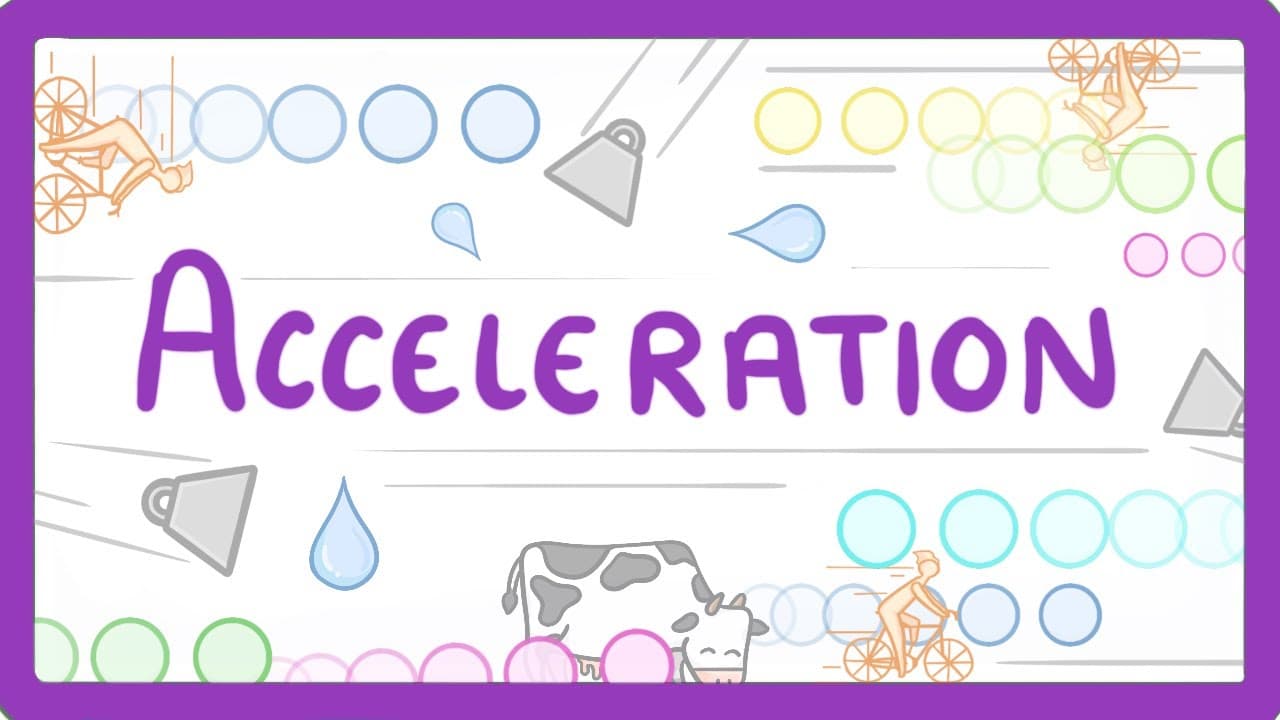
This video explains the concept of acceleration and its equations, demonstrating how to calculate acceleration and distance traveled based on initial and final velocities.
Transcript
in this video we're looking at acceleration which is the rate of change in velocity or put more simply how quickly something speeds up or slows down there are two important equations to know for acceleration but we're going to start with this top one on the left we have acceleration which is measured in meters per second squared then in the bottom ... Read More
Key Insights
- 📚 Acceleration is the rate of change in velocity, measured in meters per second squared, and represented as the change in velocity divided by time. ⏰ Calculating acceleration involves finding the difference between the final and initial velocities and dividing it by the time interval.
- ➖ Acceleration can be negative, indicating deceleration or slowing down.
- 🚗 Average acceleration is calculated over a specific time interval and may vary during that period.
- 🔀 If acceleration remains constant throughout the time interval, it is called uniform or constant acceleration.
- 📐 Another acceleration equation replaces time with distance, so you choose the equation based on whether you have time or distance given.
- 🏞️ When an object starts from rest, its initial velocity is zero.
- 🔢 Applying the acceleration equation and using the given final velocity, initial velocity, and acceleration, the height from which the ball was dropped can be calculated.
Install to Summarize YouTube Videos and Get Transcripts
Explore YouTube Video Summarizer or Get YouTube Transcript Extractor
Questions & Answers
Q: How is acceleration calculated using the equation involving time and change in velocity?
To calculate acceleration, subtract the initial velocity from the final velocity and divide the result by the time taken.
Q: Can acceleration be negative? What does negative acceleration indicate?
Yes, acceleration can be negative. Negative acceleration implies that the object is slowing down or decelerating.
Q: What is the difference between average acceleration and uniform acceleration?
Average acceleration is the overall acceleration over a specific time period, while uniform acceleration refers to constant acceleration throughout.
Q: When should the equation involving distance and change in velocity be used?
The equation involving distance should be used when the unit of distance is given in the question.
Q: How is distance calculated using the equation involving distance and change in velocity?
Divide the change in velocity squared by twice the acceleration, and the resulting value will represent the distance traveled.
Q: What is assumed about an object's initial velocity if it starts from a stationary position?
If an object starts from a stationary position, its initial velocity is assumed to be zero.
Q: What is the force responsible for acceleration downwards when an object is dropped?
The force of gravity causes objects to accelerate downwards at approximately 9.8 meters per second squared.
Q: How can the height from which a ball is dropped be calculated based on its final velocity?
By assuming the initial velocity is zero (since the ball was dropped), the equation involving distance can be rearranged to find the height.
Summary & Key Takeaways
-
Acceleration is the rate of change in velocity and is measured in meters per second squared.
-
There are two important equations for acceleration: one involving time and change in velocity, and the other involving distance and change in velocity.
-
Average acceleration is calculated by dividing the change in velocity by the time taken.
Read in Other Languages (beta)
Share This Summary 📚
Summarize YouTube Videos and Get Video Transcripts with 1-Click
Try YouTube Summary with ChatGPT & Claude or YouTube Transcript Generator
Explore More Summaries from Cognito 📚


Summarize YouTube Videos and Get Video Transcripts with 1-Click
Try YouTube Summary with ChatGPT & Claude or YouTube Transcript Generator