Do Fundamentals Require Decomposition First?
TL;DR
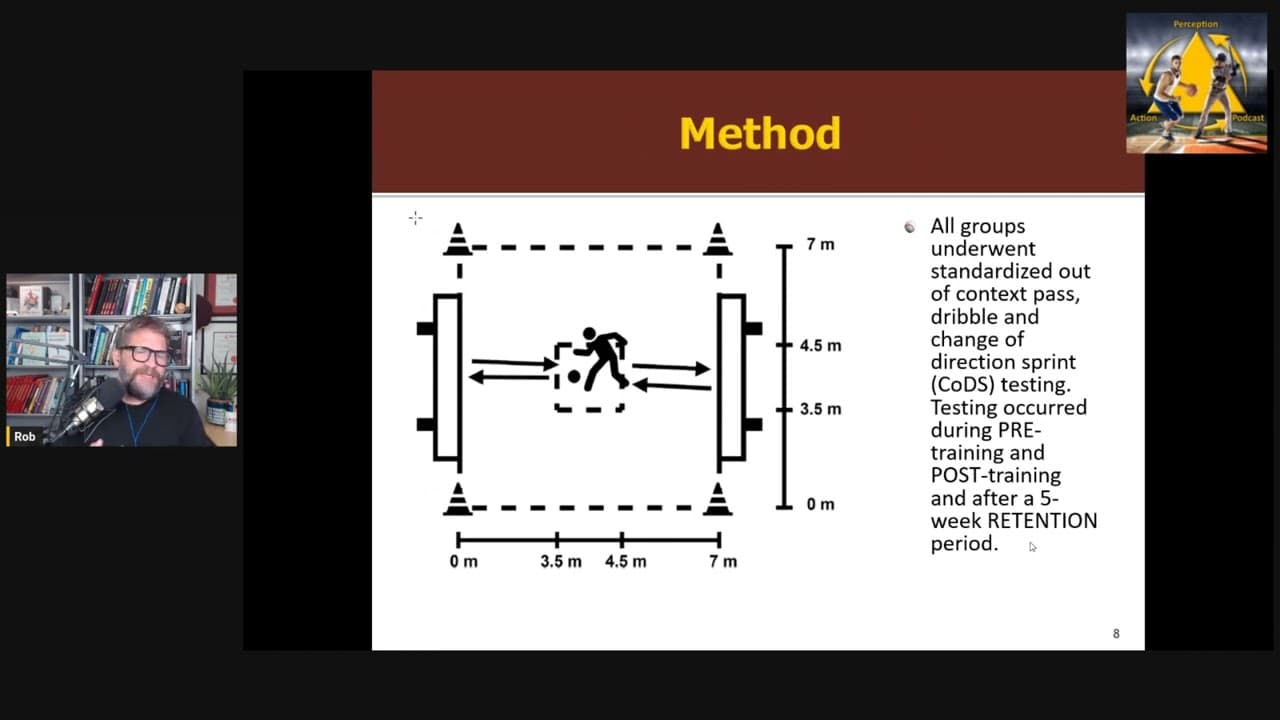
Fundamentals of a skill do not necessarily need to be learned through decomposition and repetition. A study comparing traditional isolated practice with non-linear pedagogy in youth soccer found that both methods were equally effective in developing fundamental skills. This suggests that representative practice can be as effective as isolated drills, challenging the traditional approach.
Transcript
foreign this is Rob Gray from ASU in the perception action podcast back with another article review in today's episode what I want to tackle is this the common Bugaboo we have about the fundamentals of skill and the idea I think I've expressed this before I have a lot of coaches that accept oh they really like variability self-organization explorat... Read More
Key Insights
- Non-linear pedagogy is equally effective as traditional isolated practice in developing fundamental skills.
- Traditional coaching often emphasizes isolated, repetitive practice before integrating skills into realistic environments.
- The study compared isolated practice with small-sided games designed to develop basic skills.
- Results showed no significant difference in skill development between traditional and non-linear approaches.
- Non-linear pedagogy focuses on variability and representative practice rather than strict repetition.
- The study challenges the belief that fundamentals must be developed through isolated drills.
- Greater variability in practice may be more important than a high number of repetitions.
- Representative practice can develop both technical and tactical skills simultaneously.
Install to Summarize YouTube Videos and Get Transcripts
Explore YouTube Video Summarizer or Get YouTube Transcript Extractor
Questions & Answers
Q: How can non-linear pedagogy be effective in skill development?
Non-linear pedagogy is effective in skill development by using representative practice environments that mimic real-game scenarios. This approach emphasizes variability and adaptability, allowing players to develop both technical and tactical skills simultaneously. It challenges the traditional belief that fundamentals must be learned through isolated, repetitive drills, showing that skills can be effectively developed through small-sided games.
Q: What is the traditional approach to teaching fundamentals in sports?
The traditional approach to teaching fundamentals in sports involves isolating skills and practicing them repetitively in a decomposed manner. This method focuses on developing automatic motor programs before integrating them into realistic game scenarios. Coaches often use drills, explicit instructions, and corrective feedback to teach the ideal techniques, aiming to develop fundamental skills before applying them in game-like situations.
Q: What did the study find about the effectiveness of isolated practice?
The study found that isolated practice, which involves repetitive drills in a decomposed manner, is not necessarily more effective than non-linear pedagogy in developing fundamental skills. Both methods were equally effective, suggesting that skills can be developed through representative practice environments. This challenges the traditional belief that fundamentals must be learned through isolated drills, emphasizing the importance of variability and adaptability.
Q: How does non-linear pedagogy differ from traditional coaching?
Non-linear pedagogy differs from traditional coaching by focusing on representative practice environments that simulate real-game scenarios. It emphasizes variability, adaptability, and decision-making skills rather than strict repetition and isolated drills. This approach allows players to develop both technical and tactical skills simultaneously, challenging the traditional belief that fundamentals must be learned through decomposed, repetitive practice.
Q: What are the benefits of representative practice environments?
Representative practice environments offer several benefits, including the development of both technical and tactical skills simultaneously. They mimic real-game scenarios, allowing players to adapt and make decisions in a realistic context. This approach emphasizes variability and adaptability, which can lead to better skill retention and transferability to actual games, challenging the need for isolated, repetitive drills.
Q: Why is variability important in skill acquisition?
Variability is important in skill acquisition because it allows players to adapt to different scenarios and make decisions in a realistic context. It challenges the traditional belief that a high number of repetitions is necessary for skill development. By emphasizing variability, players can develop both technical and tactical skills simultaneously, leading to better skill retention and transferability to actual games, as shown by the study comparing non-linear pedagogy with traditional approaches.
Q: What does the study suggest about the need for isolated drills?
The study suggests that isolated drills may not be necessary for developing fundamental skills. It found that non-linear pedagogy, which uses representative practice environments, is equally effective in developing skills as traditional isolated practice. This challenges the belief that fundamentals must be learned through decomposed, repetitive drills, emphasizing the importance of variability and adaptability in skill acquisition.
Q: How can coaches implement non-linear pedagogy in training?
Coaches can implement non-linear pedagogy in training by designing practice environments that mimic real-game scenarios. This involves using small-sided games, manipulating constraints, and emphasizing variability and adaptability. Coaches should focus on developing both technical and tactical skills simultaneously, rather than relying on isolated, repetitive drills. By creating representative practice environments, players can develop skills effectively and improve their decision-making abilities in game situations.
Summary & Key Takeaways
-
The study reviewed challenges the traditional belief that fundamentals must be learned through isolated, repetitive practice. It found that non-linear pedagogy, using small-sided games, was equally effective in developing soccer skills. This suggests that representative practice can be as effective as traditional drills, emphasizing the importance of variability over repetition.
-
Traditional coaching methods often focus on decomposing skills into isolated drills before applying them in realistic contexts. However, the study found no significant difference in skill development between traditional and non-linear approaches, suggesting that skills can be developed effectively through representative practice.
-
The research highlights the potential advantages of non-linear training in skill acquisition. It emphasizes that representative practice environments can develop both fundamental and tactical skills simultaneously, challenging the need for isolated drills. This approach may lead to better skill retention and adaptability in game situations.
Read in Other Languages (beta)
Share This Summary 📚
Summarize YouTube Videos and Get Video Transcripts with 1-Click
Try YouTube Summary with ChatGPT & Claude or YouTube Transcript Generator
Explore More Summaries from Rob Gray 📚


Summarize YouTube Videos and Get Video Transcripts with 1-Click
Try YouTube Summary with ChatGPT & Claude or YouTube Transcript Generator