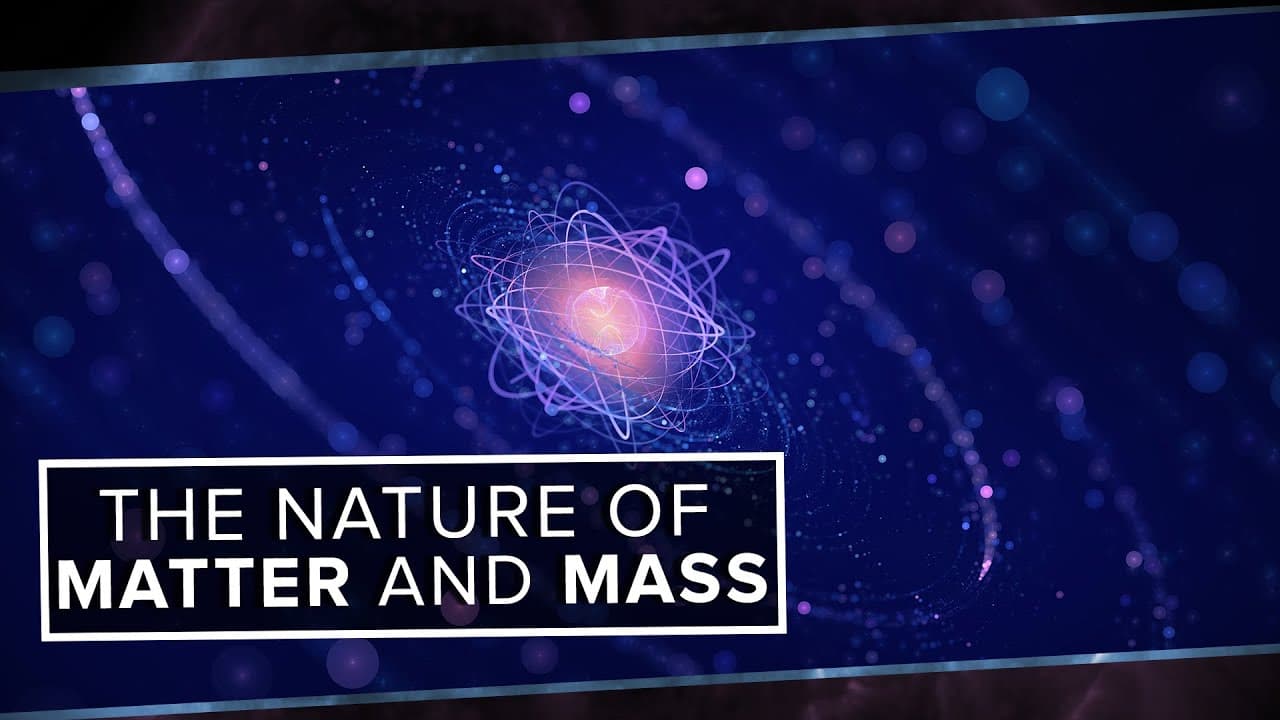
The True Nature of Matter and Mass | Space Time | PBS Digital Studios
TL;DR
Mass arises from massless particles and fields resisting acceleration.
Transcript
NARRATOR: Einstein showed us that matter, mass, and the flow of time are intrinsically connected, but opened the question, are they even real? Let's find out. In a previous episode, we talked about the speed of light-- the fastest speed there is. And we talked about how this speed limit is really the speed of causality. It's the maximum speed at ... Read More
Key Insights
- Einstein's theories link matter, mass, and time, questioning their fundamental reality and exploring their interconnectedness.
- Mass is not a fundamental property but emerges from the interactions of massless particles and fields that resist acceleration.
- The concept of inertial mass is illustrated through thought experiments like the photon box and compressed spring, showing mass as resistance to acceleration.
- E=mc² describes the relationship between mass and confined energy, not just photons, but any form of confined energy.
- The Higgs field gives particles inertia, not friction, preventing them from reaching light speed by providing resistance to acceleration.
- Gravitational mass and inertial mass are equivalent, as demonstrated by the equivalence principle, which equates acceleration in space to gravitational force.
- Massive objects curve space-time, and even confined massless particles can generate gravitational fields, affecting the curvature of space-time.
- Time does not exist for individual massless particles like photons, raising questions about how time emerges for massive objects.
Install to Summarize YouTube Videos and Get Transcripts
Explore YouTube Video Summarizer or Get YouTube Transcript Extractor
Questions & Answers
Q: What is the relationship between mass and energy?
Mass and energy are intrinsically linked through the equation E=mc², which describes the universal relationship between mass and confined energy. This means that mass can be seen as a form of energy that is confined within an object, as demonstrated by examples like the photon box and compressed spring, where energy confinement gives rise to mass.
Q: How does the Higgs field affect particles?
The Higgs field provides particles with inertia, not friction, by giving them resistance to acceleration. This resistance prevents particles from traveling at the speed of light, thus giving them mass. The Higgs field does not slow particles down like friction, but instead makes them harder to speed up or slow down, playing a crucial role in particle mass.
Q: What is the equivalence principle?
The equivalence principle states that the feeling of being accelerated in space is fundamentally the same as the feeling of weight in a gravitational field. This principle equates inertial mass, which resists acceleration, with gravitational mass, which responds to gravity. It explains why massive objects curve space-time and why the photon box feels heavy in a gravitational field.
Q: How does mass affect space-time?
Mass affects space-time by curving it, as described by Einstein's general relativity. Massive objects, through their gravitational mass, generate gravitational fields that curve the fabric of space-time. Even confined massless particles can generate gravitational fields, affecting space-time curvature, demonstrating that mass is an emergent property of energy and momentum interactions.
Q: What role do massless particles play in the nature of mass?
Massless particles, like photons, play a crucial role in the nature of mass by interacting in ways that resist acceleration. Through confinement, these particles give rise to mass, as seen in thought experiments like the photon box. Mass emerges from the interactions of massless particles and fields, challenging the notion of mass as a fundamental property.
Q: How is time related to mass and massless particles?
Time is an intriguing concept when related to mass and massless particles. While massless particles like photons experience no time, massive objects do, raising questions about when and where time arises. The video suggests that the ensemble of massless particles may experience time, though individual particles do not, prompting further exploration in future episodes.
Q: What is the significance of the photon box thought experiment?
The photon box thought experiment illustrates how mass can emerge from massless components. By filling a massless box with massless photons, the box gains mass through the resistance to acceleration caused by photon interactions. This experiment demonstrates how confined energy can give rise to mass, providing a deeper understanding of the relationship between mass and energy.
Q: How does the compressed spring example relate to mass and energy?
The compressed spring example shows that a compressed spring, holding potential energy, is more massive than a relaxed one. This is because the energy confinement within the spring increases its resistance to acceleration, illustrating the relationship between mass and confined energy. The example parallels the photon box, emphasizing the emergent nature of mass from energy interactions.
Summary & Key Takeaways
-
The video explores the nature of mass, matter, and time, questioning their fundamental reality by examining the interactions of massless particles and fields that resist acceleration, as demonstrated through thought experiments like the photon box and compressed spring.
-
Mass is shown to be an emergent property, not fundamental, arising from the confinement of massless particles and fields, with the equivalence principle linking inertial and gravitational mass, thus explaining how mass curves space-time.
-
The role of the Higgs field in giving particles inertia, not friction, is discussed, preventing them from reaching light speed, and raising questions about the emergence of time for massive objects, which will be explored in future episodes.
Read in Other Languages (beta)
Share This Summary 📚
Summarize YouTube Videos and Get Video Transcripts with 1-Click
Try YouTube Summary with ChatGPT & Claude or YouTube Transcript Generator
Explore More Summaries from PBS Space Time 📚
Summarize YouTube Videos and Get Video Transcripts with 1-Click
Try YouTube Summary with ChatGPT & Claude or YouTube Transcript Generator